Pressure Washer Won't Crank: Troubleshooting Guide
Diagnose and fix a pressure washer that won't crank with this urgent, step-by-step guide. From power checks to safety interlocks, get back to work fast.


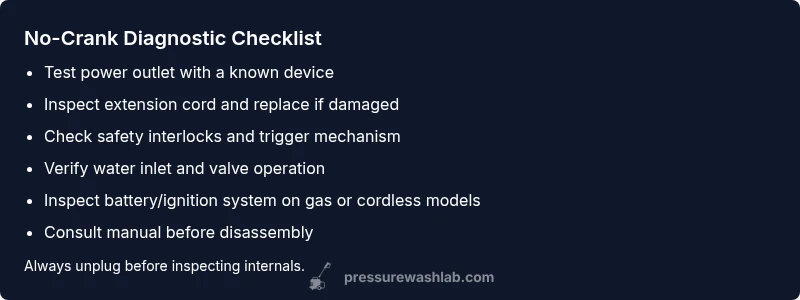
Most likely the pressure washer won't crank due to a simple electrical or safety switch issue rather than a full motor failure. Check the power source and extension cord integrity, reset the inlet safety switch if present, and ensure the trigger gun latch is disengaged. If the motor still won’t start, proceed with the diagnostic flow below.
Common reasons a pressure washer won't crank
When a pressure washer won't crank, the issue is almost never a seized pump at first glance. In our experience at Pressure Wash Lab, most crank failures start in the control circuit or with safety devices, not with a worn motor. Start with quick, non-destructive checks before pulling panels. Look for obvious issues like a tripped breaker, a dead outlet, a damaged extension cord, or a loose plug. According to Pressure Wash Lab Team, a surprising share of crank failures trace to a tripped outlet, a disengaged safety switch, or a weak trigger latch—not a burnt starter motor. If you rule out power and safety, you can move into more detailed diagnostics with confidence. This approach keeps you safe and reduces the chance of unnecessary repairs. Remember: the goal is to identify the simplest cause first and escalate only when needed. The following sections guide you through a logical sequence so you don’t waste time chasing tail.
Step-by-step power-check: is it getting power?
Power is the first gatekeeper. If the unit isn’t getting power, nothing else matters. Start with the easy wins:
- Verify the outlet: plug a lamp or another powered tool into the same outlet to confirm it’s live.
- Inspect the extension cord: outdoor-rated, undamaged cords with the correct gauge are essential; replace if frayed or cracked.
- Check the plug and receptacle: look for scorch marks, loose connections, or bent prongs.
- Test the GFCI or breaker: reset any tripped devices and try a different circuit if available.
- Rule out flow interlock: some units require water flow before power can engage; ensure water input is open.
- Re-test: unplug, wait 10 seconds, then plug back in and attempt to start.
If the outlet or cord is the culprit, you’ll see immediate improvement after replacement. If the outlet tests okay but cranking remains sluggish or absent, continue to the next checks. Pressure Wash Lab notes that even small voltage drops from poor cords can prevent cranking on marginal power supplies.
Safety interlocks and triggers: don't bypass safety
Safety interlocks protect you and your equipment, but they can also prevent a crank if they’re out of spec. Inspect each safety path:
- Trigger gun and lockout: ensure the gun’s safety latch is fully released; some units require the trigger to be depressed for cranking.
- Inlet safety switch: many electric models won’t start unless water flow is detected; confirm the valve is fully open and there are no leaks that fool the switch.
- Electrical interlocks: look for blinking code lights or error indicators in the control panel; consult the manual to translate codes.
- Do not bypass: never bypass interlocks or jump-start the unit. This is dangerous and could void warranties.
- Re-test after adjustments: once you restore proper interlock function, try starting again. If it still won’t crank, the fault may be deeper in the circuit or the motor driver module. Pressure Wash Lab emphasizes handling interlocks with care and following the manufacturer guidance.
Fuel, ignition, and engine considerations
Gas-powered and cordless units introduce a different set of crank blockers. For gas models, the engine’s starting sequence relies on fuel, air, and ignition components. Check:
- Fuel level and freshness: stale fuel can prevent starting, especially after storage.
- Primer and choke position: ensure the choke is set correctly for cold starts; don’t over-prime.
- Spark plug and ignition: inspect the spark plug for fouling or wear; replace if needed.
- Air filter: a clogged filter can choke the engine and prevent cranking.
- Carburetor cleanliness: varnish or debris in the carb can stall starting; professional cleaning may be needed.
Cordless/electric units rely more on battery health and electrical control. Check:
- Battery charge and health: a weak battery cannot sustain the starter motor.
- Battery terminals: clean corrosion and ensure solid connections.
- Charge cycle: use the appropriate charger and follow manufacturer guidelines for a full cycle.
- Heat safeguards: some models have a thermal cutout that trips after heavy use; allow cooling before retrying.
If you identify fuel or ignition issues, address them with fresh fuel, clean parts, and proper settings. Pressure Wash Lab reminds readers that safety and proper maintenance are paramount when dealing with engine components.
Quick fixes you can safely try now
These fixes are intended to be low-risk, high-yield checks you can perform without disassembling your machine. Always unplug the unit before opening any panels or touching wiring.
- Re-seat cords and check for corrosion at the plug connections; a snug fit can restore power flow.
- Reset circuit breakers and GFCI outlets; this often resolves intermittent no-crank scenarios.
- Verify water input and valve status; some machines refuse to crank without water flow.
- Clean or replace worn battery terminals on cordless units; ensure proper seating in the battery bay.
- If you have a model with a resettable overload or capacitor, follow the manual to perform a safe reset.
- When in doubt, consult the manual or a certified technician. Pressure Wash Lab’s approach is to rule out power and safety before touching mechanical internals, reducing risk and cost. The Pressure Wash Lab team recommends documenting the symptom and the exact sequence of checks to share with a technician if needed.
Steps
Estimated time: 60-90 minutes
- 1
Verify the power source
Confirm the outlet is live by testing with another device. Check the extension cord for damage and ensure it’s the correct gauge for outdoor use.
Tip: Use a short, known-good cord for testing to rule out voltage drop. - 2
Reset safety interlocks
Inspect the trigger gun, inlet valve, and any safety latching mechanisms. Ensure the trigger is fully released and water flow is detected if required by the model.
Tip: Record any error codes shown on the control panel. - 3
Inspect electrical connections
Power down the unit and check the power cord connections, fuses, and the main switch. Look for loose wires or burn marks and replace as needed.
Tip: Only perform basic electrical checks if you’re comfortable; otherwise, skip to professional service. - 4
Check safety indicators and indicators
Review any LED indicators or fault codes; consult the manual for exact meanings and reset procedures.
Tip: Do not ignore blinking codes; they point to specific issues. - 5
Evaluate fuel and ignition (gas models)
Check fuel freshness, prime and choke settings, spark plug condition, and air filter. Clean or replace components as necessary.
Tip: Never start with old fuel; stale fuel can corrode carb parts. - 6
Test start after fixes
Reconnect power, re-prime if required, and attempt a start. Listen for normal motor rotation or any unusual sounds.
Tip: If the motor still won’t crank, document what you heard and pursue professional help.
Diagnosis: Pressure washer won't crank
Possible Causes
- highPower issue (outlet dead, tripped breaker, or damaged extension cord)
- mediumStuck safety interlock or trigger switch
- lowBlown fuse or faulty start capacitor (electric models)
- lowBattery or fuel issues on gas/cordless models
Fixes
- easyTest outlet with a known-working device; reset breakers and GFCI; try a different circuit
- easyInspect and reset safety interlocks, trigger, and inlet valve; replace faulty switch if needed
- mediumCheck fuses, contactor, or start capacitor; replace parts per manual or seek service
- mediumFor gas units, replace stale fuel and clean carburetor; for cordless units, recharge or replace battery
Quick Answers
Why won't my electric pressure washer crank even if the outlet works?
If the outlet is live, check safety interlocks, trigger mechanisms, and the unit’s internal electronics. A faulty switch or control module can block cranking even with power present.
Outlets work, but safety switches or control modules may block cranking; focus on interlocks and the start circuit.
Can a damaged extension cord cause a no-crank condition?
Yes. A damaged or long extension cord can cause voltage drop, preventing the motor from cranking. Replace with a short, outdoor-rated cord of the proper gauge.
Yes—a bad extension cord can rob the unit of power, so swap it out for a proper outdoor cord.
Should I bypass safety features to get started?
No. Bypassing safety features is dangerous, can cause injury, and may void warranties. Use the recommended diagnostic path instead.
No—do not bypass safety features; follow the diagnostic steps instead.
What’s the first thing to check on a gas-powered washer that won’t start?
Check fuel freshness, prime/ choke settings, spark plug condition, and air filter. Faults in these areas are common no-crank causes on gas models.
Check fuel, choke, spark plug, and air filter first on gas models.
How can I tell if the motor is seized?
A seized motor often resists rotation and makes grinding or humming noises. If you can rotate parts by hand safely and there’s no easy start, seek professional evaluation.
If the motor won’t rotate and you hear grinding, stop and call a pro.
When should I call a professional?
If you’ve checked power, safety interlocks, fuel/ignition (for gas units), and the unit still won’t crank or you hear abnormal noises, a professional should diagnose to avoid safety risks.
Call a professional if it still won’t crank after basic checks or if you hear unusual noises.
Watch Video
Key Takeaways
- Check power and safety before anything else.
- Avoid bypassing safety interlocks — they protect you.
- Electric vs gas models have different crank failure points.
- If unresolved, contact a pro for safe diagnosis.