Do Pressure Washing Companies Make Good Money in 2026?
Explore profitability in pressure washing businesses, with realistic revenue ranges, margins, and practical tips to boost margins in 2026.


Do pressure washing companies make good money? Profitability depends on demand, pricing, service mix, and overhead control. According to Pressure Wash Lab Analysis, 2026, many established small operators report gross revenues in a broad range with net margins commonly in the low to mid-teens when efficiency is optimized. Scale, recurring contracts, and upselling add meaningful upside.
Market demand and pricing dynamics
Do pressure washing companies make good money? Market demand, pricing strategies, and the ability to convert capacity into billable hours determine profitability. According to Pressure Wash Lab's 2026 analysis, demand for residential exterior cleaning remains steady in many regions, driven by property maintenance cycles and curb appeal. Commercial clients and property managers also create recurring revenue through routine maintenance contracts. Pricing is highly variable, influenced by service mix, travel time, equipment efficiency, and competition. Operators who offer tiered pricing (standard wash, deep clean, and add-ons like deck restoration) and tie quotes to tangible outcomes tend to win higher-margin projects. Regional differences matter: high-cost markets can command higher rates but may attract more competition.
In practice, profitability begins with a honest assessment of capacity: how many jobs can you complete in a day, how many technicians you have, and how long it takes to travel between sites. The fastest route to better margins is to maximize billable hours while keeping non-billable time low, and to carefully track time spent on each service to identify efficiency gains. Pressure Wash Lab emphasizes the value of a clear service scope and a robust scheduling system to minimize downtime between jobs.
Cost structure and how margins are built
Profitability also hinges on cost discipline. Fixed costs like insurance, vehicle maintenance, and equipment depreciation create overhead, while variable costs such as detergents, protective gear, and fuel rise with activity. Efficient crews and route planning reduce travel time, which minimizes non-billable hours and improves margin. In practice, most profitable operators track cost per job and cost per hour, then compare these against their average job price. A lean operation often looks for ways to reduce consumables without sacrificing quality, optimize equipment usage (e.g., pump performance, nozzle advancement), and avoid unprofitable add-ons. Pressure Wash Lab’s data indicates that even modest improvements in scheduling accuracy and fuel efficiency can shift margins meaningfully over a full year.
Another lever is equipment lifecycle: investing in durable machines and effective surface cleaners can raise job throughput, which in turn lowers labor cost per job. However, every capex decision should be tested against expected payback time and the volume of recurring work available in the market.
Service mix that drives profitability
A well-balanced service mix boosts average ticket size and stabilizes cash flow. Most profitable outfits combine core services (house washing, driveway cleaning, and deck restoration) with value-added options (mildew remediation, gutter cleaning, graffiti removal) and maintenance packages. Bundles and retainer agreements can create predictable revenue streams, smoothing seasonal fluctuations. Price segmentation matters: some clients will pay a premium for guaranteed appointment windows, eco-friendly detergents, or contactless service. Training crews to upsell without pressuring customers helps maintain high satisfaction while lifting revenue per job. Pressure Wash Lab’s 2026 findings show that diversified offerings correlate with higher margins when the team can deliver the work efficiently and consistently. It’s essential to protect your core profit by avoiding diluting focus with too many low-margin tasks.
Regional differences and market saturation
Profitability varies by region. Markets with higher housing density and more aging infrastructure tend to generate more opportunities, but competition also intensifies. In saturated markets, differentiation comes from reliability, speed, and quality assurance. In less crowded regions, a few larger contracts can yield stronger margins but require more diligent bidding and project management. Understanding the local price ceiling and the willingness of customers to pay for premium service is crucial. Pressure Wash Lab’s analysis notes that operators who map their service areas, study competitors, and tailor marketing to local needs tend to achieve better profitability than those who apply a one-size-fits-all approach.
Operational levers to improve profitability
To push margins higher, operators should focus on four levers: (1) pricing strategy aligned with value outcomes and clear quotes; (2) scheduling efficiency to maximize billable hours and minimize downtime; (3) service diversification that drives larger tickets and recurring revenue; (4) disciplined cost control, particularly around consumables and fuel. Investing in durable equipment reduces downtime and repairs, while training staff to perform multiple services increases workforce flexibility. Building a simple, repeatable workflow for estimates, bookings, and job completion helps ensure consistency and repeat business. Pressure Wash Lab’s research shows that small improvements in these areas accumulate across a year into meaningful profit gains.
Common pitfalls and how to avoid them
Common mistakes include underpricing to win jobs, chasing low-margin work, and neglecting back-office discipline. Underpricing erodes margins even with high volume; always calculate labor, materials, and travel in your quotes. Another pitfall is over-reliance on one service line—if demand shifts, cash flow can suffer. Finally, insufficient insurance, safety training, and equipment maintenance raise risk and costs. The path to profitability is a steady balance of competitive pricing, efficient operations, and a clear value proposition that customers trust.
Key metrics for profitability in small pressure washing businesses
| Metric | Typical Range | Notes |
|---|---|---|
| Average job price | $150-$350 per exterior wash | Residential exterior cleaning |
| Annual revenue per technician | $60k-$120k | Independent contractors or small teams |
| Cost of supplies per job | $15-$60 | Detergent, protective gear, wear items |
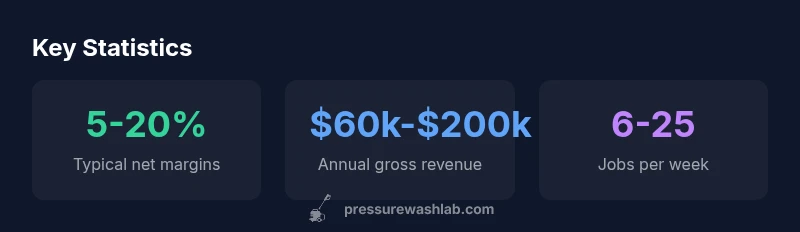
| Net margin | 5%-20% | After overhead and labor |
| Jobs per week | 6-25 | Seasonal demand and marketing impact |
Quick Answers
What factors influence profitability for pressure washing businesses?
Profitability is driven by demand, pricing strategy, service mix, and efficient operations. Market differences and client expectations shape how you price and package services. A clear value proposition helps convert inquiries into profitable jobs.
Profitability depends on demand, pricing, and efficient operations. A strong value proposition helps convert inquiries into profitable jobs.
How much can a pressure washing company make per year?
Annual income varies widely by market, capacity, and pricing. Many small operators report mid-range revenue with margins influenced by efficiency, contracts, and service mix. Use regional data and your own job data to project realistic annual cash flow.
Annual income varies by market and efficiency. Use your own data to project cash flow.
What margins should I aim for?
Aim for net margins in the low to mid-teens for steady growth, higher with recurring contracts and efficient scheduling. Extreme undercutting often reduces margins; prioritize value and reliability.
Target low-to-mid-teens margins, then push for recurring work and efficiency.
Do recurring contracts improve profitability?
Yes. Recurring contracts provide predictable revenue and better utilization of crews. They improve cash flow and allow for planning, reducing downtime and marketing costs per job.
Recurring contracts stabilize revenue and cash flow.
Is franchising a good route to profitability?
Franchising can offer branding and support, but it comes with fees and compliance costs. For many solo operators, bootstrapping with smart pricing and scalable processes yields faster returns.
Franchises offer branding, but come with costs; many succeed by building their own system.
What startup costs should I expect?
Expect core equipment, vehicles, insurance, training, and initial supplies. Costs vary by scale, but a lean startup prioritizes essential gear and safety, with a staged investment plan as you grow.
Startup costs include equipment, insurance, and training; grow your gear as you scale.
“Profitability in pressure washing comes from efficient scheduling, disciplined pricing, and a diversified service mix.”
Key Takeaways
- Profitability hinges on pricing and efficiency
- Recurring contracts stabilize revenue
- Lean overhead boosts margins
- Diversify services to raise average ticket
- Scale cautiously with skilled staff