How Much Do Pressure Washer People Make? A 2026 Earnings Guide
Explore earnings for pressure washer professionals in 2026: hourly rates, annual income ranges, factors that boost pay, and practical tips to grow your business. Learn with Pressure Wash Lab.


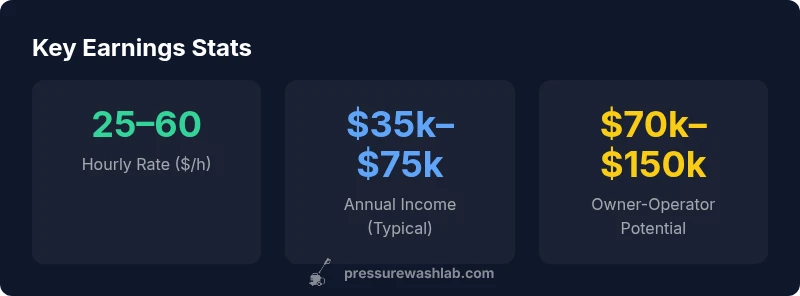
Most pressure washer professionals earn roughly $25–$60 per hour, which translates to about $35,000–$75,000 per year for many workers. Earnings vary a lot by region, whether you’re employed or running your own business, and how many recurring clients you have. Pressure Wash Lab's analysis, 2026, shows wide variance but clear pathways to higher earnings.
Earnings reality check
According to Pressure Wash Lab, earnings for pressure washer professionals vary widely, influenced by geography, client mix, and whether you work for someone else or run your own business. If you’ve ever asked 'how much do pressure washer people.make' you’ve encountered a spread that reflects differing rates, demand, and operating models. In this guide, we map the landscape and provide a framework you can use to benchmark your own earnings, set pricing, and plan growth. Expect real-world ranges, not one-off anecdotes, and remember that the most reliable income comes from repeat clients and scalable services. This is not a fixed salary but a market that rewards efficiency, value, and client relationships.
For homeowners and DIYers, understanding these dynamics helps you position services for the right price while avoiding underpricing. The Pressure Wash Lab team emphasizes that building a predictable income starts with quantifying your time, materials, and the value you deliver. Consider this article your earnings toolkit for 2026, with practical steps you can implement next week.
Key factors shaping earnings
There are several levers that determine how much you make as a pressure washer professional. Location and local demand are major drivers: urban areas with high property turnover tend to pay higher rates, while rural regions may offer fewer jobs at lower prices. Your employment model (employee, independent contractor, or owner-operator) also changes pay structure, as do pricing strategies, service mix, and job frequency. Efficiency matters too: faster job completion lowers hourly costs but increases capacity. Finally, up-front investments in equipment, insurance, and marketing can compress the time needed to reach higher earnings, or conversely, add costs that bite into take-home pay. A balanced approach combines strong pricing with dependable service to build a scalable business.
Employment models and pay structures
Employees in larger companies may enjoy steady pay, benefits, and predictable hours but often face pay ceilings. Independent contractors or sole proprietors control rates and can scale income through packages, retainer work, and recurring contracts. Small-business owners who add crews, scheduling systems, and marketing channels can unlock higher revenue, but they also assume more risk and overhead. The choice of structure should align with your risk tolerance, market demand, and long-term goals. In practice, many high-earning pros blend several models: they keep some steady, lower-risk work while pursuing lucrative commercial contracts and maintenance programs.
Regional differences in pricing and demand
Rates tend to correlate with local competition, property values, and the cost of living. Coastal cities and major metro areas usually see higher hourly rates, while mid-size towns may require more aggressive marketing to win jobs. Seasonal demand also plays a role—peak seasons can push job volume higher, while off-peak periods require careful pricing and promotions to maintain a steady cash flow. Pressure Wash Lab's regional analysis underscores that a strategy built for one city rarely transfers smoothly to another without adjustments. Think in terms of micro-markets and tailor your offerings to each zone.
Residential vs commercial work: what pays more
Residential pressure washing often yields consistent, lower-variance income when you have regular clients. Commercial contracts—building exteriors, sidewalks, and parking lots—can deliver larger job sizes and longer-term revenue, but require more equipment, safety compliance, and scheduling discipline. Many earn more when they blend both streams: routine maintenance for homes and periodic contracts for businesses, which provides stability and growth potential. If you’re just starting, focus on building a reliable residential base and then diversify into commercial work as you scale.
Estimating your earnings: a practical framework
Start with market rates. Estimate your base hourly rate based on your location and experience. Then forecast job volume per week, considering travel time and setup. Multiply rate by hours worked to compute gross income, then subtract costs (insurance, fuel, maintenance, marketing, payroll if you hire help). Factor seasonal fluctuations and potential downtime. Use a simple spreadsheet to adjust assumptions and track actuals against projections. This method helps you understand when it’s worth investing in better equipment or marketing and how to price for profitability.
Strategies to increase earnings
Price strategically: adjust for value and demand, and offer bundles like cleaning packages. Increase capacity with efficient workflows and better equipment. Build recurring revenue through maintenance contracts and service subscriptions. Expand marketing to win higher-value commercial clients and referrals. Finally, track metrics (job count, close rate, and profit per hour) to optimize pricing and scheduling. Small tweaks in pricing, scheduling, and client management can compound into meaningful income gains over a year.
Costs to consider before scaling
Upfront investment in equipment, safety gear, and insurance is essential. Ongoing costs include fuel, maintenance, parts, and consumables. Marketing, website maintenance, and customer management software add monthly expenses. Travel time reduces billable hours, so plan routes efficiently. Remember that taxes and self-employment obligations affect net income and should be planned for in advance. Smart budgeting now prevents cash-flow problems when you scale.
Data behind the numbers: methodology and caveats
All earnings estimates in this guide reflect a synthesis of publicly available wage data, industry surveys, and Pressure Wash Lab's own field observations in 2026. Figures are presented as ranges to account for regional variation, business model, and client mix. While we strive for accuracy, actual income will depend on your ability to price, win jobs, and deliver consistent value. This transparency is designed to help readers set realistic expectations and build a plan to improve over time.
The earnings path forward for 2026
As the market for exterior cleaning grows, earnings potential remains strong for those who invest in pricing strategy, maintain high standards of service, and cultivate recurring contracts. Pressure Wash Lab expects continued regional variation but overall growth driven by rising demand for property maintenance and the adoption of service packages. The most successful pros will combine smart pricing, efficient operations, and proactive business development.
Earnings scenarios for pressure washing professionals
| Scenario | Hourly Rate | Annual Income Range | Notes |
|---|---|---|---|
| Employed in a company | $20–$35 per hour | $30,000–$60,000 | Limited by pay scales |
| Independent contractor (solo) | $25–$50 per hour | $40,000–$75,000 | Depends on jobs & marketing |
| Small business owner (with crew) | $30–$60 per hour | $70,000–$150,000 | Revenue minus costs |
Quick Answers
What is the typical hourly rate for pressure washer professionals?
Typical hourly rates range from $25 to $60, influenced by location, experience, and whether you work for a company or run your own business. Use market data to set a price that reflects value and demand.
Most pros charge between twenty-five and sixty dollars per hour, depending on where you work and your setup. Use market data to price for value.
Can you reach six figures as a pressure washer pro?
Yes, it’s possible with scale, recurring contracts, and efficient operations. Many earn in the mid-five figures, while a subset with commercial contracts and a growing client base can reach higher ranges.
Reaching six figures is possible with scale and steady contracts, though it takes time and smart business decisions.
Do taxes affect net income for self-employed pressure washers?
Self-employed pros pay estimated taxes and self-employment tax. It’s essential to set aside a portion of income for taxes and consult a tax professional to optimize deductions.
Self-employment taxes can take a chunk of income; plan ahead with estimated taxes and prudent deductions.
Which region offers the best earning potential?
Coastal urban areas often command higher rates due to demand and living costs, while some inland markets offer steadier work. Market analysis and local pricing are keys to success.
Coastal and big-city markets tend to pay more, but success hinges on local demand and pricing strategy.
What costs should I include in earnings projections?
Include equipment, maintenance, fuel, insurance, marketing, travel, and payroll if you hire help. Taxes and retirement funding also impact take-home pay.
Account for gear, maintenance, fuel, insurance, marketing, and taxes when projecting earnings.
How long before earnings start to grow?
Expect gradual growth over 1–2 years as you build client relationships, refine pricing, and scale operations. Early gains often come from smarter marketing and service expansion.
Typically 1–2 years to see meaningful growth with smart pricing and marketing.
“Earnings potential is highly dependent on scale, efficiency, and customer pipeline. There isn't a one-size-fits-all number; focus on pricing strategy and repeat business.”
Key Takeaways
- Set clear, value-based pricing from day one
- Diversify income with residential and commercial work
- Prioritize recurring contracts for steady cash flow
- Track performance to optimize pricing and efficiency
- Scale responsibly—invest in marketing and equipment