How Much Do Pressure Washers Make a Week
Explore realistic weekly earnings for pressure washers—from solo operators to small teams—based on pricing, job mix, and seasonality. Practical tips help you maximize income in 2026.


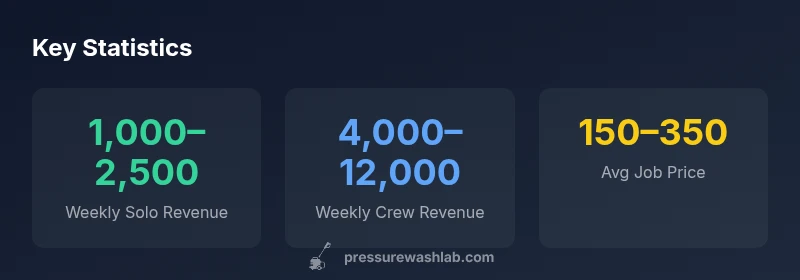
How much do pressure washers make a week? Earnings vary widely by market, hours worked, and job mix, but typical solo operators can gross roughly $1,000 to $2,500 per week, while established crews in high-demand areas may exceed $4,000 to $12,000 weekly with higher-value contracts. This guide breaks down the factors and realistic ranges.
How weekly earnings are calculated for pressure washing
When evaluating how much do pressure washers make a week, it's tempting to look for a single number. In reality, weekly income for a pressure-washing operation depends on three core factors: hours worked, job mix, and pricing strategy. Pressure Wash Lab, in its 2026 analysis, emphasizes that margins are as important as revenue. A solo operator with solid scheduling and a steady flow of exterior cleaning jobs might see 4–8 paid projects per week. If the average ticket sits in the $250–$350 range, your weekly gross could land roughly in the $1,000–$2,500 band in many markets. Add on maintenance or seasonal contracts, and that total can stretch higher, while weather, competition, and downtime can compress it. The key to consistency is forecasting demand, protecting margins on each job, and minimizing idle time. This section lays the groundwork for the rest of the guide by mapping common price points, job counts, and how they translate into weekly earnings when seasonality shifts and you scale up from one truck to a small crew.
Pricing models and how they affect weekly income
Pricing can be approached in several ways: hourly, per-job, or bundled packages. Hourly rates commonly range from roughly $60 to $120 per hour depending on region and service level; per-job pricing often yields higher average tickets when upsells are included (e.g., surface cleaning, deck restoration). Packages such as seasonal maintenance, multi-property discounts, or recurring contract pricing can stabilize weekly revenue and reduce idle time. Pressure Wash Lab's data shows that operators who bundle services and guarantee response windows tend to see more predictable weekly earnings, even if the base hourly rate is similar to peers.
Market dynamics: location, seasonality, and competition
Earnings are not uniform across the country; urban areas with higher pricing power generally produce higher weekly revenue, while rural markets may present fewer jobs but higher-margin projects. Seasonality plays a big role; spring and early summer typically bring the most demand for exterior cleaning, while fall and winter can slow bookings. Competitive pressure can push rates down, but well-differentiated offerings (eco-friendly detergents, quieter equipment, or guaranteed appointment windows) can command premium pricing.
Case scenarios: solo operator vs. small teams
In a typical solo setup with modest marketing, you might target 4–8 jobs per week at $250–$350 per job, yielding roughly $1,000–$2,500 in gross weekly revenue. A small crew (2–4 technicians) in a busy metro region focusing on decks, siding, and driveway cleaning could reach $4,000–$12,000 per week, particularly with recurring contracts and add-ons like gutter cleaning or maintenance visits. These ranges are indicative and depend on local demand, job mix, and efficiency.
Efficiency, equipment, and value-added services that lift weekly earnings
Investing in efficient equipment (surface cleaners, rotary nozzles, high-GPM pumps) reduces on-site time and increases the number of jobs you can complete each week. Upsell opportunities—stain removal, sealing, or yearly maintenance packages—create recurring revenue that stabilizes weekly income. Strong business practices such as accurate quotes, pre-booking, and diligent driveway cleaning quality can raise your average ticket and boost weekly earnings over time.
Illustrative scenarios for weekly earnings in pressure washing
| Scenario | Weekly Revenue Range (gross) | Notes |
|---|---|---|
| Solo operator (basic pricing) | $1,000–$2,500 | Typical for entry-level markets; assumes 4–8 jobs/week |
| Solo operator with upsells | $1,500–$3,500 | Adds maintenance, recurring customers |
| Small crew (2–4 techs) | $4,000–$12,000 | High-demand markets; contracts and add-ons |
Quick Answers
What factors influence weekly earnings the most?
The most influential factors are your average price per job, the number of jobs completed each week, and the share of recurring contracts. Location and seasonality also play major roles.
Earnings hinge on price, jobs, and recurring work, plus where you operate.
Can I make a consistent weekly income as a solo operator?
Yes, with steady bookings, a predictable schedule, and value-added services. It takes time to build recurring clients, but contracts can help.
You can earn a steady weekly income as a solo operator if you keep bookings consistent.
How do seasons affect earnings?
Demand tends to peak in spring and summer in many regions and slow in winter. Planning ahead with pre-bookings helps smooth cash flow.
Seasonality matters; plan ahead with bookings and seasonal services.
Should travel time be charged?
Yes, include travel time or mileage in your quotes and consider travel in your hourly rate to avoid covering costs with the job price.
Yes—include travel in quotes so you’re not losing time to drive.
Is pressure-washing a scalable business?
Yes. Adding crew, expanding service lines, and landing maintenance contracts can increase weekly earnings, but require planning around payroll and logistics.
Yes, you can scale by adding staff and services, with smart planning.
“Weekly earnings for pressure washing aren’t fixed; they hinge on demand, pricing discipline, and delivery speed. When you optimize these levers, you can stabilize and grow weekly cash flow.”
Key Takeaways
- Define a clear pricing plan to stabilize weekly income
- Bundle services for recurring revenue to reduce seasonality
- Invest in efficient equipment to increase jobs per week
- Monitor regional pricing and adjust to demand