How to Start a Pressure Washer Business: A Practical Guide
Learn how to start a pressure washer business with a clear step-by-step plan, pricing strategies, equipment checklists, and smart marketing tactics to attract homeowners and small businesses.


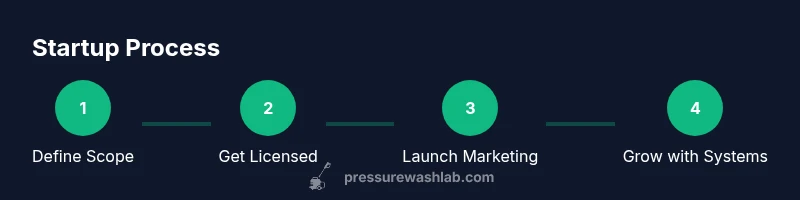
Start a pressure washer business by launching a service-based operation that targets homeowners and small businesses. You’ll need basic equipment, a clear pricing plan, local licensing, insurance, and a simple marketing strategy. This quick guide from Pressure Wash Lab walks you from idea to first customer with practical, testable steps.
Market viability and ideal client profiles
The demand for exterior cleaning services remains steady as homeowners and small business operators seek curb appeal and property maintenance. A well-structured pressure washer business can address recurring maintenance needs, from driveway cleaning to siding restoration. When you start, map your local market: identify neighborhoods with older homes, commercial properties with storefronts, and clients who value a clean first impression. Your ideal clients often include homeowners associations, property managers, and small business owners who lack in-house cleaning capabilities. According to Pressure Wash Lab, a targeted niche helps you win repeat work faster and reduces marketing waste. Begin with a simple service menu and a price framework that aligns with local competition while reflecting your value, reliability, and safety standards. This initial framing sets the tone for your brand and helps you forecast revenue and cash flow more accurately.
Brand positioning and client personas
Define clear personas: the meticulous homeowner who wants a pristine exterior, the property manager who needs predictable service, and the small contractor who could refer you for subcontracted jobs. Create a value proposition that differentiates you from DIY tidying or generic handymen. Emphasize safety training, insurance, fast response times, and a guaranteed outcome. Your messaging should be consistent across your website, business cards, and social profiles. Building trust early—through testimonials, before/after photos, and transparent pricing—will convert inquiries into booked jobs. Pressure Wash Lab’s experience shows that consistent branding and dependable service yield higher retention rates and more word-of-mouth referrals.
My first steps to validate demand
Start with a soft launch targeting a handful of friends, neighbors, or local businesses who consent to trial cleanings at a reduced rate. Track inquiries, conversion rates, and time spent per job. Use simple accounting (even a spreadsheet) to compare revenue to costs for each job. With a few validated jobs, you’ll gain real-world data to refine your pricing, scheduling, and operations. This early validation also supplies social proof that fuels your marketing efforts and helps you project monthly revenue more realistically.
Risk awareness and early safeguards
Learn the basics of risk management early. Ensure your equipment is in good working order, wear appropriate PPE, and implement a simple safety checklist for each job. Verify that local environmental rules are followed for water runoff and detergent use. Insurance coverage and proper licensing are critical to protect you and your clients. By establishing these safeguards from day one, you reduce the chance of costly mistakes and build client confidence from the start.
Quick-start checklist
- Define your service menu and pricing framework
- Acquire essential equipment and safety gear
- Register the business and obtain insurance
- Create a simple marketing plan and online presence
- Schedule and complete your first jobs with quality results
- Collect feedback and refine operations
This block lays the groundwork for sustainable growth by aligning market demand with practical execution, while keeping safety and compliance front and center.
Brand credibility and early proof
Invest in a few high-quality before/after photos and short client testimonials. These visuals power your website and social channels, helping you stand out in local search results. A credible brand—supported by transparent pricing and clear communication—reduces buyer hesitation. Pressure Wash Lab’s guidance emphasizes authenticity and consistency as keys to winning repeat business. As you gain trust, you’ll find it easier to expand services and geographic reach.
Tools & Materials
- Business planning tools (notebook or software)(To map service lines, pricing, and financials; include a simple cash-flow model)
- Pressure washer (gas or electric)(Choose 2,500–3,200 PSI range with 2–4 GPM for residential work)
- Surface cleaner attachment(Improves efficiency on driveways and sidewalks)
- Hoses, hoses reels, and spray nozzles(Include a variety of nozzle tips (0, 15, 25, 40 degrees) and a 25-foot or longer hose)
- Detergents and cleaners compatible with exterior surfaces(Follow label guidance; avoid harmful chemicals for grass or plants)
- Personal protective equipment (PPE)(Gloves, eye protection, hearing protection, boots; weather-appropriate clothing)
- Vehicle and storage solution(A van or trailer to transport gear; secure mounting for equipment)
- Basic insurance and licensing documents(General liability insurance; local business license; permits as required)
- Scheduling and invoicing tools(CRM or simple spreadsheet; invoicing software or templates)
Steps
Estimated time: 6-12 weeks for a solid first-run into market; full stabilization may take 3–6 months
- 1
Define business scope
Clarify which exterior surfaces you will service and what neighborhoods you’ll target. Establish a simple pricing framework based on local competition and your costs.
Tip: Document your value proposition clearly to guide later marketing. - 2
Register and insure
Choose a business structure (e.g., sole proprietorship or LLC) and obtain necessary licenses. Secure general liability insurance before any job.
Tip: Verify local requirements with your city or county clerk’s office. - 3
Build basic equipment kit
Select a mid-range pressure washer, add a surface cleaner, hoses, PPE, and detergents. Ensure all gear passes safety checks.
Tip: Test equipment on a non-critical surface to calibrate your water pressure and cleaning technique. - 4
Set pricing and packages
Create a simple menu with per-job and per-hour options, including a travel fee if you serve outside a defined radius.
Tip: Offer bundled packages (e.g., driveway + porch) to increase average ticket size. - 5
Create a basic online presence
Launch a simple website or landing page and claim your Google Business profile. Use before/after photos to showcase results.
Tip: Consistency in branding boosts trust; post regularly and respond to inquiries promptly. - 6
Market your service locally
Leverage local SEO, community groups, and referrals. Consider introductory offers to generate first reviews.
Tip: Ask satisfied clients for referrals and testimonials to build social proof. - 7
Streamline operations
Set up a simple scheduling system and an easy invoicing flow. Track jobs, time, and materials for future pricing tweaks.
Tip: Automate reminders for upcoming appointments to reduce no-shows. - 8
Review and adjust
After 2–3 months, review profitability, client feedback, and marketing results. Adjust pricing, packages, and workflows accordingly.
Tip: Keep a monthly financial snapshot to catch drift early. - 9
Scale responsibly
As demand grows, consider hiring help or subcontracting to cover larger areas while maintaining quality.
Tip: Maintain consistent safety practices and training when expanding.
Quick Answers
Is starting a pressure washer business profitable?
Profitability depends on demand, pricing, and operating efficiency. A focused service menu with recurring clients and disciplined cost control can improve margins over time.
Profit depends on demand and efficiency; start small, track results, and adjust pricing to protect margins.
Do I need a license to operate a pressure washing business?
Licensing requirements vary by location. In most areas you need a business license and insurance; confirm local codes with your city or county.
Licenses vary by location; usually you need a business license and insurance.
What equipment do I need to start?
A mid-range pressure washer, surface cleaner, hoses, tips, PPE, and a reliable vehicle. Detergents and a simple billing method complete the kit.
You’ll need a good washer, attachments, hoses, PPE, and a transport vehicle.
How should I price services?
Start with a simple per-job or hourly rate, include travel time, materials, and overhead, and adjust after the first month based on actual costs.
Begin with straightforward pricing and refine after your first month of operations.
What insurance is required?
General liability insurance is essential; workers’ comp if you hire employees. Check state and local requirements.
General liability is essential; check if you need workers’ comp for staff.
How long does it take to start selling services?
With solid planning, licensing, equipment, and initial marketing, you can book your first jobs within 4–12 weeks.
Most people land their first job within 1–3 months with proper setup.
Watch Video
Key Takeaways
- Define a focused service scope and pricing from day one
- Protect your business with licenses and insurance
- Build a simple, repeatable sales process and branding
- Manage cash flow with basic bookkeeping and forecasting
- Grow responsibly by validating demand and expanding gradually