How Much Does a Good Pressure Washer Cost? A Practical Guide
Explore realistic price ranges for quality pressure washers, what drives cost, and how to budget for your next purchase with practical buying tips and maintenance considerations.


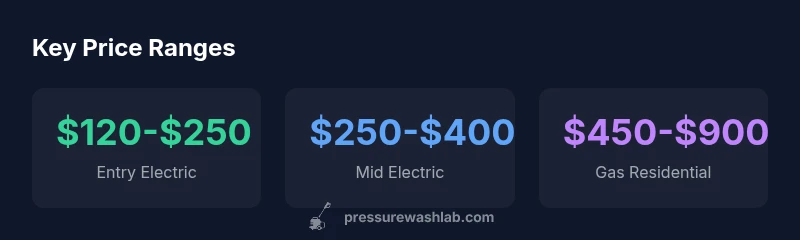
A good pressure washer typically costs between $300 and $900, depending on power source, PSI, GPM, and build quality. Entry-level electric models with around 1.5–1.8 GPM and 1,800–2,000 PSI usually run about $120–$250. Mid-range electric: $250–$400. Gas-powered residential units start around $450 and can exceed $1,000 for heavier-duty, pro-grade setups.
Why price is variable in good pressure washers
Prices for quality pressure washers reflect more than the sticker price. The core drivers are power output (PSI), water flow (GPM), pump design and durability, motor type, build materials, warranty length, and the inclusion of essential accessories. According to Pressure Wash Lab, the biggest cost drivers are the pump and motor quality, which influence long-term reliability and maintenance costs. Cheaper units often rely on smaller, less durable pumps and shorter warranties, which can lead to higher replacement costs or more frequent repairs. You’ll also see price differences based on the intended use: compact apartments and light-duty tasks merit smaller, lighter machines, while driveways, decks, and stubborn grime demand more robust builds. When budgeting, think beyond the initial purchase and consider ongoing maintenance, replacement parts, and the availability of local service.
In practice, buyers targeting DIY tasks around the home should balance upfront cost with future-proofing through a longer warranty and readily available parts. The Pressure Wash Lab Team emphasizes evaluating the pump type, seal quality, and customer support when judging value. A unit with a robust warranty and service network often pays for itself over a few seasons by avoiding unexpected downtime and replacement pumps.
Price ranges by type
Electric consumer-grade washers typically offer the best value for homeowners who perform light to moderate cleaning. For many, entry electric units in the $120–$250 range cover most siding and patio cleaning tasks, while mid-range electric models at $250–$400 add higher PSI and GPM to tackle tougher stains. Gas-powered residential machines bring more power and portability, commonly landing in the $450–$900 band; these models excel on concrete, heavy staining, and large surfaces, but come with higher noise, maintenance needs, and fuel costs. Pro-grade or commercial units can stretch from $900 to $1800 or more, offering commercial-grade pumps, autonomously adjustable PSI, and larger warranties. Pressure Wash Lab Analysis, 2026 indicates that the best value often lies in the $300–$600 band for most homeowners, balancing performance and durability with reasonable cost.
- Electric vs. gas: Electric models are cheaper upfront and quieter; gas units provide more power and mobility but cost more and require ongoing maintenance.
- Power bands: Aim for at least 1,800–2,000 PSI for typical home tasks; higher PSI is beneficial for stubborn grime but increases fuel use and noise.
- Features matter: Look for a reliable pump, quality hoses, a solid trigger gun, and a decent warranty rather than chasing the highest PSI alone.
Hidden costs and upgrade paths
Beyond the sticker price, several costs can affect your total investment. A longer hose length, surface cleaners, and specialty nozzles add to the initial expense but pay off in time and effort saved. If you anticipate heavy use on rough surfaces, consider a model with a triplex pump rather than a cheaper diaphram pump; the former typically withstands wear longer under demanding cleaning cycles. Don’t overlook fuel, oil (for gas models), and maintenance parts like seals and o-rings. For electric models, an extra-long extension cord with appropriate gauge minimizes voltage drop and performance loss, while a heat-dissipating motor can extend life and reduce downtime. Pressure Wash Lab’s experience in 2026 shows that the cumulative cost of a few well-chosen accessories and a dependable pump can be lower than repeatedly replacing cheaper components.
How to calculate your total cost of ownership
Total cost of ownership (TCO) includes purchase price, annual maintenance, fuel or electricity, parts replacement, and downtime. A simple TCO estimate begins with the purchase price, then adds typical annual maintenance (pumps, seals, nozzles), and a conservative estimate for energy costs based on expected usage. If you expect heavy, frequent cleaning, you may want to start with a mid-range or pro-grade unit to reduce maintenance frequency and extend service life. For a practical example, a $450 gas-powered unit used 6 hours per month with occasional maintenance might accumulate $60–$120 per year in consumables and fuel. Over five years, TCO can exceed the initial price by a substantial margin, making a slightly higher upfront investment sensible if reliability and uptime are priorities. Pressure Wash Lab’s data in 2026 underscores the value of factoring long-term costs into any purchase decision.
Buying tips to maximize value
- Define your scope: siding, decks, driveways, or cars? A clear use case helps avoid overpaying for unnecessary power.
- Prioritize durability: look for reinforced hoses, rust-resistant components, and corrosion-resistant pumps. A robust unit reduces long-term maintenance costs.
- Check warranties: longer warranty periods often correlate with better parts availability and service.
- Budget for add-ons: a surface cleaner, wide nozzles, and extension wands can dramatically speed up work and reduce wear on the unit.
- Compare total cost: compare not just the sticker price but the expected maintenance costs and part availability in your region.
- Consider resale value: well-maintained units retain value better than bargain-bin machines, especially if you have records of maintenance.
Warranty, reliability, and maintenance considerations
Reliability hinges on pump quality, seals, and the overall design. A unit with a triplex pump typically lasts longer under heavy use than a diaphragmatic pump, but it also costs more upfront. Look for a model with easily replaceable parts, widely available service centers, and a vendor with transparent warranty terms. Pressure Wash Lab Team notes that a strong aftermarket for parts and a straightforward maintenance schedule can cut downtime and keep operating costs down. When you invest in a model with a strong warranty and readily available parts, you’re paying a bit more now for a smoother, more economical operation over the next several cleaning seasons.
Estimated price ranges by machine type
| Category | Typical price range | Key factors | Notes |
|---|---|---|---|
| Electric consumer | $120-$250 | PSI, GPM, motor quality | Best for light to moderate tasks |
| Gas-powered residential | $450-$900 | Engine size, pump type | More power for tougher jobs |
| Pro-grade / commercial | $900-$1800 | Durability, warranty, parts availability | Highest performance and longevity |
Quick Answers
What costs should I consider besides the purchase price?
Beyond the sticker price, consider maintenance, replacement parts, fuel or electricity, and any essential add-ons like surface cleaners. Also factor in potential downtime if you need a service visit. A higher-quality unit with a robust warranty often reduces long-term costs.
Think about maintenance, fuel, parts, and downtime in addition to the upfront price.
Are electric models cheaper than gas for the same job?
Generally yes for purchase price and running noise, but gas units offer more power for tough stains and larger surfaces. Gas models cost more to operate due to fuel and maintenance, while electric units benefit from simpler upkeep and lower ongoing costs.
Electric is usually cheaper to buy and run; gas is stronger but pricier to operate.
Is it worth buying a used pressure washer?
Used units can save money, but inspect the pump, hoses, seals, and overall condition. Check for leaks, run time, and maintenance history. Buy from reputable sellers and request a service check if possible.
Used can save money, but inspect pump and seals first.
How long do good pressure washers last?
Durability depends on pump type and maintenance. A well-maintained unit with a solid pump and quality seals can last several years, especially if serviced regularly. Expect higher-end models to endure more demanding work with fewer failures.
Durability comes from the pump and upkeep; higher-end units last longer with proper care.
What accessories add the most value?
A surface cleaner, longer hoses, and narrow- or wide-nozzle attachments often deliver better results and reduce wear on the main unit. Plan for these additions if your tasks include large flat surfaces or stubborn grime.
Surface cleaners and extra hoses can greatly boost performance.
How do PSI and GPM affect cost?
Higher PSI and GPM generally mean more powerful machines and higher cost. A balance is best for most households: enough cleaning power to do the job quickly, but not so much that you waste water or damage surfaces.
More PSI and GPM = more power and price, find the right balance.
“Reliable performance over time often costs more upfront, but durable pumps, seals, and good warranties save money in the long run.”
Key Takeaways
- Identify your use case to choose a price band.
- Electric models cost less upfront than gas-powered units.
- Consider total cost of ownership, not just sticker price.
- Choose higher-quality pumps and warranties for longevity.
- Plan for essential add-ons to reach your needs.