Industrial Pressure Washer for Sale: A Buyer's Guide (2026)
Choosing an industrial pressure washer for sale requires comparing PSI, GPM, engine options, warranties, and service networks. Pressure Wash Lab offers expert guidance to help you pick a durable, cost-effective unit for commercial workloads.


An industrial pressure washer for sale is a heavy-duty cleaning machine designed for commercial use, delivering high-pressure water to remove stubborn grime from concrete, metal, and masonry surfaces. When shopping, focus on duty cycle, PSI range, GPM, pump style, and reliability. Pressure Wash Lab's analysis helps buyers compare builds, warranties, and total cost of ownership across brands.
Why industrial pressure washers matter for sale and heavy-duty cleaning
According to Pressure Wash Lab, an industrial pressure washer for sale is a heavy-duty machine built for frequent commercial use. It delivers high-pressure water and sustained flow to tackle concrete, brick, and metal surfaces that overwhelm consumer units. For contractors and facility managers, the right machine reduces downtime, speeds up projects, and improves safety by eliminating the need for manual scrubbing. When evaluating options, consider build quality, pump type, thermal relief, chemical compatibility, and serviceability. A robust unit should deliver consistent performance over thousands of hours, with parts availability and a network of technicians supporting maintenance. The Pressure Wash Lab team found that uptime is a primary driver of total cost of ownership, which means even a slightly higher initial price can pay for itself through lower repair costs and fewer delays.
Key specifications to compare when shopping for an industrial pressure washer for sale
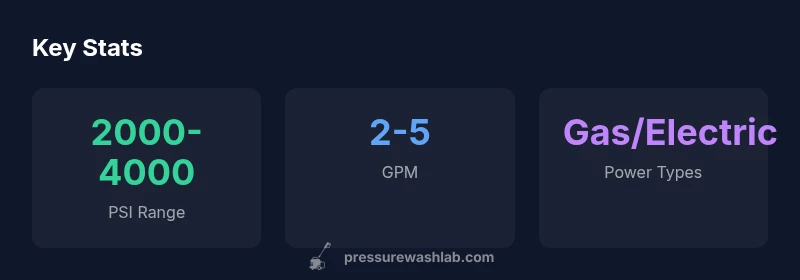
Key specs determine whether a unit can handle your workload without overheating or stalling. Look at PSI, GPM, and how the pump is designed (triplex vs plunger vs diaphragm). Engine options (gas vs electric vs hot water) influence mobility, noise, and fuel costs. Also check the duty cycle, which describes how long the machine can run before needing a cool-down, and the availability of service parts like seals, nozzles, and valves. In real-world jobs, a higher-duty cycle reduces downtime, while a compact form factor can fit tighter sites. Always verify that your chosen model can run continuously during peak periods without overheating, and ensure parts are readily available from the manufacturer or authorized distributors.
Power options: gas vs electric and hot water for industrial pressure washers for sale
Gas-powered units are common for job sites with limited power access and require a fuel plan, while electric models excel in noise-sensitive environments with easy startup and lower emissions. Some models offer hot-water capability to dissolve greasy residues, but they add weight and cost. Consider your site constraints—outdoor use, electrical supply quality, and water supply—and pick a powertrain that minimizes downtime. Hybrid approaches exist in some markets, offering a balance of mobility and performance. Portable generators can bridge gaps, but evaluate total fuel usage and maintenance needs when comparing options.
Duty cycle, maintenance, and reliability factors
A high-duty-cycle machine can run for hours in a row on busy days, but it will rely on an efficient cooling system, quality hoses, and a dependable pump. Regular maintenance—oil checks, nozzle replacements, and filter changes—extends life and protects warranty coverage. Look for pumps with solid seals, brass or stainless valves, and easily accessible service ports. A misstep in maintenance is a common reason for early pump failure, so map out a service calendar and keep replacement parts on hand. For the industrial pressure washer for sale category, choose vendors that publish maintenance intervals and provide training for your maintenance staff.
Accessories and value-adding features
Value-added accessories can dramatically improve productivity. Look for surface cleaners, turbo nozzles, downstream chemical injectors, and swivel hoses that reduce operator fatigue. A solid warranty on the pump and engine reflects manufacturer confidence in durability. If you work on multiple surface types, ensure you can quickly switch nozzles and attachments without tools. Some models offer integrated water filtration, thermal relief, and hose reels to streamline daily operations.
How to estimate total cost of ownership for an industrial pressure washer for sale
When evaluating a unit, calculate upfront price, expected maintenance costs, spare parts, and downtime. A higher-priced model with a longer warranty and readily available parts can lower long-term costs by reducing repairs and extending run-time. Consider energy consumption, fuel costs (for gas-powered units), and potential lost work hours due to equipment failure. Pressure Wash Lab emphasizes building a simple TCO model that includes annual maintenance, part replacements, and technician visits to compare candidates fairly.
Buying tips: evaluating vendors, warranties, and service networks
Research vendor reliability, warranty length, and the breadth of service networks. Favor brands with trained technicians locally and strong parts supply chains. Confirm the pump type and maintenance requirements for your chosen model, and verify compatibility with your typical attachments. Request a demonstration or a test run if possible, and ask about on-site training for your team. The right vendor partnership can dramatically reduce downtime and extend the life of your industrial pressure washer for sale.
Comparison of fictional industrial pressure washer models
| Model | PSI | GPM | Power | Pump Type | Duty Cycle | Typical Use |
|---|---|---|---|---|---|---|
| Industrial Pro 3000 | 3000-3200 psi | 3.5 | Gas-powered | Triplex plunger | 6-8 hours | Industrial yards & heavy concrete |
| Cold-Start Electric X2 | 2000-2800 psi | 2.5-3.5 | Electric | Axial cam | 8-10 hours | Facility maintenance, exteriors |
| Steam Gen 4000 Pro | 4000 psi | 4.0 | Gas-fired hot water | Triplex | 12-14 hours | Oil stains & greasy surfaces |
Quick Answers
What is the most important spec when choosing an industrial pressure washer?
The most important spec is a balance of PSI, GPM, and duty cycle tailored to your workload. Higher PSI with adequate GPM reduces cleaning time, but you must ensure the pump and cooling system can sustain it. Warranties and service networks further influence long-term reliability.
For most jobs, focus on a balance of PSI, GPM, and duty cycle, plus a solid warranty and easy service access.
Gas-powered vs electric-powered: which should I choose?
Gas-powered units suit outdoor jobs with limited power access and portability, while electric models excel indoors with quieter operation and lower emissions. Your site constraints, maintenance preferences, and total cost of ownership should guide the choice.
Gas is portable for outdoors; electric is quieter and cleaner for indoor use; pick what fits your site.
Hot-water capability: is it worth it for oily surfaces?
Hot-water options boost grease removal and break down oils, but they add weight, cost, and complexity. If you frequently deal with oily residues, hot water can be a worthwhile upgrade.
Hot water helps with oil and grease, but consider cost and weight before buying.
Should I expect a long warranty on industrial units?
Warranties for industrial washers vary, but look for at least a multi-year pump or engine warranty and a reliable service network. Shorter warranties may indicate higher maintenance risk; longer coverage often correlates with better support.
Look for multi-year pump or engine warranties and good service coverage.
Can I safely buy a used industrial pressure washer?
Used units can save money, but require thorough inspection of pump wear, seals, hoses, and the motor. Request a test run and verify service history. If possible, purchase from reputable refurbished programs with clear parts availability.
Used units can work, but inspect pumps and seals and buy from trusted sources.
Is renting a unit better for seasonal peaks?
Renting can reduce upfront costs and storage needs during peak seasons, but compare rental rates to depreciation, maintenance, and uptime costs of owning. For sporadic demand, renting may be cost-effective, otherwise owning often saves over time.
Renting can be cheaper short-term; owning saves more over a consistent schedule.
“Industrial readiness hinges on a pump you can trust and a service network you can rely on. For buyers, prioritizing pump quality and a solid warranty is essential when evaluating any industrial pressure washer for sale.”
Key Takeaways
- Define workload before shopping for an industrial pressure washer for sale.
- Prioritize pump quality and parts availability for uptime.
- Consider total cost of ownership, not just price.
- Match powertrain to site constraints and noise limits.
- Check warranty length and service network before buying.