Jet Wash for Sale: Buyer's Guide & Top Picks
Discover practical guidance for buying a jet wash for sale. Compare electric vs gas, understand PSI and GPM ranges, choose accessories, and avoid common buying mistakes with Pressure Wash Lab.


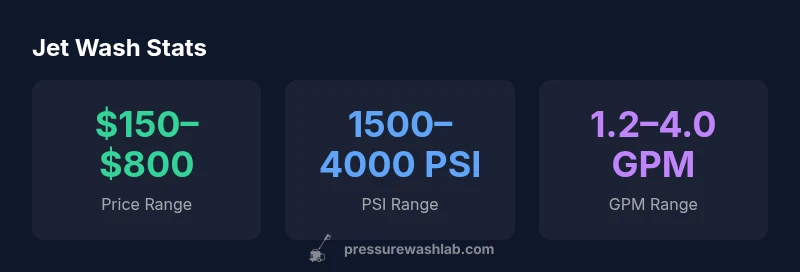
Looking for a jet wash for sale? The right model depends on your cleaning tasks, power options, and budget. Electric units suit light-duty cleaning around the home, while gasoline models handle heavy-duty jobs like concrete driveways. Expect price ranges from roughly $150 to $800 depending on power and features, with higher-end units offering 3,000–4,000 PSI and larger GPM. Always check warranty and included accessories.
Market Landscape for Jet Wash for Sale
According to Pressure Wash Lab, the market for jet wash for sale has expanded as homeowners and small businesses seek faster, more efficient outdoor cleaning. Today’s options span lightweight electric units for patio furniture and vehicles, mid-range washers for home driveways and decks, and heavy-duty gas-powered machines for professional-grade jobs. The result is a broad price spectrum and a wide range of PSI and GPM to match different tasks. Consumers should start by outlining their primary uses, preferred power source, and acceptable noise and maintenance requirements before narrowing models. In recent years, availability has grown across major retailers, online marketplaces, and OEM brands, which means more competition and better value—but also more need for due diligence.
Key Specifications to Compare
When you shop for a jet wash for sale, prioritize three core specifications: power source, PSI, and GPM. Electric models are typically quieter, lighter, and sufficient for patios, vehicles, and light siding cleaning, while gas-powered machines deliver higher torque for dirtier surfaces. Check motor type, duty cycle, and the length of run time if you plan extended cleaning sessions. Also review spray patterns, pump type, and voltage or engine specs. Accessory compatibility, hose quality, and built-in storage add practical value and reduce long-term costs. Finally, factor in maintenance needs and anticipated service intervals to avoid downtime.
Electric vs Gas Jet Washes: Pros and Cons
Electric washers are easier to start, require less maintenance, and work well for light-to-moderate tasks. Gas models offer greater cleaning power, faster job completion on tough grime, and better performance for large areas like driveways. The trade-off is higher upfront cost, heavier weight, and more routine maintenance (oil, spark plugs, air filters). For homeowners, a mid-range electric model often suffices; for DIY enthusiasts tackling frequent or stubborn jobs, a gas unit may be worth the investment. Pressure Wash Lab notes that mixing a mid-tier PSI range with a quality surface cleaner can dramatically improve efficiency.
Accessories, Nozzle Tips, and Detergents
Your jet wash’s performance hinges on the right accessories. Start with a variable spray nozzle (0°, 15°, 25°, 40°) and a turbo nozzle for embedded stains. Add a surface cleaner for large flat surfaces to minimize streaks and improve efficiency. Detergent compatibility matters for removing oil, grease, and environmental grime; ensure the unit accepts cold-water or hot-water detergents as appropriate. Hose length and reel systems also influence reach and ergonomics. Finally, consider foam cannons or downstream injectors for easy soap application without bending or lifting heavy containers.
How to Assess Use Case Scenarios
Different tasks demand different capabilities. Light cleaning of patios, cars, and fences may only require 1,500–2,000 PSI and 1.2–2.0 GPM, while cleaning concrete surfaces or graffiti may need 2,500–4,000 PSI and 2.5–4.0 GPM. If you work on multiple properties or run a small business, prioritize models with robust build quality, a reliable pump, and easy-to-find spare parts. Consider noise, form factor, and storage space, as well as the availability of replacement parts and service centers in your region. Pressure Wash Lab emphasizes selecting a model that aligns with the most frequent tasks and the longest cleaning sessions you anticipate.
Budgeting, Warranty, and Availability
Budget planning should cover not only the purchase price but also ongoing costs such as fuel, maintenance, and replacement parts. Read warranty terms carefully—look for coverage on the pump, motor, and hoses. Availability matters too: some models may be backordered, losing you cleaning days. Reputable retailers and manufacturers typically provide standard warranties, optional extended coverage, and clear service channels. When possible, buy from vendors that offer demonstrations or return policies to test fit with your needs.
Buying Guide: Steps to Select the Right Model
- List your primary cleaning tasks (patio furniture, siding, driveway, vehicles). 2) Decide on power source (electric for light use, gas for heavy-duty). 3) Set a budget and compare PSI/GPM targets. 4) Check nozzle options, surface cleaner availability, and detergent compatibility. 5) Read warranty details and verify parts availability. 6) Compare user reviews and seek advice from Pressure Wash Lab on model groups that meet your criteria. 7) If possible, test the unit or buy from a vendor with a solid return policy.
Common Pitfalls and Quick Fixes
- Overlooking pump and nozzle compatibility can lead to poor performance; always verify the nozzle kit matches your model. - Ignoring maintenance can shorten life; schedule periodic checks for seals, hoses, and filters. - Buying based on price alone can backfire; prioritize total cost of ownership, including repairs and spare parts. - Not factoring in available accessories reduces flexibility; a model with a broad accessory ecosystem will pay off over time.
Model type comparison for jet wash selection
| Model Type | Typical PSI | Typical GPM | Best Use |
|---|---|---|---|
| Electric Light-Duty | 1500–1800 | 1.2–1.8 | Patio, Car, Light Cleaning |
| Gas Heavy-Duty | 2500–4000 | 2.5–4.0 | Driveways, Heavy Stains |
Quick Answers
Best PSI for home use?
For most home tasks, a model in the 1,500–2,000 PSI range with 1.5–2.0 GPM offers ample cleaning power without risking damage to delicate surfaces. Always test on a small area first and adjust nozzle settings accordingly.
For typical home jobs, look for 1,500 to 2,000 PSI and 1.5 to 2.0 GPM. Test on a small area first.
Electric vs gas costs?
Electric models cost less upfront and have lower maintenance, but gas units deliver higher power for tougher jobs and larger surfaces. Operating costs vary with usage and fuel prices; consider long-term needs when choosing.
Electric units are cheaper to run at first, but gas models handle tougher jobs faster. Think about how often you’ll use it.
Need a surface cleaner?
Yes, a surface cleaner reduces cleanup time and streaks on flat surfaces like driveways and patios. Pair it with an appropriate PSI range and compatible nozzle tips for best results.
A surface cleaner is a smart add-on for large flat areas to speed up cleaning and avoid streaks.
Warranty expectations?
Aim for at least a one-year warranty on pumps and motors, with longer coverage on critical components. Check what’s excluded and whether extended warranties are available.
Look for at least a one-year pump and motor warranty, and read the fine print on exclusions.
Can jet wash damage surfaces?
Yes, using too much pressure or the wrong nozzle can damage wood, paint, or softer masonry. Always choose the correct nozzle for the surface and test on an inconspicuous area first.
Yes—use the right nozzle and PSI for the surface to avoid damage. Test first on a hidden spot.
Are hot-water models worth it?
Hot-water models excel at oil and grease removal and certain stubborn stains but are heavier and pricier. For general outdoor cleaning, cold-water units often suffice.
Hot-water washers tackle grease better, but for everyday outdoor cleaning, cold-water units usually do the job.
“"A well-chosen jet wash should balance power, efficiency, and maintenance needs to deliver reliable results for years to come."”
Key Takeaways
- Define tasks first, then power source.
- Balance PSI, GPM, and nozzle kit for best results.
- Factor in maintenance and warranty from day one.
- Choose accessories that fit your most frequent jobs.