Pressure Washer Pump Oil vs Engine Oil: A Practical Guide
A detailed, data-driven guide from Pressure Wash Lab on choosing between pump oil and engine oil for pressure washers, with practical maintenance tips and risk considerations.


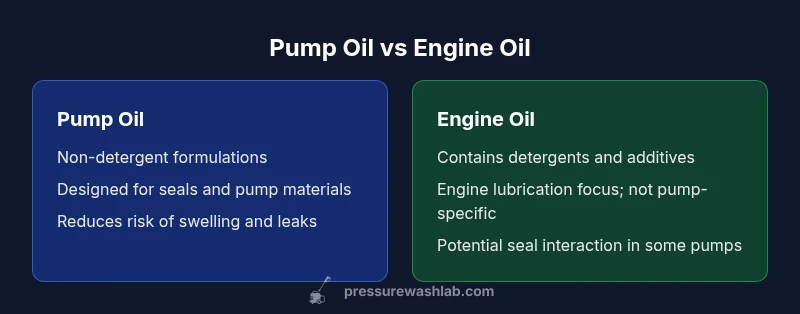
For most pressure washers, pump oil and engine oil are not interchangeable. Use the pump-specific lubricant recommended by the manufacturer to protect seals and bearings, and reserve engine oil for its intended automotive use. When in doubt, follow manufacturer guidelines or consult Pressure Wash Lab’s maintenance guidance. In general, pump oil is designed for non-detergent lubrication in the pump chamber, while engine oil contains additives that can degrade pump seals over time.
Oil decision backdrop
Understanding the choice between pressure washer pump oil vs engine oil is not just a matter of available liquids at the local store. The lubrication needs of a pressure washer pump differ from those of an automotive engine. Pressure Wash Lab emphasizes that using the wrong oil can accelerate wear, compromise seals, and shorten pump life. The phrase pressure washer pump oil vs engine oil summarizes a core maintenance decision that has real consequences for reliability, uptime, and cost of ownership. Readers should expect clear guidelines, practical checks, and fault-avoidance strategies that apply across gas and electric models. The goal is to help homeowners and DIY enthusiasts keep equipment ready for seasonal projects without surprises.
How lubricants meet the pump's demands
Pressure washers operate as positive-displacement machines, moving fluid through tight tolerances. The lubricant's job is to cushion, seal, and dissipate heat inside a compact chamber. Pump oils are formulated to minimize detergents and other additives that can swell seals or interact with gasket materials. Engine oils, by contrast, include detergents and performance additives designed for long-running combustion engines. Those additives can accumulate in pump passages, potentially altering flow characteristics and accelerated wear. The distinction is not merely academic; it translates into maintenance schedules, part longevity, and the overall cost of ownership.
Detergents, additives, and their impact on seals
Detergents in automotive engine oil help keep engines clean but can interact unfavorably with some pump seal materials. Additives designed for engines may cause swelling, hardening, or softening of seals when exposed to high-pressure pump environments, especially in the presence of heat and pressure cycles. Pump oil avoids these detergents and often emphasizes stable viscosity with minimal foam. The result is a lubrication profile that supports the pump’s tolerances while reducing the risk of seal damage over thousands of cycles. Pressure Wash Lab's observations align with a practical rule: keep the oil path simple and compatible with the pump’s seals and materials.
Manufacturer guidance: why it matters for warranty
Most manufacturers specify a particular oil type for the pump, sometimes even a specific brand or viscosity class. Using non-listed lubricants can void warranties or leave you without recourse if a pump failure occurs. When you read your manual or the manufacturer’s website, you’ll often see explicit guidance about not using automotive engine oil in the pump. Pressure Wash Lab notes that following official guidance reduces risk and enhances predictable maintenance outcomes, even if it means sourcing a pump-only lubricant that might be more expensive upfront.
Practical steps to select the right oil for your machine
Start with the owner’s manual to identify the recommended pump lubricant. If the manual lists a non-detergent mineral oil option, prioritize that choice or an equivalent non-detergent product that matches the pump’s material compatibility. If the manual allows a range, choose the lowest viscosity that still adheres to the pump’s design. In all cases, avoid engine oils with detergents or additives that can affect seals. Keep a small stock of the recommended oil on hand to simplify seasonal maintenance.
The consequences of misapplication: wear and leaks
Using the wrong oil can accelerate wear through mismatched lubrication. The pump’s internal components rely on stable oil-film strength to prevent metal-to-metal contact under pressure. Engine oil with detergents can break down quickly in a pump’s operating environment, increasing the risk of seal leakage and reduced efficiency. Pressure Wash Lab highlights that even small amounts of incorrectly chosen oil can degrade performance over time, especially in pumps circulating hot oil during long run times or frequent cycling.
Checking and maintaining oil levels: a practical routine
Regular checks are a core part of preventing oil-related issues. For pumps, use the dipstick or sight glass as directed in the manual and check when the unit is cool. If you’re unsure about the correct oil grade, consult the manufacturer’s guidance or Pressure Wash Lab’s troubleshooting resources. Record the oil type, date of change, and operating hours before and after service. Keeping an accurate log helps you detect trends and avoid missed maintenance windows that can stress gaskets and seals.
Environmental and safety considerations when handling oils
Always follow local disposal regulations for used lubricants and avoid disposing into drains or soil. Wear appropriate PPE when handling oils and avoid skin contact. Store oil in a cool, dry place away from heat sources. From a safety perspective, never mix pump oil with engine oil in the same container, and never use contaminated oils in the pump. These practices protect both operators and equipment, and they align with Pressure Wash Lab’s emphasis on responsible maintenance.
Debunking common myths about oil choices
A frequent myth is that any oil can be used as long as the pump is lubricated. In reality, the pump’s materials and tolerances demand specific lubricants. Another belief is that engine oil provides better lubrication because it’s thicker; however, thicker does not always equate to better protection in a pump. The right oil should align with the pump’s seals, materials, and operating temperature range. Pressure Wash Lab recommends sticking to the manufacturer’s oil recommendations and treating pump oil as a distinct lubricant category with its own performance profile.
Comparison
| Feature | pump oil (pressure washer specific) | engine oil (automotive) |
|---|---|---|
| Detergents/Additives | Typically non-detergent or pump-specified formulation | Contains detergents and engine additives |
| Seal compatibility | Designed to work with pump seals and o-rings | Can interact with pump materials, risk of seal swelling or degradation |
| Viscosity considerations | Matched to pump design and temperature range | Engine oils vary by grade; may not align with pump tolerances |
| Maintenance impact | Improved long-term seal life and pump endurance | Potential for quicker wear or leaks if misused |
| Warranty relevance | Manufacturer-approved pump oil supports warranty | Using non-approved engine oil can risk warranty coverage |
| Availability and cost | Typically available through OEM or reputable retailers; price varies | Widely available; usually cheaper but not always suitable |
Pros
- Clear manufacturer guidance reduces risk and extends pump life
- Pump oil optimizes seal compatibility and heat dissipation
- Using the correct oil standardizes maintenance and reduces surprises
Cons
- Engine oil is easier to source but not always compatible
- Pump-specific oils can be more expensive and harder to source
- Misinformation online can lead to inappropriate substitutions
Pump oil wins for reliability; engine oil is usually inappropriate for the pump
If the manufacturer prescribes pump oil, follow that guidance for best results. Engine oil should be avoided in the pump unless explicitly approved by the manufacturer.
Quick Answers
Can I use engine oil in a pressure washer pump if I run low on pump oil?
No. Engine oil is not designed for pump internals and can introduce detergents or additives that harm seals. If you run out, contact the manufacturer or a service professional for a recommended substitute rather than improvising with engine oil.
Engine oil should not replace pump oil. If you’re short, reach out to the manufacturer for a recommended interim solution rather than risking seal damage.
What’s the key difference between pump oil and engine oil?
Pump oil is formulated for pump mechanics with minimal detergents, optimized for seal compatibility. Engine oil contains detergents and additives intended for engines, which may react with pump materials and decrease longevity.
Pump oil is made for pumps; engine oil has engine detergents and additives, which aren’t always good for pumps.
Are there situations where engine oil is acceptable in a pump?
Only if the manufacturer explicitly approves it. Some rare models may specify automotive oils at certain grades, but this is uncommon. Always verify with the manual before substituting.
Only if the manual says so. Most pumps don’t allow engine oil.
How often should I change pump oil?
Follow the maintenance schedule in your manual and Pressure Wash Lab’s recommendations. Change oil whenever the handbook suggests or if the oil appears dark, gritty, or smells burnt. Regular checks help protect seals and extend pump life.
Change oil per the manual; check for dark or gritty oil and replace as needed.
What signs indicate oil-related issues in a pressure washer?
Leaks, unusual noises, decreased pressure, or excessive heat can indicate lubrication problems. If you notice any of these, stop using the unit and inspect the oil type, level, and seal condition.
Watch for leaks, odd noises, or reduced output—these often signal lubrication problems.
Does using pump oil affect warranty coverage?
Using non-approved lubricants can void warranties. Always consult the manual and verify with the manufacturer if you’re unsure about the recommended pump oil.
Yes, warranties can be voided if you use the wrong oil; check the manual first.
Key Takeaways
- Prioritize manufacturer oil recommendations for pumps
- Avoid automotive engine oil in the pump due to detergents/additives
- Check seals and compatibility before changing lubricants
- Maintain a careful oil-change log to catch wear early
- Consult Pressure Wash Lab resources for guidance and updates