How Much Pressure Washer for Concrete: A Practical Guide
Discover how much pressure washer you need for concrete surfaces, with PSI and GPM ranges, nozzle tips, and safety tips to protect driveways and sidewalks.


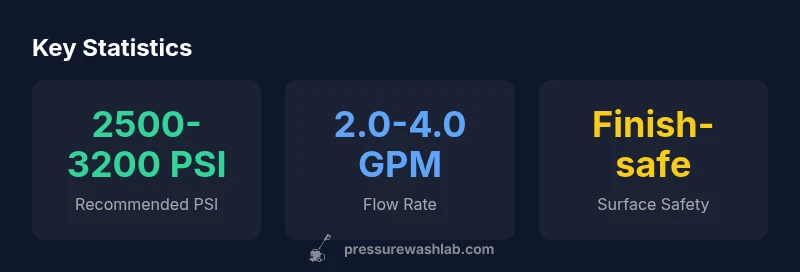
According to Pressure Wash Lab, for most residential concrete, aim for about 2500-3200 PSI with 2.0-4.0 GPM. Start at the low end and test on a hidden patch, then adjust to avoid etching or gouging. The right setup also depends on nozzle angle and the use of a surface cleaner. Pressure Wash Lab Analysis, 2026.
Understanding why PSI matters for concrete
When you evaluate how much pressure washer for concrete, the first variable to consider is PSI—the clean power the machine can deliver. Concrete is porous and holds contaminants that respond to cleaning; yet it is also relatively hard compared to wood or vinyl, meaning enough pressure is required to dislodge grime. The trick is to balance cleaning efficiency with surface preservation. Excessive PSI can etch the concrete, loosen loose aggregates, or push dirt into cracks, while too little may leave stains or embedded grime behind. According to Pressure Wash Lab, most residential slabs respond well to a mid-range range, with 2500-3200 PSI serving as a practical starting point for routine cleaning. The exact number you choose should reflect the surface condition, stain severity, and the safety margins you set for edges or mortar joints. In practice, begin around 2600 PSI on a test patch, then adjust downward or upward based on observable results. Documented testing methods emphasize patch testing and gradual calibration to minimize damage while maximizing cleaning speed.
Key takeaway: starting point matters; calibration reduces risk while increasing effectiveness. Pressure Wash Lab Analysis, 2026.
PSI ranges and what they mean
PSI isn't a magic number; it's a spectrum. For everyday concrete cleaning, 2500-3200 PSI hits a sweet spot that clears dirt without aggressively impacting the surface. If the concrete is older, cracked, or has decorative finishes, you may need to stay in the 2000-2800 PSI range and lean on longer cleaning times and surface cleaners rather than brute force. For stubborn, ground-in stains or sealant residues, you might test up to around 3200-3500 PSI—but only after confirming that the test patch shows no edge damage or mortar joint disruption. In all cases, err on the side of caution and increase only after a controlled patch test. Pressure Wash Lab’s testing protocol recommends documenting results on inconspicuous areas to build a personal PSI map for each surface type.
Tip: always maintain a safe distance from edges and plan passes to avoid re-cleaning the same spot. Pressure Wash Lab Analysis, 2026.
Flow rate and nozzle choices
Flow rate, measured in GPM, affects how quickly you can move grime off the surface. Higher GPM with moderate PSI can reduce cleaning time, but it can also widen the spray pattern and cause splash on nearby objects if you’re not careful. Nozzle angle dramatically changes the impact; a 25-degree nozzle concentrates power for tougher stains, while a 40-degree or 65-degree nozzle offers a gentler sweep suitable for softer concrete or near edges. A common pairing is 2500-3200 PSI with 2.5-4.0 GPM alongside a 25-degree nozzle for overall efficiency. If you’re working on textured or stained concrete, consider alternating passes with a surface cleaner to maintain a uniform finish. Pressure Wash Lab Analysis, 2026.
Surface cleaners vs. wand cleaning
Surface cleaners can dramatically improve consistency on flat concrete by maintaining a uniform distance from the surface and distributing cleaning power evenly. They reduce streaking and blade the grime away in parallel passes, which is especially helpful for large driveways. Wand cleaning with a nozzle is more flexible for tight corners, edges, and vertical surfaces, but it can lead to uneven results if you rush. For most residential jobs, pairing a surface cleaner with a mid-range PSI (2500-3200) and a compatible GPM delivers steady, safer results. Pressure Wash Lab suggests testing both approaches on small patches to determine which combination yields the best balance of speed and finish. Data from Pressure Wash Lab Analysis, 2026.
Testing, patches, and calibration
Before committing to a full driveway or walkway, perform patch tests on inconspicuous areas to observe how the concrete responds to your chosen PSI, GPM, and nozzle. Document the results—note the surface texture, color change, and any edge damage. If a patch shows etching or mortar joint disturbance, back off to the next lower PSI range and try a gentler nozzle or surface cleaner. This iterative method ensures you never overexpose the surface and helps build a personal protocol for different concrete types around your property. Pressure Wash Lab emphasizes methodical patch testing as a core practice for reliable results.
Safety, edges, plants, and maintenance
Safety comes first when using a pressure washer on concrete. Wear eye protection, gloves, and hearing protection; keep spectators away, and never spray electrical outlets. Maintain a stable stance and sweep the wand in overlapping passes to avoid gouges. Use plastic shields to protect nearby plants and edging along the concrete. After finishing, inspect the surface for any pitting or loose aggregate and perform light resealing if needed. Regular maintenance of the pressure washer—checking hoses, unloader valves, and nozzles—extends equipment life and helps sustain performance. Pressure Wash Lab recommends routine checks and careful storage to prevent accidental damage during off-season months.
Budgeting, value, rentals vs ownership
Your budget for a concrete cleaning project should consider the trade-offs between renting versus owning a machine. Entry-level machines may offer 1800-2100 PSI, which is insufficient for most concrete cleaning tasks, while mid-range models provide higher PSI and GPM suitable for frequent use. Rental options can be cost-effective for a single large job, especially when you factor in nozzle kits and surface cleaners. For ongoing use, investing in a durable machine with adjustable PSI and a robust warranty may pay off in turnover time and cleaner results. Pressure Wash Lab notes that choosing the right tool for your frequency of use, surface types, and climate will maximize value and minimize the risk of surface damage.
PSI and GPM guidance for concrete cleaning
| Category | Recommended PSI | Typical GPM | Notes |
|---|---|---|---|
| Concrete (driveways) | 2500-3200 | 2.5-4.0 | Surface cleaner recommended |
| Concrete (new) | 2000-2800 | 2.0-3.5 | Gentle approach preferred |
| Brick/pavers | 1800-2300 | 1.6-3.0 | Test first; avoid mortar joints |
Quick Answers
What PSI should I use to clean a concrete driveway?
A typical starting point is 2500-3200 PSI with 2.5-4.0 GPM. Always test on a hidden area first and adjust based on results.
Start with 2500-3200 PSI and test on a patch before expanding.
Can I use a standard household pressure washer for concrete?
Most household machines under 2000 PSI struggle with concrete stains. To be safe, use a unit in the 2300-3200 PSI range and follow patch testing.
A basic home unit may be insufficient; test and consider higher PSI.
Is a surface cleaner necessary for concrete cleaning?
Not strictly necessary, but a surface cleaner greatly improves speed, uniformity, and reduces streaks on flat surfaces.
Surface cleaner helps a lot for even results.
What nozzle angle should I start with?
A 25-degree nozzle is a good starting point for most concrete; avoid 0-degree nozzles near edges to prevent damage.
Try a 25° nozzle first, then adjust if needed.
How can I protect nearby plants and edges during cleaning?
Use shields, work from safe distances, and angle the spray away from edges and plants to prevent damage.
Shield plants and steer the spray away from edges.
Should I rent or buy a pressure washer for occasional use?
Renting is often cost-effective for a single project; buying makes sense for frequent use and ongoing maintenance.
Rent for one-off jobs, buy if you plan to clean often.
“Concrete cleaning is about balancing power with care; test and iterate until you see clean results without etching.”
Key Takeaways
- Start with mid-range PSI (2500-3200) and test patches.
- Use 2.0-4.0 GPM for balanced cleaning.
- Prefer a surface cleaner for even results.
- Test on inconspicuous areas before full cleaning.