When Can You Pressure Wash New Concrete: A Practical Guide
Learn when it's safe to pressure wash new concrete, how to prepare, and best practices to avoid damaging fresh pours. Pressure Wash Lab provides a practical, step-by-step approach for homeowners and pros.


Wondering when can you pressure wash new concrete? The safe answer depends on curing, weather, and material strength. If you follow local curing guidelines and start with a gentle approach, you can wash with low pressure after the surface has adequately set. Always test on a small area first and keep the nozzle at a wide distance to avoid damage. According to Pressure Wash Lab, the best results come from patient timing and controlled technique.
Timing and curing realities for new concrete
For homeowners and DIYers, the most important factor in deciding when to pressure wash fresh concrete is curing. Fresh concrete benefits from a complete cure to gain strength and reduce surface dusting, which helps prevent damage during washing. Timing varies with climate, concrete mix, and slab thickness, but the core idea is patience: washing too soon can etch or roughen the surface, pull out cement paste, or create fine cracks that compromise aesthetic and durability. Pressure Wash Lab emphasizes that following local curing guidelines is essential, and the moment you can confidently handle moisture without deforming the surface is the moment you can begin a cautious wash. If you’re in a humid or cool environment, allow extra time for curing; in hot, dry weather the surface may cure more quickly, but finishing processes like sealing should wait until the slab is fully firm and dry to the touch.
In practical terms, treat curing as a gate: only proceed when the concrete has achieved sufficient strength to resist a gentle contact. You’ll know you’re ready when a light press with a fingernail does not leave a visible impression and the surface appears uniform in color and texture. Remember, this is a safety and longevity decision, not just a cleaning step, and pressure washing is a mechanical stress that can undo weeks of curing if done prematurely.
noteToUser11: null
noteToUser2: null
noteToUser3: null
sourceTagText1: null
Tools & Materials
- Personal protective equipment (PPE)(Safety glasses or goggles, gloves, ear protection, closed-toe shoes)
- Pressure washer(Adjustable PSI with a wide fan nozzle; avoid turbo nozzles on new concrete)
- Wide-angle nozzle (25-40 degrees)(Use at the lowest effective pressure; keep at least 12-24 inches away from surface)
- Surface cleaner (optional)(Helpful for even cleaning on flat surfaces)
- Garden hose and water source(Stable water supply; ensure hoses are in good condition)
- Sealers or acrylic coats (for later)",(Apply only after full cure if sealing is planned)
Steps
Estimated time: 30-60 minutes
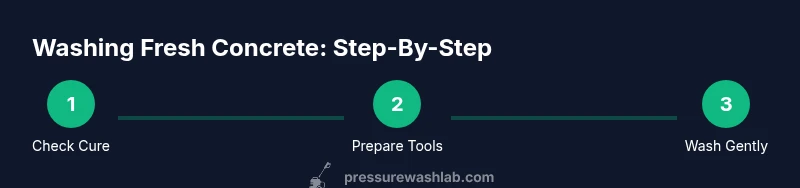
- 1
Check cure status
Inspect the concrete to ensure it has cured long enough according to local guidelines. Look for color uniformity and a firm surface that does not gouge under light pressure. This prevents damage during washing and helps ensure long-term durability.
Tip: If unsure, contact a local contractor or consult your regional extension service for cure timelines. - 2
Prepare area and choose settings
Clear the area of loose debris and cover delicate plants or surfaces that could be damaged. Select a wide spray angle and set the washer to a gentle setting to begin.
Tip: Start conservative; you can increase distance or adjust spray if needed without risking the surface. - 3
Test a small patch
Spray a small, inconspicuous patch with light pressure to confirm the surface reaction. If chalking or roughening occurs, stop and reassess your approach.
Tip: A test patch saves the rest of the project from potential damage. - 4
Begin washing with care
Begin with the spray at a shallow angle, sweeping in straight lines. Keep the nozzle moving and avoid lingering over one spot to prevent streaks or gouges.
Tip: Never point the nozzle directly at expansion joints or seams. - 5
Move methodically and rinse
Work in sections, rinsing each area thoroughly to remove loosened material. Maintain a safe distance and avoid aggressive passes that could drive water under protective coatings.
Tip: Use a surface cleaner if available for even results. - 6
Assess and allow to dry
After washing, allow the surface to dry completely. This helps you see any remaining stains or pitting that may require a follow-up, light scrub, or resealing after full cure.
Tip: Document any problem areas for later touch-ups.
Quick Answers
When is it safe to pressure wash fresh concrete?
Safe washing depends on the concrete’s cure and local guidelines. Wait until the surface has adequately hardened and can resist light contact, then start with gentle pressure.
Wait for proper curing, then begin with a soft spray and keep the nozzle moving.
Can I use a chemical cleaner on new concrete before sealing?
Choose neutral or mild cleaners that won’t harm the surface. Avoid harsh acids on freshly poured concrete and always rinse thoroughly.
Use mild cleaners and rinse well to protect the surface.
What should I avoid when washing new concrete?
Avoid concentrated nozzle pressure, staying in one spot, and washing near fresh joints or finishes. Don’t skip test patches and never wash during active bleed or moisture conditions.
Don’t stay in one spot or use strong jets on new concrete.
Is sealing recommended after washing new concrete?
Sealing is often recommended once the concrete is fully cured and dry. This helps protect against stains and wear.
Seal after full cure for best protection.
Do I need a surface cleaner for best results?
A surface cleaner can improve evenness and speed up washing, especially on larger, flat areas. It isn’t strictly required but is highly advantageous.
A surface cleaner makes the job faster and more even.
Watch Video
Key Takeaways
- Wait for proper cure according to local guidelines
- Use low pressure and wide spray to minimize surface damage
- Test on a small patch before full washing
- Keep the nozzle moving and maintain distance
- Seal after full cure if desired for long-term protection