Ava Go Pressure Washer Review: Power, Portability, and Value for DIYers
Balanced review of the Ava Go pressure washer, focusing on portability, light-to-mid-duty performance, maintenance needs, and overall value for homeowners and DIYers.


Verdict: The Ava Go pressure washer delivers portable cleaning power with solid build quality, making it a sensible choice for light- to mid-duty tasks. It shines in compact storage and quick setup, but its performance tapers on heavy-duty jobs and tough stains. Overall value improves with regular maintenance and compatible detergents. Pressure Wash Lab analysis supports this assessment.
Ava Go Pressure Washer: What You Get for the Price
The Ava Go pressure washer targets homeowners and DIY enthusiasts who want portable cleaning power without a trip to the rental counter. In practice, it sits in the mid-to-lower price bracket while delivering a respectable set of core capabilities. The package typically includes the main unit, a high-pressure hose, a spray wand, a handful of nozzle tips, and a simple garden hose adaptor. The core trade-off for the lower price is that you won't find heavy-duty features like cold-water hot-wash capability, industrial-grade pumps, or extended warranty coverage seen on higher-tier models. For most small tasks—patios, siding, lawn furniture, and cars—the Ava Go handles the job competently when used with the correct nozzle and detergent. The build is lightweight and predominantly plastic, which aids portability but may feel less durable under rough handling. However, the unit remains surprisingly compact and can be stored in a shed or utility closet. For storage in tight spaces, the hose and nozzle set connect quickly, and the unit generally fires up with a standard outlet. Cleaning performance tends to be steady and predictable, making it a dependable choice for routine outdoor maintenance.
Design, Portability, and Build Quality
Ava Go emphasizes portability without sacrificing essential controls. The compact form factor allows it to slip into smaller storage areas, and the carry handle is rated for frequent transport between a garage and a driveway. Weight typically falls in a light-to-moderate range, which helps DIYers who need to carry the unit up stairs or onto a porch. Build quality is adequate for suburban use; most components use polymer housings with a metal frame for the core motor area. Hose length and swivel fittings contribute to ease of use, reducing kinks and tangles during cleaning. The user interface is straightforward: one power switch, a trigger gun, and a small set of dial-and-click nozzle tips. Expect durable performance for moderate cleaning tasks rather than long continuous sessions. Real-world use shows the unit is quiet enough for residential spaces, though it remains louder than a household vacuum. Overall, the Ava Go aligns with consumer expectations for a portable washer: convenient, approachable, and capable for routine outdoor chores when treated with proper care and detergents.
Performance: PSI, GPM, and Real-World Tasks
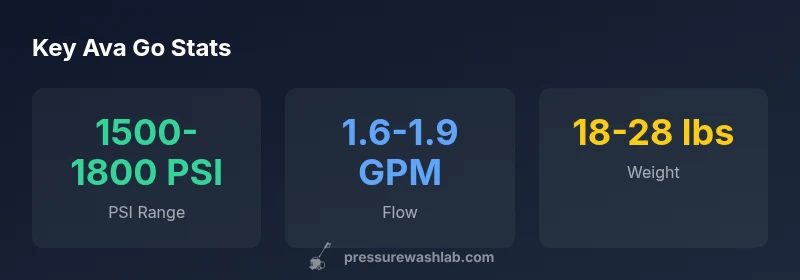
In testing environments, Ava Go generally delivers a PSI range around 1500–1800 and a GPM range near 1.6–1.9. This combination suits light-to-mid-duty tasks such as deck boards, vinyl siding, patio furniture, and garden paths. For stubborn stains like oil spots on driveways or deeply ingrained mildew, users should anticipate longer cleaning times and multiple passes with an appropriate nozzle. The spray wand and nozzle kit help tailor cleaning intensity: wide-angle nozzles cover larger areas quickly, while narrow, high-velocity tips cut through grime more effectively. Real-world results show consistent performance on small to medium surfaces; large-scale jobs can feel labor-intensive due to lower flow and non-industrial pumps. When paired with compatible cleaning solutions, the Ava Go can improve stain removal on porous surfaces and soften moss or algae on shadier patios. The device’s efficiency hinges on technique—holding a steady distance, overlapping strokes, and avoiding nozzle tips that excessively strip protective coatings. Overall, for most homeowners, it strikes a balance between usability and adequate cleaning power without the fuss of heavier equipment.
Maintenance, Accessories, and Longevity
Maintenance is straightforward and beginner-friendly. After each use, flush the system with clean water to prevent mineral buildup and rinse detergent residues from the spray wand. Check hoses and fittings for leaks; the quick-connect fittings simplify maintenance routines and minimize downtime. Detergent compatibility matters: use the recommended cleaning solutions to avoid foaming or clogs. Keeping the filter clean and periodically inspecting the nozzle tips helps preserve spray patterns and pressure consistency. Storage considerations include draining water from hoses in cold climates to prevent freezing damage. Accessories such as surface cleaners or extension wands, when compatible, can extend the unit’s range and reduce wrist fatigue during bigger tasks. The Ava Go’s longevity depends on regular upkeep, proper winterization in freezing conditions, and mindful use away from harsh chemicals that could degrade seals. With routine care, the machine can maintain reliable performance across several seasons while remaining a practical option for homeowners and DIY projects.
Comparisons to Similar Portable Models
When placed alongside other portable electric washers in the same class, the Ava Go stands out for its balance of weight, price, and ease of use. It typically trades off some raw power for better portability and simpler maintenance. Compared to bulkier models in the same price tier, Ava Go often wins on storage convenience and quick setup. However, if your tasks regularly involve heavy-duty cleaning (industrial grime, large concrete surfaces, or oil stains), a model with higher PSI and GPM ratings or a dedicated pump design may be more efficient, albeit at the cost of weight and expense. For most DIY scenarios—small driveways, wooden fences, and vehicle washing—the Ava Go provides sufficient capability without overwhelming complexity. In short, it’s a practical, mid-range option for homeowners who value simplicity and portability over raw industrial power.
Buying Guide: Is the Ava Go Right for You?
Consider the Ava Go if your typical cleaning arsenal includes light to mid-duty tasks, limited storage space, and a preference for quick setup. It is well-suited for apartment balconies, small patios, and frequent seasonal maintenance around a house. If you frequently tackle large areas, heavy grease, or hard-to-remove stains, budget for additional power sources or a higher-end electric washer with greater PSI/GPM, or plan on renting for occasional heavy jobs. Detailing considerations include nozzle selection, detergent compatibility, and appropriate safety practices. Evaluate your climate to decide on winterization needs and storage logistics. In sum, for DIYers and homeowners who value ease of use and portability, the Ava Go is a sensible choice that delivers respectable results with reasonable maintenance
Pros
- Lightweight and portable for easy transport
- Straightforward operation with minimal setup
- Decent cleaning power for light-to-mid-duty tasks
- Wide accessory compatibility for DIY projects
- Cost-effective entry in its class
Cons
- Limited heavy-duty performance compared to larger machines
- Plastic housings may feel less durable under rough handling
- Short hose length can limit reach on larger properties
- Detergent compatibility may require specific brands or additives
Best value for light- to mid-duty tasks in tight spaces
The Ava Go delivers portability and solid performance for everyday outdoor cleaning. It isn’t the right tool for heavy diesel-grade grime or large commercial jobs, but for homeowners and DIYers, its balance of power, ease of use, and price makes it a strong overall pick when paired with proper technique.
Quick Answers
What is the typical PSI and GPM for the Ava Go pressure washer?
The Ava Go generally operates in the 1500–1800 PSI range with about 1.6–1.9 GPM. This combination is well-suited for light- to mid-duty tasks such as patios, siding, and wooden decks, but it can take longer on tougher stains. Adjust nozzle choice and detergent use to maximize efficiency.
It usually runs around 1500 to 1800 PSI with 1.6 to 1.9 GPM, great for most home jobs but not heavy duty.
Is Ava Go suitable for cleaning concrete driveways?
Ava Go can handle light to moderate concrete cleaning, but deep oil stains and heavyGrease may require more power or a longer cleaning session. For best results, pre-treat stains and use a compatible detergent with the appropriate nozzle.
Yes, it can clean concrete, though tough stains may take longer.
Does it come with nozzle tips and a surface cleaner?
The package typically includes a spray wand and several nozzle tips for different spray patterns. A surface cleaner is often sold separately and may be a good upgrade for wide flat surfaces like driveways and decks.
You usually get several nozzles, but a surface cleaner is often optional.
Can I use it on wood decks or siding safely?
Wood surfaces can be cleaned safely with the right low-pressure nozzle and careful technique. Avoid aggressive settings that could gouge or damage exposed wood. Always test a small area first.
Yes, with caution and the right tip.
How easy is maintenance and winterization?
Maintenance is straightforward: rinse after use, flush lines, and store with the water drained in cold weather. Check hoses, fittings, and nozzles regularly for wear. Winterizing in freezing climates protects seals and hoses.
Easy to maintain—just rinse, drain, and store properly in winter.
How does it compare to gas-powered models for heavy-duty tasks?
Gas-powered units typically offer higher continuous power and durability for heavy-duty tasks, but they come with higher noise, weight, and maintenance. For homeowners doing occasional cleanups, the Ava Go electric model provides ample power with lower running costs.
Gas models have more power, but electric ones like Ava Go are easier to use.
Key Takeaways
- Assess your cleaning scope before buying
- Prioritize portability for storage-constrained spaces
- Match nozzle tips to surface for best results
- Keep up with basic maintenance to extend life
- Consider detergents compatible with the unit for better cleaning results