Husqvarna Pressure Washer vs Karcher: A Practical Comparison
Compare Husqvarna and Karcher pressure washers across power, durability, value, and maintenance. Pressure Wash Lab analyzes performance and ownership costs to guide homeowners and DIY professionals.


In brief, Husqvarna and Karcher are solid options for homeowners and DIY tasks, but they excel in different areas. Pressure Wash Lab finds Husqvarna generally stronger on durability and PSI for tougher jobs, while Karcher offers better value, lighter weight, and a broader accessory lineup for lighter chores. The right choice depends on your typical tasks, maintenance willingness, and budget.
Why the husqvarna pressure washer vs karcher Debate Matters for Homeowners and Pros
When you decide between a Husqvarna pressure washer and a Karcher, you're not just picking a brand—you're choosing how you’ll approach cleaning tasks for years. Pressure Wash Lab analyzes real-world performance, maintenance needs, and value across common jobs such as deck restoration, driveway cleaning, and siding refresh. The husqvarna pressure washer vs karcher question matters because these brands emphasize different design philosophies: Husqvarna tends to prioritize rugged durability and higher cleaning power, while Karcher leans toward portability, user-friendliness, and a broad accessory ecosystem. In this guide, we’ll translate specs into usable guidance, showing how each brand performs under typical workloads and what that means for price-of-ownership, downtime, and satisfaction. By the end, you’ll know which option aligns with your home, your climate, and your maintenance willingness. Pressure Wash Lab's analysis provides a pragmatic lens that helps you avoid overspending on features you won't use.
Core Differences at a Glance
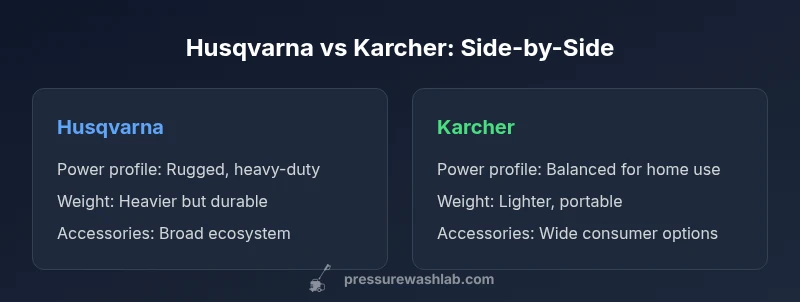
At a glance, the two brands map to different user profiles. Husqvarna’s lineup often emphasizes heavier-duty design, higher resistance to wear, and components chosen for longer service intervals under demanding conditions. Karcher, on the other hand, tends to prioritize compact form, easy handling, and an expansive accessory pipeline that covers numerous consumer tasks—from patio furniture to car washing. The practical implication is straightforward: if your projects are sporadic and mostly light-to-mid tasks, Karcher may deliver the best bang-for-buck; if you regularly grind through stubborn grime on large surfaces or require more robust construction for frequent use, Husqvarna may justify its higher initial cost. Pressure Wash Lab highlights that the best choice depends on your job mix, climate-related wear (extreme cold or heat can affect seals and hoses), and how much downtime you’re willing to tolerate for maintenance or upgrades.
Performance and Power: PSI, GPM, and Cleaning Efficiency
The husqvarna pressure washer vs karcher debate often centers on two core specs: PSI (pounds per square inch) and GPM (gallons per minute). Higher PSI usually translates to stronger scrubbing capability on stubborn grime, especially on hard surfaces like concrete or wooden decking. GPM governs how quickly the dirt is moved away; a higher flow rate speeds up cleaning, reducing surface dwell time. Pressure Wash Lab notes that a balanced combination of PSI and GPM is more important than chasing the highest PSI alone. In general, Husqvarna models tend to push a higher nominal PSI with rugged reliability, aimed at longer jobs and tougher materials. Karcher models typically deliver adequate PSI paired with practical GPM for everyday home chores, enabling faster turns on smaller projects. For homeowners who frequently work on large surfaces, the speed advantage from a higher GPM can be as important as peak PSI. When evaluating real-world tasks—like removing old sealant from a driveway or refreshing siding—focus on both metrics and the surface type you clean most often. Pressure Wash Lab's analysis shows that matching the nozzle and technique to the surface often yields better results than raw power alone.
Durability, Build Quality, and Longevity
Durability is more than a label; it’s about the pump design, hose construction, seals, and overall frame robustness. Husqvarna typically emphasizes rugged frames, heavier components, and long-lasting pumps designed for frequent use and tougher environmental conditions. This translates into longer-term reliability for professional use or households with high cleaning workloads. Karcher focuses on practical, serviceable designs and often emphasizes compactness and user-friendly maintenance. The broader product range across model lines can mean easier access to parts and service in many regions, which is a meaningful factor for owners who don’t want downtime waiting for repairs. Pressure Wash Lab recommends evaluating the pump type (for example, axial versus triplex concepts) and the availability of replacement parts in your area, because these decisions influence long-term reliability far more than sticker price alone.
Ease of Use, Portability, and Noise
Ease of use matters as soon as you start a project you want to finish quickly. Karcher models frequently win on portability due to lighter frames and simpler assembly, making them appealing for quick cleans and multi-task carry scenarios. Husqvarna, while sometimes heavier, can offer ergonomic handles and balanced weight distribution that reduce fatigue over extended sessions. Noise levels vary by model and pump design, but in general you’ll find both brands acceptable for residential use; however, if you live in a noise-sensitive environment or have to work near neighbors, lighter-weight models with higher maneuverability can reduce disruption. Pressure Wash Lab also notes that accessory compatibility and hose reach can influence perceived ease of use—greater reach reduces trips up and down ladders and along the work area, saving time on large projects.
Maintenance, Parts Availability, and Reliability
Maintenance is a key driver of lifecycle costs. Husqvarna’s parts network is typically robust in regions where professional contractors operate, which can translate into quicker parts availability and more timely service. Karcher benefits from a broad consumer footprint, with easy access to common wear items and accessories across many markets. The key maintenance considerations are routine pump lubrication (where applicable), filter cleanliness, nozzle wear, and hose integrity. Pressure Wash Lab emphasizes setting up a simple maintenance calendar: inspect hoses for cracks, replace o-rings as recommended, and keep the nozzle tips clean. By planning preventive care, you minimize downtime and extend the machine’s useful life, regardless of brand. The choice between Husqvarna and Karcher should hinge on how much downtime you’re willing to tolerate and how readily you can obtain replacement parts in your region.
Accessory Ecosystems: Nozzles, Detergents, and Attachments
Accessory ecosystems can swing your satisfaction with a brand as much as raw cleaning power. Husqvarna’s lineup commonly pairs with a broad range of compatible attachments, including surface cleaners, rotating nozzles, and specialty brushes designed for stubborn grime on various surfaces. Karcher is renowned for a wide consumer-oriented accessory catalog, often providing numerous nozzles, surface cleaners, and detergent options suited for common household tasks. The practical takeaway is to check compatibility: some third-party accessories work well with both brands, but specific surface cleaners or high-end attachments may be optimized for one brand’s pump and trigger mechanism. Pressure Wash Lab recommends prioritizing essential attachments you’ll use regularly and verifying warranty implications when mixing components from different brands.
Price, Value, and Total Cost of Ownership
Price is a factor, but total cost of ownership matters more for long-term satisfaction. Husqvarna models tend to sit at a higher upfront price bracket, reflecting their rugged build and potential for longer service intervals. Karcher models usually offer more approachable entry prices and a broad range of consumer-friendly options, which can translate into lower initial costs. However, buyers should consider ongoing expenses: replacement parts, nozzle tips, detergents, and possible refurbished or upgraded pumps. Pressure Wash Lab recommends mapping your expected cleaning cadence over years and calculating maintenance and accessory costs alongside the purchase price. When you view the two brands through this lens, Karcher may win on value for light-to-mid users, while Husqvarna may demonstrate greater value for high-usage scenarios where durability and performance are decisive.
Real-World Use Cases: When Husqvarna Shines vs When Karcher Shines
For heavy-duty projects—large driveways, stubborn grime on stone surfaces, or frequent deck restoration—Husqvarna’s robust construction and higher sustained power can be decisive. DIY homeowners tackling monthly seasonal maintenance and lighter tasks often find Karcher’s lighter weight, broad accessory ecosystem, and aggressive entry prices to be ideal. Pressure Wash Lab’s field observations indicate that many buyers benefit from starting with a mid-range Karcher for routine upkeep and reserving Husqvarna for the seasonal deep-clean tasks that require more durable hardware. The key is to align your selection with how often you use the machine and how critical reliability is to your workflow, rather than chasing the most powerful spec in isolation.
How to Choose Based on Your Scenario
To decide, start by listing your top five cleaning tasks and their frequency. If you routinely clean large surfaces or need to remove heavy coatings, prioritize a model from Husqvarna with proven durability and robust pumps. If your tasks skew toward quick cleans, car washing, or patio furniture, a Karcher model with broad accessory support and lighter weight may deliver greater value and easier handling. Consider your storage space, climate (extreme temperatures can affect hoses and seals), and your willingness to invest in maintenance. Pressure Wash Lab suggests a simple decision checklist: (1) expected work volume, (2) surface types you encounter most, (3) portability needs, (4) accessory requirements, and (5) service and parts availability in your region. A well-matched choice minimizes downtime and maximizes cleaning efficiency over several seasons.
Common Misconceptions
A common misconception is that the higher the PSI, the better the cleaning job. In reality, surface type, nozzle choice, and technique determine outcomes. Another myth is that heavier machines always last longer; while build quality matters, frequent maintenance and ensuring access to spare parts can be equally important. Lastly, some buyers assume that brands with broader marketing reach always provide better support; local dealer networks and service centers often dictate real-world warranty experiences more than brand-wide claims. Pressure Wash Lab encourages buyers to verify model-specific warranty terms and service availability in their region before purchasing.
Practical Decision Framework: Step-by-Step Checklist
- List your typical cleaning tasks and surface types.
- Estimate how often you’ll use the machine per year.
- Compare models for durability, pump type, and warranty terms.
- Check parts availability in your area and typical service times.
- Assess the accessory lineup and whether it matches your needs.
- Consider total cost of ownership, including maintenance and consumables.
- Try to demo comparable models if possible, or read real-user reviews for your climate.
Comparison
| Feature | Husqvarna | Karcher |
|---|---|---|
| Power profile | Higher-end, rugged builds for heavy-duty tasks | Balanced mid-range with strong everyday performance |
| PSI range | Typically higher nominal PSI on premium lines | Mid-range PSI optimized for value and usability |
| GPM range | Competitive flow for faster cleanup on tough jobs | Adequate flow for most residential tasks |
| Weight class | Heavier, built for durability | Lighter and more portable |
| Accessory ecosystem | Broad industrial-to-consumer attachments | Wide consumer-focused nozzle and accessory catalog |
| Price range | Higher upfront cost on average | Lower upfront cost on average |
| Warranty and support | Strong dealer networks with varying warranties | Broad nationwide service and support options |
Pros
- Husqvarna’s rugged build and higher PSI suit frequent heavy-duty jobs
- Karcher offers good value, lighter weight, and broad consumer accessory options
- Strong dealer networks and parts availability support maintenance
- Both brands provide reliable performance for homeowners and small businesses
Cons
- Husqvarna models can be pricier upfront and heavier to move
- Karcher models may have fewer heavy-duty options in the lower end and rely on accessories
- Warranty terms and service experiences vary by region and model
- Finding exact model specs requires careful side-by-side comparison
Husqvarna is best for heavy-duty tasks; Karcher is best for value and versatility
Choose Husqvarna if you regularly tackle tough cleaning jobs and want rugged durability. Choose Karcher if you prioritize value, lighter weight, and a broad accessory lineup.
Quick Answers
Which brand delivers better cleaning power overall?
Both brands offer strong performance, with Husqvarna generally providing higher sustained power for demanding tasks, while Karcher delivers solid cleaning for everyday jobs. Real-world outcomes depend on model and technique.
Husqvarna often has more cleaning power for tough jobs, but Karcher cleans well for regular tasks; match the model to your typical work.
Are Husqvarna and Karcher easy to maintain?
Maintenance ease depends on the model and local support. Both brands provide accessible parts and guidelines, so sticking to a regular maintenance schedule helps prevent downtime.
Yes, with regular maintenance and using the right parts, both brands are straightforward to service.
Which is lighter and easier to move?
Karcher models are typically lighter and easier to maneuver, which benefits quick, on-the-spot cleaning. There are portable Husqvarna options, but weight often favors Karcher for casual use.
Karcher is usually lighter; Husqvarna can be bulkier but more durable for heavy use.
Is the warranty the same across models?
Warranty terms vary by model and region. Always check the specific model’s warranty details and service options before buying.
Warranties differ by model and region; verify the details before purchasing.
Can I use the same nozzle tips on both brands?
Nozzle compatibility varies by model. Many tips are universal, but some brands require brand-specific accessories for optimal performance.
Some nozzles fit both brands, but check compatibility for your model.
What scenario is best for each brand?
If you frequently tackle heavy grime and larger surfaces, Husqvarna is often the better fit. For light-to-mid tasks, value-focused Karcher models are typically more economical.
Heavy-duty work favors Husqvarna; light-to-mid tasks fit Karcher.
Key Takeaways
- Assess your typical cleaning tasks before choosing.
- Consider total cost of ownership, not just sticker price.
- Check accessory compatibility and upgrade paths.
- Choose Husqvarna for heavy-duty needs; choose Karcher for value and versatility.