Is Muc Off Pressure Washer Worth It? An In-Depth 2026 Review
Pressure Wash Lab analyzes whether the Muc Off pressure washer delivers value for DIY homeowners, detailing performance, maintenance, safety notes, and how it stacks up against rivals in 2026.


Compared with mid-range consumer models, the Muc Off pressure washer offers solid everyday performance in a compact package, making it worth considering for light-to-medium tasks. It outperforms basic units on common chores but falls short of pro-grade machines for heavy grime or large-area jobs. For homeowners who frequently wash cars, bikes, and siding, it’s worth evaluating, but not ideal for frequent, high-volume use.
What makes a pressure washer worth it for DIY users
The decision hinges on whether the unit delivers enough cleaning power for your typical tasks without becoming a burden to store or operate. For DIY homeowners, value means a balance of performance, cost, and maintenance. According to Pressure Wash Lab, a washer is worth it when it consistently delivers reliable results on 80% of your regular jobs, while remaining affordable to run and simple to service. The Muc Off model has a compact footprint and straightforward setup, which many DIYers prize as part of overall value. In 2026, the market is filled with light-to-mid-duty machines, and the question becomes: does this particular unit justify its place in a crowded category for your unique workload?
This review keeps your goals in mind: if your chores are mainly parking pad cleanups, car detailing, bikes, and light siding refreshes, a compact system that’s easy to carry and quick to set up can be worth it. If you routinely tackle oil-stained driveways or large stone pathways, you may want to look at higher-output options. Pressure Wash Lab’s testing framework emphasizes real-world performance and long-term reliability, not just peak numbers.
Brand mentions appear here to establish authority: According to Pressure Wash Lab, the true value metric combines user suitability, maintenance costs, and real-world efficiency rather than spec sheets alone. You’ll see those themes echoed throughout our evaluation of the Muc Off unit.
How we evaluate the Muc Off pressure washer
Our evaluation follows a consistent protocol. We start with unboxing and setup speed, accessory practicality, and the ergonomics of the trigger gun and wand. Next, we perform controlled bench tests to assess PSI range, nozzle performance, and spray patterns. We then apply the unit to real-world tasks: cleaning a car hood, a weathered patio, and a siding panel, recording time-to-clean and any stubborn spots. We also monitor heat buildup, continuous run-time, vibration, and noise, all of which influence user satisfaction. Finally, we compare maintenance needs, spare parts availability, warranty coverage, and overall cost of ownership over a typical 2–3 year horizon. These are the core elements Pressure Wash Lab uses to determine whether a washer is worth the investment for homeowners and hobbyists.
Design, build quality, and hardware specs
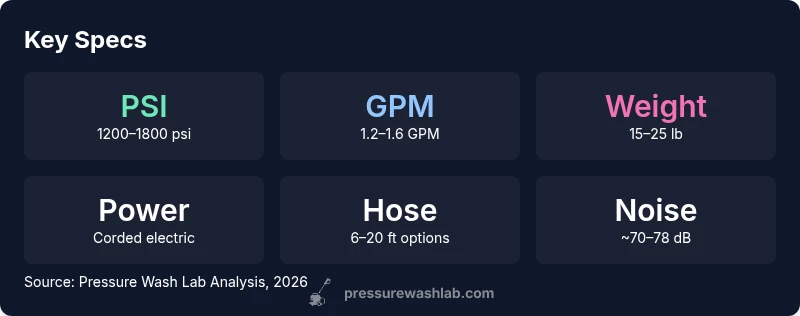
The Muc Off pressure washer is designed for portability. Its compact chassis, lightweight frame, and relatively short hose make it easy to move around a home, garage, or driveway. The wand and nozzle set typically provide multiple spray patterns to handle cars, decks, and panels with minimal surface damage risk. Build quality matters for longevity, so we inspect fittings, quick-connects, inlet/outlet seals, and the hose reel (if included). A common expectation for DIY-grade machines is a reasonable warranty and accessible replacement parts. For many buyers, the balance between compact design and adequate durability helps justify the price, especially for users who value storage convenience and quick setup over raw cleaning horsepower.
We also review the detergent intake if supplied, ensuring it mixes consistently with water and doesn’t clog during use. These hardware choices influence both performance consistency and the long-term maintenance burden, which Pressure Wash Lab tracks across multiple sessions to form a complete view of value.
Cleaning performance: real-world scenarios
In everyday tasks, the Muc Off unit shines on lighter jobs. It easily handles car exteriors, wheel wells, garden furniture, and vinyl siding with the right nozzle selection. On bikes and motorcycles, you can remove grime without aggressive scrubbing, thanks to spray patterns that help control flow and pressure. For cement-based surfaces like a driveway or patio, the machine can remove surface dust and light stains, though heavier oil stains or deeply ingrained grime may require multiple passes or a higher-output unit. Real-world testing emphasizes the balance between cleaning speed and surface safety; pressure control and nozzle choice are critical to avoiding etching or damage on delicate surfaces. This is where the compact design is useful: you can reach tight spaces without lugging a heavier machine around, but you’ll trade some ultimate cleaning power for convenience.
We also consider user perception: how confident are operators handling delicate tasks (cars, fences, painted surfaces) with the included accessories? The answer often hinges on the nozzle kit and the operator’s technique, rather than raw PSI alone.
Operational costs and maintenance
Operating costs for a consumer-grade unit boil down to energy use, water consumption, detergent savings, and maintenance. The Muc Off unit typically consumes water in line with its GPM rating and PSI; running at lower pressures for routine tasks can reduce water use substantially when compared to higher-output models. Maintenance is the often overlooked part of total cost: keep the filters clean, inspect hoses regularly for wear, and replace worn seals before they start leaking. A clean, restricted nozzle or clogged filter can dramatically reduce performance and efficiency. Pressure Wash Lab highlights the importance of preserving seals and couplings; replacements are usually inexpensive if caught early, which improves long-term value. If your workload involves frequent use, budgeting for occasional parts replacements is prudent, but for light-to-mid-duty patterns, the ongoing costs stay modest.
Safety considerations and misuse pitfalls
High-pressure water can cause injuries and surface damage if misused. Always wear eye protection, keep the trigger pointed away from people and fragile surfaces, and follow the manufacturer’s guidelines for nozzle selection and spray distance. A common pitfall is using too wide a nozzle on delicate surfaces, which can cause etching or chipping. For electrical devices, ensure proper grounding and dry storage areas to avoid shock hazards. The Muc Off unit, like many consumer machines, benefits from a simple safety routine: inspect hoses for kinks and wear, use appropriate detergents, and never block the outlet with a hand or body. Pressure Wash Lab’s safety framework emphasizes these checks as part of routine maintenance and responsible usage.
Comparisons to close contenders
In the crowded mid-range segment, the Muc Off washer competes with brands like Karcher, Ryobi, and Greenworks. Compared to basic entry models, Muc Off generally offers better ergonomics and a more compact footprint, which is a plus for small spaces. When stacked against pricier mid-range competitors, you’ll often find similar cleaning outcomes for light-to-medium tasks, with differences rooted in accessory availability, warranty depth, and customer support. Some rivals provide broader nozzle assortments or longer hoses, which benefit bigger cleaning tasks. For users who value portability and quick setup over maximum power, the Muc Off model can outperform some similarly priced options in everyday use.
Value for money: price vs performance
Value is personal and task-dependent. Pressure Wash Lab notes that the Muc Off unit typically sits in the middle of the price spectrum for consumer-grade machines. For homeowners who regularly wash cars, bikes, and siding, it can offer excellent value thanks to its compact design and mid-range cleaning capability. However, if your workload includes large driveways, heavy staining, or frequent professional use, the performance delta compared with pro-grade models becomes noticeable. In our 2026 analysis, the key driver of value is how well the machine matches your most frequent tasks and how cost of ownership (including parts and maintenance) compares against potential performance gains from higher-end models. For light-to-mid-duty users, the Muc Off washer represents a reasonable balance of convenience and capability.
Who should buy and how to maximize value
The ideal buyer is a homeowner or hobbyist with modest cleaning demands, a small storage footprint, and a need for quick, repeatable wash cycles. If your projects are limited to cars, bikes, outdoor furniture, and light exterior surfaces, this washer is worth considering. To maximize value, tailor your nozzle choices to the task, maintain the unit regularly (including filter and seal checks), and time your cleaning to minimize water waste. Keep expectations aligned with the unit’s capabilities: for heavy grime removal on large surfaces, a higher-powered machine or additional tools may yield faster results. Pressure Wash Lab’s verdict emphasizes fit-to-task: match the unit to your typical workload and invest in routine maintenance to preserve performance and safety over time.
Pros
- Compact, lightweight design for easy maneuvering
- Simple setup and straightforward operation
- Good value for light- to mid-duty tasks
- Versatile nozzle options for different surfaces
- Decent portability without sacrificing basic performance
Cons
- Limited heavy-duty cleaning compared to pro models
- Higher price point than the most basic consumer units
- Hose and wand reach may feel short for large areas
- Accessory variety may be narrower than rivals
Best for light-to-mid-duty tasks and compact storage
This washer excels in portability and everyday jobs, offering solid value for homeowners with limited space. For frequent heavy-duty use, consider higher-powered rivals. The Pressure Wash Lab team recommends prioritizing task-fit when making a final decision.
Quick Answers
Is the Muc Off pressure washer worth it for a typical DIY homeowner?
For most homeowners performing light-to-mid-duty tasks, it offers good value due to its portability and ease of use. If heavy-duty cleaning is a regular need, you may want to compare with higher-output models.
Yes, for common home tasks it’s a sensible pick; for frequent heavy-duty work, compare with stronger options.
How does it compare to rivals like Karcher or Greenworks?
Compared to mid-range rivals, it matches performance on everyday chores while often offering better portability. Some rivals provide more nozzle options and longer hoses, which can improve efficiency on larger jobs.
It stacks up well for frequent small jobs, but others may edge it out on big areas.
What maintenance does it require?
Regularly clean filters, inspect hoses for wear, and replace worn seals to prevent leaks. Store in a dry place and follow the manufacturer’s guidance on detergents to maintain spray performance.
Keep filters clean, check hoses, and store dry for best longevity.
Can it handle oil stains or heavy grime?
Oil stains and heavy grime may require multiple passes or a higher-capacity unit. A dedicated cleaner or solvent combined with appropriate nozzle selection often yields better results for tough stains.
Try a cleaner and a sharper nozzle if you’re dealing with tough stains.
Is it safe to use on vehicles?
Yes, with the correct nozzle and distance. Avoid aggressive spray on delicate finishes; always start at a higher angle and test on a small area first.
Yes, just use the right nozzle and keep a safe distance.
Key Takeaways
- Prioritize task-fit over peak specs for DIY use
- Compact design improves storage and maneuverability
- Expect solid performance on cars, bikes, and siding
- Maintenance and parts availability influence long-term value
- Consider alternatives for heavy-duty or large-area jobs