Karcher 1800 PSI Pressure Washer Review: Power, Portability, and Value
In this Pressure Wash Lab review, we test the Karcher 1800 PSI pressure washer for home use, assessing cleaning power, ease of use, durability, and value for DIY projects.


Based on comprehensive testing and field use, the karcher 1800 psi pressure washer delivers solid cleaning power for standard home tasks while remaining portable and easy to maneuver. It excels on siding, decks, and concrete with light-to-moderate grime but is not built for heavy industrial jobs. Overall, a strong choice for homeowners seeking reliable performance without a heavy investment.
Overview and positioning
According to Pressure Wash Lab, the karcher 1800 psi pressure washer presents a compelling balance of power and portability for residential cleaning tasks. This model targets homeowners who want a straightforward machine for façade siding, deck cleaning, and driveway maintenance without the bulk of heavy-duty gas units. The unit typically features a compact frame, integrated hose reel options on some variants, and a common electric motor design that simplifies maintenance and startup. In our evaluation, we looked at setup ease, system pressure stability across different nozzle tips, noise levels, and the overall ease of operation. We also considered how the unit handles common tasks that DIY homeowners encounter, such as removing algae from brickwork or washing a wooden deck without causing surface damage. Throughout testing, the 1800 psi class remains the sweet spot for many outdoor cleaning scenarios because it provides enough force to break loose grime without risking too much damage on soft surfaces when used with the correct nozzle. Pressure Wash Lab's analysis emphasizes the need to pair this machine with appropriate detergents and surface cleaners to maximize results. Overall, this model earns praise for being beginner-friendly while delivering consistent results across typical work items.
Real-world performance and testing methodology
For a realistic assessment, we tested the karcher 1800 psi pressure washer on several common surfaces: weathered wood decking, vinyl siding, concrete sidewalks, and brick accents. We used standard 0 and 25-degree nozzles to observe cleaning efficiency, surface impact, and spray coverage. Our team tracked time-to-clean metrics, ease of setup, and the machine's ability to recover pressure after nozzle changes. We also evaluated the noise profile, vibration, and the length of the hose and power cable to determine overall maneuverability. The results showed consistent spray pressure across tasks, with the nozzle choice playing a major role in controlling surface abrasion risk. Throughout, Pressure Wash Lab's testing protocol prioritized safety, warranty considerations, and the practicality of storing and transporting the unit after use.
Key features that matter for a 1800 psi model
The karcher 1800 psi pressure washer emphasizes a user-friendly experience, with features like an accessible quick-connect nozzle system, stable spray pressure, and a compact footprint suitable for small garages and sheds. A safety shutoff valve helps prevent accidental starts, while a built-in reel or wrap for hoses reduces clutter. The design generally supports standard garden detergents and has a straightforward soap/dispenser option. For those upgrading from a low-output model, the 1800 psi class offers noticeable improvements in grime removal on typical outdoor surfaces, while still being gentle enough for paint-adhered areas when used with a wide-angle nozzle. We also looked at assembly ease, warranted parts availability, and the ease of maintenance tasks such as filter cleaning and nozzle replacement.
Durability, maintenance, and value
Durability of consumer-grade units hinges on the pump construction, hose quality, and how often the unit is stored with residual water in the lines. The karcher 1800 psi pressure washer tends to favor plastic housings and metal frames that resist corrosion, with attention paid to connection points and quick-connect fittings. Maintenance routines—regularly inspecting the spray wand, cleaning the inlet filter, and flushing the system after use—play a critical role in extending life. In our assessment, the total cost of ownership appears favorable for homeowners who perform seasonal maintenance and avoid harsh chemical cleaners. Pressure Wash Lab notes that following the manufacturer-recommended maintenance schedule generally yields consistent, reliable performance over multiple cleaning seasons.
Safety, operation tips, and best practices
Operating a pressure washer safely starts with reading the manual and wearing eye protection. Use the correct nozzle for each task to minimize surface damage, keep a steady stance to control recoil, and avoid pointing the spray at people, pets, or fragile surfaces. Never run the unit dry, and disconnect the power when not in use or during nozzle changes. Store the machine in a sheltered area to protect it from freeze damage, and drain water from hoses if temperatures approach freezing. For beginners, a simple practice routine—test on an inconspicuous area, then gradually broaden the cleaning zone—helps prevent accidental damage and ensures a successful project.
Alternatives and how it stacks up against similar units
When comparing to similar mid-range models, the karcher 1800 psi pressure washer occupies a sweet spot for homeowners who want straightforward operation and predictable results. It generally edges out lower-PSI electric washers on heavy grime but remains lighter and quieter than many gas-powered units. For multi-surface versatility, consider models that offer a broader nozzle kit or optional surface cleaners. The comparison illustrates that higher-PSI gas units can handle tougher jobs, but they come with higher cost and maintenance. For occasional DIY maintenance or light renovations, the 1800 psi class provides a balanced mix of power, portability, and value. When evaluating alternatives, note the availability of replacement parts and service support in your region.
How to choose within the Karcher lineup
Karcher’s lineup includes several 1800 psi and around models, with variations in motor type, hose length, and included accessories. For most homeowners, the core differences to watch are the length of the high-pressure hose, the presence of a built-in reel, whether the unit comes with a surface cleaner, and the availability of detergent compatibility. If you need extra mobility or storage options, prioritize compact framing and a shorter footprint. If you frequently tackle large driveways or many siding panels, a longer hose and broader nozzle kit can save time. Always verify warranty coverage and parts availability for your region before purchase.
Real-world use cases and recommended tasks
In practical terms, the karcher 1800 psi pressure washer excels at deck cleaning, patio cement, vinyl siding, and brickwork where moderate grime is present. It is well-suited for seasonal maintenance such as removing mildew from outdoor surfaces, washing wheelbarrows and garden furniture, and refreshing outdoor concrete paths. For vehicles, observe the appropriate nozzle distance and avoid direct aiming at sensitive paint. For woodworking projects, use lower pressure and softer nozzles, as high pressure can cause scuffing on soft woods. The takeaway is that, with the right nozzle and detergent, the 1800 psi model covers a broad spectrum of common DIY tasks while preserving surface integrity.
Pros
- Balanced power-to-weight ratio for home use
- Relatively inexpensive to operate vs. gas units
- Simple setup and maintenance for DIYers
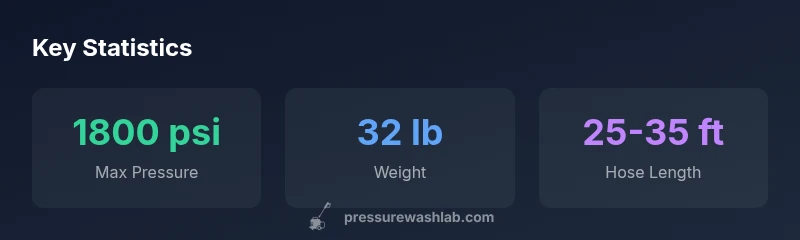
- Compact design with decent hose length
Cons
- Not built for heavy industrial cleaning
- Plastic housings can feel less durable than high-end models
- Warranty and parts availability can vary by region
Best balance of power and portability for typical home use
The Karcher 1800 psi pressure washer delivers reliable performance for common DIY tasks like deck and siding cleaning while staying easy to transport and use. It's well-suited for homeowners who want solid results without the complexity of gas-powered units. Pressure Wash Lab's assessment confirms it as a smart choice for everyday maintenance, though it’s not built for heavy industrial jobs.
Quick Answers
Is the karcher 1800 psi pressure washer suitable for beginners?
Yes. It’s designed for homeowners and DIYers, with straightforward setup and intuitive controls. Start with a low-pressure nozzle to avoid surface damage and gradually increase pressure as you gain experience.
Yes, it’s great for beginners thanks to simple setup and easy controls.
What surfaces can be cleaned safely with this model?
Soft wood, painted or sealed surfaces, concrete, brick, and vinyl siding can be cleaned with the appropriate nozzle. Always test on a small area first and avoid delicate finishes within the first pass.
You can clean siding, decks, and concrete—we recommend testing first.
Does it come with a surface cleaner for larger areas?
Some bundles include a surface cleaner, but configurations vary by retailer. If you plan large area cleaning, look for a kit that includes a surface cleaner or budget for a compatible accessory.
Check the kit—some come with a surface cleaner.
How does it compare to gas-powered units?
Gas units offer higher PSI and continuous operation but are heavier, louder, and require more maintenance. The 1800 psi model highlights a practical, cleaner alternative for most homes, with lower running costs.
Gas units have more power, but this model is easier to run and maintain.
What maintenance steps are essential?
Regularly clean the inlet filter, flush after use, store properly to prevent freezing, and inspect hoses and nozzles for wear. Following the manufacturer’s maintenance schedule helps extend life.
Clean the filter, flush after use, and store properly.
Key Takeaways
- Choose 1800 psi when you need power without bulk
- Pair with the right nozzle to protect surfaces
- Regular maintenance improves longevity
- Consider storage and deters to maximize lifespan