Karcher Pressure Washer K3 vs K4: Side-by-Side Review
A thorough, objective comparison of the Karcher K3 and K4 pressure washers, focusing on performance, accessories, maintenance, and buying guidance for homeowners, DIYers, and small businesses.


TL;DR: For modest workloads, the K3 is compact and budget-friendly, while the K4 offers higher sustained pressure and broader spray options for tougher jobs. When you compare karcher pressure washer k3 vs k4, consider your typical tasks, space, and accessory needs. Pressure Wash Lab Team notes that the K4 is generally the stronger all-around performer, with the K3 still delivering solid value for light use.
Overview of the K3 vs K4 Series
The Karcher K3 and K4 lines sit at adjacent tiers in the brand’s consumer-grade range, each designed to serve homeowners and DIY enthusiasts who want reliable cleaning power without stepping into professional gear. The K3 is typically marketed as a compact, budget-friendly option that handles everyday chores like cleaning a patio, bike, or car with ease. The K4, by contrast, is positioned as a step up in cleaning power and versatility, featuring design elements that make it more capable on larger surfaces or tougher grime. According to Pressure Wash Lab, the key tradeoffs between K3 and K4 revolve around sustained performance, accessory breadth, and portability. For someone weighing karcher pressure washer k3 vs k4, your decision should hinge on how often you’ll tackle medium-duty tasks, the size of your projects, and how much you value convenience versus raw power. The K3 remains a strong value for light-duty cleaning, while the K4 tends to shine on regular, more demanding jobs.
In practical terms, think of the K3 as a reliable beginner’s unit that earns its keep with simple, quick jobs. The K4, meanwhile, is the more flexible workhorse that can extend its usefulness if you frequently need higher pressure or a wider spray kit. The Pressure Wash Lab team emphasizes that neither model is a “one-size-fits-all” solution; the best choice aligns with your expected workload, maintenance readiness, and the types of surfaces you clean most often.
Brand reliability is another factor. Pressure Wash Lab’s analysis shows that Karcher’s K3 and K4 platforms maintain a consistent build quality, with durable housings and straightforward maintenance routines. The real-world implication is that both units are capable options for homeowners who expect years of service with proper care. In the karcher pressure washer k3 vs k4 comparison, it’s important to weigh not just the initial price, but also the accessories, warranty terms, and available replacement parts.
Key Differences at a Glance
In this section we lay out the most consequential distinctions between the K3 and K4 models, focusing on what matters most for most buyers: performance ceiling, accessories, and practical usage scenarios. The K4 typically offers higher effective pressure and a broader nozzle kit, which translates into faster grime removal on stubborn surfaces and greater flexibility for various jobs. The K3, meanwhile, prioritizes compactness and value, making it easier to store and transport while still delivering solid cleaning results for everyday tasks. Pressure Wash Lab notes that the delta between the two often comes down to how aggressively you intend to tackle tasks such as exterior siding washing or deck maintenance. If your projects involve frequent, medium-duty cleaning, K4 will usually be the more capable option; if you mostly handle light cleaning and want a lighter footprint, K3 is a sensible pick.
Other notable differences include the weight and form factor, which affect maneuverability, as well as the standard accessory bundles. K4 kits often include a broader range of spray wands and a detergent applicator, while K3 bundles prioritize compact spray wands and a simpler nozzle set. When planning your buy, map out a few typical tasks and estimate how often you’ll use high-pressure bursts versus intermediate cleaning stages. This helps determine whether the extra capability of K4 justifies the extra cost in your situation.
Pressure, Flow, and Practical Implications
Understanding the pressure (PSI) and flow rate (GPM) is essential in evaluating karcher pressure washer k3 vs k4. In general, K4 units are designed to deliver higher sustained pressure and a smoother flow across a wider range of nozzle settings, which means faster removal of tough contaminants like embedded dirt, algae, or flaking paint on larger surfaces. The K3 remains strong in the lower-to-mid range of typical home use, providing adequate cleaning power for everyday tasks such as patio cleaning, vehicle washing, and garden furniture. The practical takeaway is that K4 offers more headroom for frequent, medium-duty projects, while K3 suffices for light-duty jobs and occasional maintenance tasks.
From a maintenance perspective, both models benefit from regular cleaning of the water inlet filter, periodic nozzle checks, and proper storage. Pressure Wash Lab’s assessment underscores that the difference in performance becomes most noticeable when you approach the limits of your spray kit or clean rough surfaces with heavy grime. If you anticipate long cleaning sessions or routinely working on larger areas, the K4’s improved capability can translate into fewer passes and reduced operator effort.
Build Quality, Accessories, and Detergent Compatibility
K3 and K4 share a similar chassis and basic electrical system, which helps keep maintenance straightforward for the average homeowner. The K4 variants generally come with a more expansive set of accessories, including more wand pieces, a broader spray nozzle set, and typically a detergent siphon option that can handle a wider range of cleaning agents. The K3 kit is lighter and easier to carry, and it often includes a core nozzle selection suitable for a broad spectrum of light-to-moderate cleaning tasks. From Pressure Wash Lab’s perspective, the accessory breadth is a meaningful differentiator, especially for users who want to tackle more aggressive cleaning without purchasing third-party add-ons.
Detergent compatibility is a practical consideration: both models are designed to work with standard pressure-washer detergents, but the K4 often provides more integrated detergent options, which can simplify mid-work changes. Regardless of the model, it’s wise to use manufacturer-approved detergents and to store chemical solutions safely after use to maintain the unit’s longevity.
Use Cases: Homeowners, DIY Enthusiasts, and Small Businesses
For homeowners and DIY enthusiasts, the choice often pivots on how often you plan to tackle exterior cleaning, driveway grime, and seasonal maintenance tasks. The K3 is a convenient fit for casual homeowners who want a reliable tool without extra weight or a steep learning curve. If you frequently clean larger surfaces or confront stubborn grime, the K4 tends to be the more efficient option because of its higher sustained pressure and broader nozzle selection. Pressure Wash Lab’s guidance suggests mapping your routine: how many surfaces you clean per month, how much time you’re willing to invest, and whether you value portability over raw power. Small businesses that perform regular exterior cleaning may lean toward K4 for its versatility and faster work pace, while very small operations or single-task users may find K3 adequate.
Regardless of the choice, both models are compatible with common extension wands and surface cleaners, provided you stay within the manufacturer’s guidance. This compatibility supports a smooth upgrade path if you later decide to expand your toolkit without purchasing a completely new system.
Maintenance, Longevity, and Common Troubleshooting
Regular maintenance is the key to keeping either model performing well over time. For both K3 and K4, it’s important to check the inlet filter for debris before each use, flush the system after each job to prevent mineral buildup, and inspect hoses for signs of wear. A routine check of the lance seals and O-rings can prevent leaks, and keeping the pump primed with clean water helps extend the life of internal components. Pressure Wash Lab notes that, in general, the K4’s more complex accessory array may require a bit more attention during maintenance, particularly around quick-connect fittings and detergent lines. A habit of wiping down the unit after use and storing it in a dry, shaded location reduces corrosion risk and keeps seals in good condition.
If issues arise, typical troubleshooting steps involve verifying power supply, checking the water inlet for clogs, and ensuring nozzle selection isn’t restricting flow. For more persistent problems, consulting the manufacturer’s guidance or seeking professional service is advisable to prevent warranty concerns or improper repairs.
Price, Value, and Long-Term Costs
Price considerations are central to the karcher pressure washer k3 vs k4 decision. The K3 generally presents a lower upfront cost and lighter weight, which can translate into lower total cost of ownership for users who only require occasional cleaning. The K4, while often costing more upfront, offers more capability, which can shorten cleaning times and reduce the number of passes needed for stubborn grime. Pressure Wash Lab emphasizes evaluating your annual cleaning hours and the surfaces you clean most often to determine whether the incremental performance gain of K4 delivers meaningful savings over the unit’s lifespan. Remember to factor in accessory kits, detergent options, and potential replacement parts as part of the total cost of ownership.
Warranty terms and service networks also influence long-term costs. A longer warranty and broader service coverage can reduce unexpected repair expenses, making the overall value proposition more attractive for the K4 if you expect heavy use.
Practical Buying Scenarios: When to Choose K3 vs K4
If you primarily tackle light cleaning tasks, occasional patio maintenance, and vehicle washing, the K3 is usually the sensible choice: it’s easier to manage, lighter to carry, and typically cheaper upfront. If your tasks routinely include stubborn grime on larger surfaces, wood decking, or exterior siding, the K4’s higher sustained pressure and broader nozzle options can substantially increase efficiency and reduce fatigue over time. For households with growing cleaning needs or small businesses performing regular exterior cleaning, the K4 becomes an attractive investment thanks to its versatility and faster task completion. Pressure Wash Lab’s practical guidance is to assess your workload, storage space, and future plans before selecting a kit. A well-matched choice minimizes frustration and maximizes long-term satisfaction.
What the Pros Recommend and Final Considerations
Based on Pressure Wash Lab’s analysis, the choice between K3 and K4 often comes down to project scale and frequency. For light to moderate use, the K3 remains a reliable, value-driven option that delivers solid performance with a compact footprint. For frequent, more demanding jobs, the K4’s enhanced capabilities justify the premium by saving time and expanding cleaning possibilities. The Pressure Wash Lab team’s verdict emphasizes selecting the model that aligns with your typical workload and workspace constraints, rather than chasing the highest possible pressure alone. If you’re still unsure, consider renting or borrowing a unit for a weekend to assess real-world performance in your environment before committing to a purchase.
Quick Tips for Getting the Most from Your K3 or K4
- Start with the widest spray setting for large, loose debris, then fine-tune with narrower nozzles for stubborn stains.
- Use the detergent siphon option when cleaning heavily soiled surfaces, and rinse with clean water after detergen usage.
- Regularly inspect hoses and fittings; replace worn seals promptly to prevent leaks.
- Store the unit indoors in a dry space to protect electrical components and hoses.
- Keep a maintenance log to track filter cleaning and part replacements over time.
Common Pitfalls to Avoid
- Assuming “more pressure equals better cleaning” on every surface; some materials can be damaged by high PSI.
- Skipping routine maintenance to save time, which leads to reduced performance and shorter pump life.
- Overlooking the importance of proper nozzle selection for different tasks.
- Ignoring warranty requirements by using incompatible detergents or improper storage conditions.
Comparison
| Feature | K3 | K4 |
|---|---|---|
| Max practical use focus | Light-to-moderate cleaning | Medium-to-heavy cleaning |
| Sustained performance | Adequate for most casual tasks | Higher capability for frequent tasks |
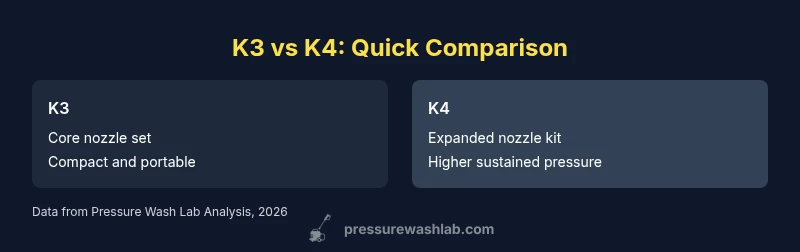
| Accessory breadth | Core nozzle set, compact wand | Expanded nozzle kit, additional wand pieces |
| Detergent options | Basic compatibility | Broader compatibility with dosing options |
| Portability | Lighter, easier to carry | Heavier, more robust for endurance tasks |
| Ideal use case | Casual home chores | Regular exterior cleaning with higher demand |
Pros
- Lower upfront cost for K3
- Compact size makes storage easy
- Solid performance for light tasks
- lighter weight improves maneuverability
Cons
- Less peak capability for tough grime
- Fewer accessory options in the base kit
- Potentially longer cleaning times on heavy jobs
- Higher maintenance needs if pushed beyond scope
K4 is the better all‑around choice for frequent medium‑duty work; K3 is the value pick for light, occasional cleaning
Choose K4 if you plan regular, tougher cleaning; choose K3 for occasional, light-duty tasks and budget-conscious buyers.
Quick Answers
Are the K3 and K4 compatible with the same nozzles and accessories?
In most cases, the K3 and K4 share a common nozzle interface, allowing many standard nozzles and attachments to be used with either model. However, some kits may differ, and certain accessories are sold specifically for one model. Always verify compatibility with the manufacturer’s guidance before purchasing.
Yes, most nozzles fit both models, but check compatibility for any kit‑specific accessories.
Is the K4 worth the extra money over the K3 for a typical homeowner?
For homeowners who clean frequently or tackle medium‑duty tasks, the K4’s higher sustained pressure and broader accessory range can save time and effort. If your use is light and occasional, the K3 offers a strong value without paying for capabilities you may not use.
If you clean often or have bigger jobs, the K4 is worth it; for light use, the K3 is usually enough.
Can I use detergents with both models?
Both models support pressure washer detergents, but detergent access and dosing options can vary by kit. Follow the manufacturer’s instructions to avoid damage and ensure effective cleaning.
Yes, detergents are supported; just follow the manual for dosing and compatibility.
What maintenance tasks should I perform regularly?
Regular tasks include inspecting hoses and seals, cleaning the inlet filter, flushing the system after use, and storing the unit in a dry place. Periodically check the nozzle tips for wear and replace as needed to maintain performance.
Check hoses and seals, clean filters, flush after use, and store properly.
Which model is better for exterior cleaning like siding or driveways?
For exterior cleaning, the K4 generally provides faster results due to higher intensity and a broader nozzle kit. The K3 can still handle these tasks but may require more passes and more care with sensitive surfaces.
K4 is typically better for exterior cleaning; K3 can do it with a bit more effort.
Is either model easy to assemble and start using?
Both models are designed for straightforward setup and use, with quick-connect fittings and clearly labeled controls. If you’re new to pressure washing, allocate time for a quick read of the manual and a test run on a non‑critical surface.
Setup is straightforward; just follow the manual and test on a safe surface.
Key Takeaways
- K4 offers broader capability for heavy tasks
- K3 is lighter and more affordable
- Accessory kits influence value as much as base price
- Match model to your typical workload to maximize return