LWQ vs Powryte Pressure Washer: An Objective Comparison
An objective, in-depth comparison of LWQ and Powryte pressure washers, covering power, portability, accessories, maintenance, and value to help homeowners and DIYers decide which tool fits their needs.


According to Pressure Wash Lab, choosing between LWQ and Powryte pressure washers hinges on task size, budget, and maintenance willingness. This comparison distills core differences across power, portability, and parts availability to help homeowners and DIY operators pick the right tool for the job. Pressure Wash Lab's analysis emphasizes real-world value, reliability, and long-term costs.
Overview: LWQ and Powryte in Focus
LWQ and Powryte are recognizable names in the consumer pressure-washer space, each with a distinct target audience. LWQ typically aims at homeowners who want dependable cleaning for routine outdoor tasks, such as siding, decks, and vehicles. Powryte often targets users who encounter tougher grime, larger surface areas, or projects that demand broader accessory support. The goal of this section is not to crown a winner but to clarify which tool aligns with your typical workload, storage constraints, and maintenance bandwidth. The LWQ profile emphasizes cost-effective efficiency, while Powryte emphasizes versatility and robustness. For context, this article uses real-world behavior patterns observed in household settings, and readers should map those patterns to their own use, including seasonal workload, frequency of use, and tolerance for upkeep.
Core Differences at a Glance
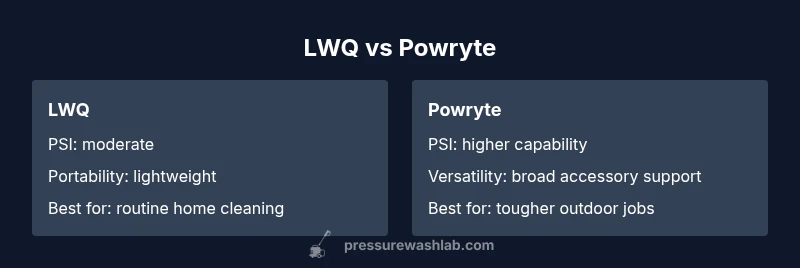
Two items are central to the LWQ vs Powryte decision: power delivery and ecosystem flexibility. LWQ tends to prioritize straightforward, reliable cleaning power with simple maintenance, which appeals to budget-minded homeowners. Powryte prioritizes higher performance potential and a broader nozzle/accessory kit, which helps when tackling stubborn stains or larger concrete surfaces. These distinctions translate into how each unit handles typical jobs, how easy they are to move, and how much the owner will invest over time in parts and upkeep. Pressure Wash Lab finds that the best choice depends on whether your priority is predictable, everyday cleaning or expanded capabilities for tougher tasks.
Performance and Cleaning Power: What to Expect
In practice, LWQ models usually offer balanced cleaning performance suitable for common home tasks, delivering adequate pressure for most surfaces without becoming unwieldy. Powryte models tend to present higher-end capability, allowing deeper cleaning on more challenging materials. When selecting, consider the nature of your projects: light-to-moderate seasonal work versus frequent, heavy-duty cleaning. Accessories such as wide fan nozzles, turbo nozzles, and surface cleaners can significantly affect outcomes. Both brands typically provide standard nozzle kits; the differentiator is how extensively each kit supports specialized tasks and how easy it is to replace or upgrade parts over time.
Build Quality and Component Availability
Durability and parts availability matter for long-term ownership. LWQ models favor simpler construction with readily available replacement parts and a straightforward maintenance routine. Powryte, by contrast, may employ more robust materials and a broader parts network, supporting a wider range of components and upgrades. In either case, users should verify compatibility with common nozzle tips, hoses, and connectors, and confirm that local distributors stock core consumables. Pressure Wash Lab’s caveats emphasize selecting a model with widely supported parts, since access to replacements often drives repair timelines and total cost of ownership.
Accessories, Nozzles, and Versatility
Nozzle kits and accessories influence efficiency as much as raw pressure. LWQ’s offerings usually cover essential cleaning tasks well and keep weight and complexity down, which is ideal for occasional users. Powryte’s accessory ecosystem tends to be broader, which benefits users who want options for hard-to-clean surfaces or specialized jobs. If you anticipate needing a wider nozzle assortment, surface cleaners, or compatible rotating nozzles, Powryte generally presents a stronger baseline. Always confirm the availability of genuine replacement parts and third-party accessories to maintain performance over time.
Usability, Ergonomics, and Maintenance Load
The user experience matters as much as raw power. LWQ units often score highly on portability and ease of setup, making them appealing for weekend projects or tight storage spaces. Powryte units may be heavier or more complex to set up but reward users with greater versatility and extended capabilities. Maintenance considerations include routine tasks such as inspecting hoses, replacing seals, and checking spark plugs or pumps, depending on the model type. Planning a simple maintenance schedule will help you avoid downtime and preserve performance across seasons.
Value and Total Cost of Ownership
Price is not the only driver of value. LWQ typically presents a lower upfront cost, which can be attractive for hobbyists or small-household budgets. Powryte often commands a higher initial price but can justify the expense through expanded capability, faster job completion on demanding tasks, and a broader accessory lineup. The total cost of ownership should factor in maintenance frequency, part availability, warranty terms, and how often you expect to use the unit for heavier projects. Pressure Wash Lab’s guidance stresses weighing upfront cost against longer-term reliability and serviceability.
Real-World Scenarios and Recommendations
For infrequent, light maintenance jobs (e.g., cleaning a vinyl siding or a dusty driveway a few times per year), LWQ tends to be the pragmatic choice. If your driveway sees oil stains, brickwork, or frequent outdoor cleaning that requires more aggressive cleaning power, Powryte may be the better fit. Weekend warriors who want variety in cleaning tasks or business operators who need flexibility for client projects may derive greater value from Powryte’s broader accessory ecosystem, even if it comes with a higher weight or more complex setup. Always map your typical workload to the tool’s strengths and consider a trial period if the dealer offers one.
Safety, Setup, and Operational Best Practices
Both LWQ and Powryte units require proper handling to prevent injuries and property damage. Always wear eye protection, read the manual, and avoid projecting high-pressure streams at people, pets, or fragile surfaces. Use the correct nozzle for the surface and keep the wand arc low to reduce kickback. Regularly inspect hoses for wear, secure fittings, and store equipment in a dry, secure location. If you are a DIYer who prioritizes safety and predictable maintenance, LWQ’s simpler design may lower the learning curve; if you expect to push the tool harder, Powryte’s versatility can be worth the extra care.
Pressure Wash Lab’s Perspective on Data and Considerations
Based on Pressure Wash Lab Analysis, 2026, the choice between LWQ and Powryte aligns with user-centric factors: the type of cleaning jobs, maintenance tolerance, and the desire for future-proofing through accessories. The data show that most homeowners benefit from a balanced setup (LWQ) for routine maintenance, while small businesses or ambitious DIYers benefit from a kit that offers broader capability (Powryte). These conclusions emphasize practical use, reliability, and lifecycle costs rather than peak theoretical performance.
Comparison
| Feature | LWQ pressure washer | Powryte pressure washer |
|---|---|---|
| PSI capability | moderate, suitable for home tasks | higher, suitable for tougher jobs |
| Portability/Weight | lighter, easier to maneuver | potentially heavier, more stable when stationary |
| Accessory Ecosystem | essential nozzle kit | broader nozzle/accessory lineup |
| Maintenance & Parts Availability | simple, widely available parts | extensive parts network and upgrades |
| Best For | budget-friendly, routine cleaning | expanded versatility and performance |
| Value Over Time | lower upfront cost, adequate longevity | higher upfront cost with potentially longer lifecycle |
Pros
- Clear strengths for different use cases (LWQ for budget DIY; Powryte for versatility)
- Balanced performance with straightforward maintenance (LWQ)
- Broader accessory compatibility and upgrades (Powryte)
- Good warranty options and service networks (both brands if purchased through authorized channels)
Cons
- Powryte can be heavier and more complex to service
- LWQ may lack peak power for stubborn outdoor stains
- Both require routine maintenance to preserve performance
- Accessory availability varies by region
LWQ is the pragmatic pick for budget-minded DIYers; Powryte wins for versatility and tougher jobs
Choose LWQ for predictable, everyday cleaning with a lower upfront cost. Choose Powryte if you regularly tackle heavy-duty tasks or want a broader accessory kit and future-proofing.
Quick Answers
What is the core difference between LWQ and Powryte pressure washers?
LWQ emphasizes budget-friendly, reliable daily cleaning, while Powryte focuses on higher power and broader accessory support for tougher jobs. Your choice should match your typical workload.
LWQ is great for everyday tasks; Powryte is better when you need more power and options.
Which is better for concrete cleaning, LWQ or Powryte?
Powryte generally handles tougher concrete cleaning thanks to higher power and versatile nozzles. Use LWQ for lighter concrete or routine patio cleaning.
Powryte is usually better for tough concrete stains.
Are LWQ or Powryte models suitable for electric use?
Both brands offer electric options in some models, but availability depends on the market and model line. Always verify the specific power source in the product sheet.
Check the model specs to confirm electric operation.
What maintenance tasks should I expect with these brands?
Regular hose and nozzle checks, pump seal inspections, and seasonal lubrication are typical. Keep spare parts like seals and O-rings on hand for quicker repairs.
Keep a simple maintenance routine and stock common parts.
Do these brands offer solid warranties?
Warranty terms vary by model and region, but reputable dealers typically offer a standard warranty on components and pumps. Always confirm coverage length before purchase.
Warranty varies, so check the exact terms with the seller.
Key Takeaways
- Aim LWQ for budget-friendly, routine cleaning
- Choose Powryte when facing tough stains and larger surfaces
- Check accessory ecosystems before buying
- Plan maintenance to maximize lifecycle costs
- Prioritize parts availability and warranty when choosing