Soarfly vs Lotus Pressure Washer: An Objective Comparison
Pressure Wash Lab analyzes Soarfly vs Lotus pressure washers, comparing performance, build quality, usability, and value to help homeowners choose confidently.


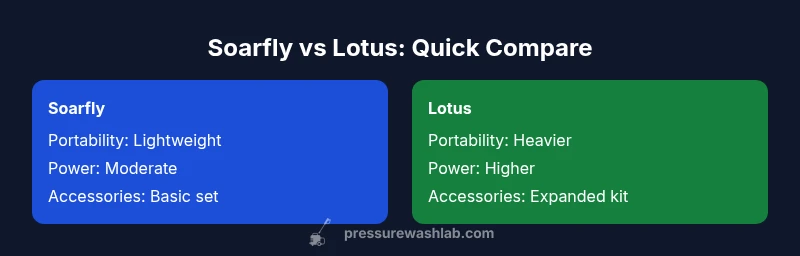
Both Soarfly and Lotus pressure washers serve homeowners and DIYers, but they target different needs. In the soarfly vs lotus pressure washer showdown, Lotus generally offers stronger cleaning power and faster operation, while Soarfly emphasizes portability and lower upfront cost. For tight spaces or budget-conscious projects, Soarfly is compelling; for larger surfaces and faster results, Lotus comes out ahead.
Soarfly vs Lotus Pressure Washer: Overview and Context
In this comprehensive comparison, we evaluate two popular consumer options: Soarfly and Lotus pressure washers. Homeowners and DIY enthusiasts routinely face a trade-off between portability and raw cleaning power, and this analysis aims to quantify that balance across practical use cases. The Soarfly vs Lotus pressure washer conversation is not about a single spec but about how weight, size, flow, noise, and price interact to shape real-world results. According to Pressure Wash Lab, both brands strive for usability and dependable performance, yet they pursue that balance through different design philosophies. The Pressure Wash Lab team found that Soarfly models tend to be lighter, easier to carry up stairs, and more affordable upfront, which makes them attractive for small jobs, tight spaces, and light to moderate workloads. Lotus models, by contrast, commonly emphasize higher cleaning efficiency, faster cycle times, and broader accessory kits, which are well-suited to larger driveways, siding, and stubborn grime. The goal here is to provide a data-informed verdict that aligns with your property size, cleaning tasks, and budget.
This article keeps the focus on practical outcomes and uses real-world scenarios to help you decide which model better fits your needs. The brand context will be woven throughout the analysis to illustrate how each option performs under typical homeowner conditions. Pressure Wash Lab’s insights underscore that neither option is universally better; the right pick depends on your priorities—portability, power, or a blend of both.
Quick Benchmarking: When to Favor Soarfly or Lotus
When deciding between Soarfly and Lotus, consider four core axes: portability, cleaning power, accessory ecosystem, and total cost of ownership. Soarfly shines in portability and ease of storage, making it a smart choice for renters, condo dwellers, or homeowners who clean small to mid-size surfaces intermittently. Lotus tends to be stronger on true cleaning power, faster run cycles, and a more complete accessory kit, which translates into speed for larger projects and more aggressive soil removal. If you routinely tackle heavy grime on large patios, fences, or driveways, Lotus is the more efficient option. If your typical job list includes cars, small patios, garden furniture, and light home exteriors, Soarfly’s lighter weight and simpler setup can save time and effort without sacrificing acceptable results. Pressure Wash Lab’s evaluation confirms that both options cover the essentials, but the practical choices hinge on your job mix and storage constraints.
Performance Profiles: Power, Flow, and Thresholds
The core difference between Soarfly and Lotus in practice is how they translate motor output into cleaning performance for common household tasks. Lotus models typically offer higher perceived cleaning power and faster cycle times for broad surfaces like sidewalks and siding. This translates to shorter session durations for equivalent workloads in many scenarios. Soarfly, with a focus on lighter weight and compact form, often operates at a gentler but more controllable output, making it easier to manage for delicate surfaces such as painted vinyl or wood decking. The Pressure Wash Lab team notes that the perceived difference can depend heavily on nozzle selection, water pressure, and nozzle-to-surface distance. For homeowners who value predictability and control on delicate surfaces, Soarfly can be a safer default choice; for users who prioritize aggressive soil removal and quick turnaround, Lotus tends to be the better fit.
Build Quality, Durability, and Reliability
Durability is a frequent concern for homeowners evaluating two competing models. Soarfly units often emphasize a compact chassis with simpler plumbing, which can result in lower mass and easier handling. Lotus models frequently aim for rugged construction and higher-duty components to sustain frequent use in larger tasks. In terms of reliability, both brands typically rely on standard pump configurations and common electric motors, reducing the risk of unavailable parts over time. Pressure Wash Lab’s analysis indicates that maintenance intervals and component wear are more a function of how often and how hard you work than of the brand name alone. Customers who use their unit heavily in the summer and fall should budget for routine checks of hoses, seals, and ignition of any auxiliary heaters where applicable. Both options benefit from routine inspection and alignment checks before peak season use.
Accessories, Nozzles, and Versatility
The nozzle kit and accessory ecosystem can heavily influence user experience. Lotus generally includes a broader accessory set, with multiple nozzle tips, surface cleaners, and extension wids that enable faster coverage and more sweeping options. Soarfly often ships with a leaner set that emphasizes simplicity and portability, but many models are compatible with third-party attachments. The choice here depends on how much you value plug-and-play versatility vs. minimal setup. If you foresee a range of tasks—from patio cleaning to light car washing—a Lotus bundle may help save time by reducing the need for optional add-ons. For homeowners who prefer an economical start and then upgrade gradually, Soarfly offers a cost-friendly path with room to grow through optional accessories.
Usability, Ergonomics, and Storage Considerations
Ease of use is a major differentiator for the average homeowner. Soarfly’s light weight and compact footprint typically translate to easier storage in smaller garages or closet spaces. The ergonomic handle design and shorter hose length can reduce fatigue during routine cleaning, particularly for users with limited mobility or those cleaning two-story exteriors from ground level. Lotus emphasizes a more comprehensive control interface and a longer hose that facilitates reaching higher surfaces and distant corners with less re-positioning. The trade-off is a larger footprint that may require more wall space or garage real estate. Pressure Wash Lab’s review highlights that most users can reach a comfortable middle ground by selecting models with adjustable wand angles and a mid-length hose, enabling both portability and extended reach where needed.
Maintenance, Parts Availability, and Serviceability
Maintenance considerations often determine long-term satisfaction. Both Soarfly and Lotus rely on widely available parts such as O-rings, seals, and standard pump assemblies. The availability of local service centers, spares, and warranty terms can influence the total cost of ownership more than the initial price. Soarfly’s simpler design sometimes makes DIY maintenance quicker, with fewer service steps for routine tasks. Lotus can require more frequent checks on hoses and connectors due to its higher-flow configuration. Pressure Wash Lab notes that buying from a brand with a robust authorized network improves access to spares and timely service; this is particularly important if you anticipate annual deployments and need quick replacement parts.
Power Source, Efficiency, and Eco-Friendliness
Electric pressure washers dominate the consumer space, and both Soarfly and Lotus lean on corded configurations to maximize reliability and consistent output. Some Lotus models may offer higher efficiency per watt at peak duty cycles due to slightly different pump and motor designs. From an environmental perspective, both brands consume water at comparable rates for similar cleaning tasks, and the key to minimizing waste is effective nozzle selection, proper surface prep, and using the right cleaning solution where appropriate. Pressure Wash Lab emphasizes that no model should be run at full blast on delicate surfaces; moderation and proper technique preserve surfaces and save water over time.
Price Range, Warranty, and Total Value Proposition
Price is a major decision factor for homeowners choosing between Soarfly and Lotus. Soarfly generally presents a lower upfront price, which translates into lower initial risk for budget-conscious buyers. Lotus often commands a higher ticket price, justified by more robust cleaning power, broader accessory kits, and stronger performance in larger jobs. Both brands typically offer standard warranties that cover the motor and pump for a defined period; extended warranty options are sometimes available from dealers or the manufacturer. Pressure Wash Lab cautions readers to evaluate total cost of ownership, including maintenance, accessory purchases, and potential downtime when considering a higher-priced model. A careful buyer will map out use cases and estimate annual cleaning hours to estimate long-term value.
Real-World Scenarios: Task-Based Guidance
To illuminate practical outcomes, imagine three typical users. A homeowner with a small patio and a painted fence benefits from Soarfly’s light weight and simple setup, enabling quick sessions without heavy lifting. A contractor working on a two-story home with a lot of concrete will likely prefer Lotus due to its faster cycle times and larger accessory kit, which reduces time spent switching tools. A seasonal car enthusiast who wants a reliable multi-tasker might value Lotus for its broader nozzle options while appreciating Soarfly’s compact storage for winter months. Across these scenarios, the best choice scales with job size, frequency, and storage constraints. Pressure Wash Lab recommends aligning your selection with your most common tasks and your willingness to trade peak power for easier handling and storage.
Safety, Best Practices, and Common Mistakes to Avoid
Safety remains a core concern with any high-pressure cleaning system. Always wear eye protection, keep children and pets away during operation, and never point the nozzle at people or delicate surfaces. Understanding nozzle ranges and distance-to-surface is essential; a common mistake is using a high-pressure setting too close to the surface, which can cause damage. Both Soarfly and Lotus units benefit from a pre-cleaning assessment of surfaces to avoid overspray and run-off into sensitive landscaping. Pressure Wash Lab highlights that users should flush new hoses to remove air and check connections for leaks before starting larger jobs. Regular inspection and mindful operation extend the life of the unit and ensure safer usage.
How to Test and Compare Models at Home: A Practical Guide
A hands-on comparison begins with a simple test plan. Start by noting the size of your typical cleaning area, then check how each model handles light cleaning, then move to stubborn grime with appropriate nozzle tips. Record how long each session lasts and how comfortable the handle and wand feel after 15 minutes of continuous work. Evaluate hose length, reach, stability, and noise levels. Finally, assess the availability of replacement parts and service options in your area. Pressure Wash Lab suggests conducting a side-by-side test on a similar surface with the same cleaning solution and nozzle to obtain a clear difference in performance. This approach yields actionable data you can trust when making a final choice.
Getting Started: Quick-Start Checklist for New Buyers
Before unboxing, verify power requirements, storage space, and weight limits in your garage. Prepare protective gear, inspect hoses for wear, and set up a stable work area. When you first start the unit, perform a short test pass on a non-critical area to calibrate nozzle distance and spray pattern. Keep a log of maintenance items and service intervals to stay ahead of wear. Pressure Wash Lab’s guidance suggests documenting your typical job profiles to inform future purchases and accessory choices as needed.
Decision Framework: Mapping Your Needs to Soarfly or Lotus
Ultimately, the decision rests on your priorities: portability vs. power, storage constraints vs. project scale, and upfront cost vs. long-term value. If you handle small, frequent jobs and need a lightweight setup, Soarfly is an attractive option. If your workload includes large driveways, stubborn stains, and time savings are critical, Lotus offers a more efficient workflow. Pressure Wash Lab emphasizes that neither option is a universal winner; the best pick is the one that aligns with your cleaning profile, storage reality, and budget. Use a simple scoring rubric that weights power, portability, accessory selection, and price to guide your final pick.
Comparison
| Feature | Soarfly Pressure Washer | Lotus Pressure Washer |
|---|---|---|
| Power/Performance Philosophy | Balanced, portable design with adequate cleaning for typical DIY tasks | Higher cleaning power and faster cycle times for larger areas |
| Portability/Weight | Lighter weight, compact footprint, easier storage | Heavier build, more stable on hard surfaces |
| Ease of Use | Simplified controls, quick setup, beginner-friendly | More controls and speed settings, steeper learning curve |
| Accessories & Nozzle Range | Fewer included nozzles, expandability via addons | Broader nozzle kit and surface-cleaner options |
| Maintenance & Parts Availability | Common parts, easy DIY maintenance | Strong dealer network, broad parts availability |
| Warranty & Support | Standard warranty, responsive support | Potential extended warranty and robust service |
| Best For | Small spaces, budget-conscious projects | Large areas, speed-focused tasks |
Pros
- Lower upfront cost for entry-level users
- Better portability for storage and transport
- Quicker setup for small-area cleaning
- Easier to handle for users new to pressure washing
- Good option for light to moderate cleaning tasks
Cons
- Lower cleaning power on stubborn grime
- Limited accessory kit out of the box
- Potentially shorter service life under heavy use
- Higher price-to-performance ratio for large jobs with Soarfly
Lotus generally offers superior power and efficiency for larger projects, but Soarfly provides compelling value for portability and budget-conscious buyers.
Choose Lotus when cleaning speed and surface coverage matter most. Choose Soarfly if you prioritize portability, storage ease, and a lower initial investment. Pressure Wash Lab’s analysis supports a power-versus-portability decision framework.
Quick Answers
Which is better for heavy-duty cleaning, Soarfly or Lotus?
Lotus generally offers higher cleaning power and faster cycle times ideal for heavy staining and large surfaces. Soarfly is adequate for lighter, more frequent tasks and tighter spaces. Choose Lotus for speed and scale, Soarfly for maneuverability and budget.
Lotus is usually better for heavy-duty cleaning thanks to its higher power. Soarfly is great if you need something light and easy to move.
Is Soarfly more portable than Lotus?
Yes, Soarfly models typically prioritize lighter weight and compact form, making storage and transport easier. Lotus is heavier and may require more space, though it offers broader capabilities.
Yes—Soarfly is generally more portable and easier to store.
Do these models run on gas or electricity?
Both Soarfly and Lotus are primarily electric-powered pressure washers for consumer use. Gas-powered options exist in the broader market, but not typically in these two lineups. This affects noise, emissions, and runtime.
They’re usually electric, which means quieter operation and easier maintenance.
What maintenance is required to keep them performing well?
Routine maintenance involves inspecting hoses and seals, checking nozzle attachments for wear, and flushing the system after heavy use. Regularly lubricating the pump and replacing worn O-rings helps extend life. Pressure Wash Lab recommends keeping a maintenance log.
Do basic checks, replace worn seals, and keep a log of maintenance.
Which one offers better warranty support?
Warranty terms vary by region and retailer, but most models from both brands include standard coverage with optional extensions. Check the dealer network for service availability and response times in your area.
Warranty terms vary; confirm with the retailer for local coverage and service.
Key Takeaways
- Prioritize project size: Lotus for large areas, Soarfly for small spaces
- Evaluate total cost of ownership, not just sticker price
- Check accessory kits to ensure coverage for your tasks
- Test handling and storage fit before buying
- Consider service networks and spare parts accessibility