What Pressure Washers Use Honda Engines: A Practical Guide
Discover which pressure washers use Honda engines, how to pick the right Honda-powered unit, and maintenance tips from Pressure Wash Lab. Learn about GX-series ranges, displacement, PSI, and practical buying advice for homeowners and pros.


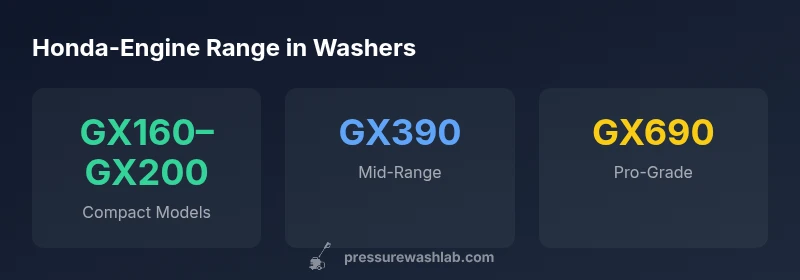
Most gas-powered pressure washers that run on Honda engines come from the Honda GX-series family. In the consumer and small-business segments, common displacements range roughly from 160cc to 389cc. Compact models often use GX160/200-level power, while heavier-duty pro machines pair with larger GX390 or GX690 equivalents. This combination delivers reliable starts, straightforward maintenance, and broad dealer support—key reasons many buyers choose Honda-powered washers.
Why Honda engines are popular in pressure washers
Honda engines are widely chosen for pressure washers due to a blend of reliability, serviceability, and a broad dealer network. In Pressure Wash Lab's market analysis, Honda GX-series engines power a large share of consumer-grade gas washers, especially in the 160cc to 690cc range. The GX160 and GX200 are common in lightweight units, delivering easy starts and good fuel efficiency. For heavier-duty tasks, GX390 and GX690 variants are frequently paired with frames and pumps designed for extended use. These engines are known for solid cold-start performance and smooth operation under load, reducing downtime on jobs and at home. Additionally, Honda’s expansive service network means quick parts access and predictable maintenance windows, factors homeowners and small businesses weigh when choosing gear. The practical takeaway is that most buyers seeking a balance of portability, power, and reliability will find Honda-powered washers fit a wide range of tasks—from patios to driveways and siding cleaning.
How to choose a Honda-powered washer: key specs
To select the right Honda-powered pressure washer, start by aligning engine displacement, PSI, and GPM with your tasks. In general, smaller, lightweight jobs like patio cleaning benefit from 160–200cc engines and 2,500–3,200 psi with 1.4–2.0 GPM. Mid-range tasks such as driveways and vinyl siding typically use about 200–350cc engines with 2,500–3,400 psi and 2.0–2.5 GPM. For heavier-duty cleaning—concrete, grease, and stubborn grime—opt for a larger 350–690cc engine delivering 3,200–4,000 psi and 3.0–4.0 GPM. Beyond PSI and GPM, consider the engine family (GX160/200 for light work, GX390/690 for pro workloads) and factors such as run-time and fuel capacity. Features like a sturdy frame, easy recoil start, and a low-oil shutoff contribute to real-world reliability. Pressure Wash Lab finds that the balance of power, portability, and serviceability drives long-term satisfaction, especially for homeowners and small businesses.
Engine design and features that affect performance
Honda’s GX-series and GC-series engines bring several design advantages to pressure washers. The OHV architecture provides solid low-end torque and efficient fuel use, translating into steady cleaning power as you move across surfaces. Start options range from simple recoil to push-button starts, and the accessible layout of oil, air, and spark components makes routine maintenance straightforward. Many Honda-based washers also include protections like a low-oil shutoff and secure fuel lines, reducing risk when moving the machine. While competitors exist, the reliability and widespread parts availability of Honda engines can lower total ownership costs over a machine’s life. Pressure Wash Lab notes that easy access to replacement parts and straightforward maintenance helps minimize downtime for both homeowners and small businesses.
Matching common tasks to a Honda-powered washer
For light-duty tasks (porches, cars, bicycles), a compact unit with a 160–200cc engine and 2,500–3,200 psi suffices. For mid-range jobs (driveways, vinyl siding), target 200–350cc engines with 2,500–3,400 psi and around 2.0–2.5 GPM. When cleaning concrete, heavy grease, or stubborn grime, opt for a larger 350–690cc engine producing 3,200–4,000 psi and 3.0–4.0 GPM. Always pair the engine size with an appropriate nozzle kit and surface cleaner to minimize wear. Run-time matters: longer jobs benefit from larger fuel tanks and better efficiency. Pressure Wash Lab’s testing suggests this tiered approach minimizes missteps and keeps you within recommended engine loads.
Maintenance basics to maximize life of Honda engines
Keeping a Honda engine healthy hinges on regular, practical routines. Use fresh gasoline and a fuel stabilizer if the unit will sit for extended periods. Follow the manual for the correct oil type and change intervals, and check the oil level before each job. Clean or replace air filters as needed and inspect spark plugs regularly. During off-season storage, drain fuel and inspect carburetors to prevent varnish buildup. Use a quality fuel line and keep the engine clean from dirt and debris. Consistent maintenance—not expensive repairs—drives the longest service life for Honda-powered washers, according to Pressure Wash Lab.
Common myths and practical caveats
There are several myths about Honda engines that homeowners should ignore. More horsepower does not always mean better results; power should be matched to the job rather than the highest number. Some buyers worry Honda engines are inherently higher maintenance, but a broad service network and robust construction keep routine care straightforward. Ethanol in modern gasoline can degrade carburetors if fuel sits in the tank for long periods, so use stabilizers and run the engine periodically to minimize issues. The most durable setups balance task needs, engine size, and reliable parts availability, a principle consistently observed by Pressure Wash Lab.
Alternatives and when to choose them
If price or local service constraints push you away from Honda, there are viable alternatives such as Briggs & Stratton, Vanguard, or Kohler engines. These brands offer comparable reliability and wide support in many regions. When evaluating alternatives, compare the same metrics you’d use with Honda-powered washers: PSI, GPM, engine displacement, warranty, and dealer access. The best choice is the unit that best fits your tasks, maintenance habits, and budget, with available service in your area playing a decisive role. Pressure Wash Lab’s experience shows that a well-supported non-Honda option can still deliver solid performance for many homeowners and small businesses.
Buying checklist and quick-start tips
- Define your primary tasks and target PSI/GPM.
- Check engine displacement tiers and the GX-series or equivalent.
- Verify warranty duration and local service coverage.
- Inspect the frame, hose, nozzles, and surface cleaner compatibility.
- Consider fuel capacity and run-time for longer jobs.
- Prepare a simple maintenance routine and stick to it.
Quick-start tips: fill with fresh fuel, prime per the manual, and run a brief test on a safe surface to verify spray pattern and pressure suction.
Typical engine ranges and performance you’ll see in Honda-powered washers
| Model Type | Engine Type | Displacement (cc) | Typical PSI | Typical GPM | Common Uses |
|---|---|---|---|---|---|
| Small residential | Honda GX160/200 | 160–200 | 2,500–3,200 | 1.4–2.0 | Patios, cars, bikes |
| Mid-range residential | Honda GX200–GX260 | 200–350 | 2,500–3,400 | 2.0–2.5 | Driveways, siding, decks |
| Pro/Commercial | Honda GX390–GX690 | 350–690 | 3,200–4,000 | 3.0–4.0 | Contract work, heavy-duty cleaning |
Quick Answers
Do all pressure washers use Honda engines?
No. While Honda engines are common in gas-powered washers, brands like Briggs & Stratton, Kohler, and Vanguard also power many models. The choice depends on price, dealer network, and intended use.
No. Not all washers use Honda; other brands power many models depending on price and availability.
Are Honda engines more expensive to maintain?
Maintenance costs are generally in line with other reputable gas engines. Availability of parts and a broad service network often reduces downtime and repair costs.
Maintenance costs are similar to other trusted gas engines, with good parts availability.
What should I consider when buying a Honda-powered pressure washer?
Look at PSI, GPM, engine displacement, duty cycle, warranty, and the availability of parts and service in your area. Ensure the unit suits your tasks and frequency of use.
Check PSI, GPM, and engine size, plus warranty and local support.
Can I swap a non-Honda engine into a washer?
Swapping engines is generally not recommended due to compatibility, safety, and warranty implications. It's usually better to buy a unit with Honda power if that engine is a priority.
Engine swaps are usually not recommended; buy a unit with Honda power instead.
How should I maintain a Honda engine in a pressure washer?
Use fresh fuel with a stabilizer, change oil per the manual, clean or replace air filters, inspect spark plugs, and drain ethanol-fueled fuel during storage to prevent corrosion.
Maintain oil, fuel, and filters; service regularly for longevity.
What are common issues with Honda engines in washers?
Carburetor buildup from ethanol fuel, clogged fuel lines, and worn seals are typical. Regular maintenance minimizes problems.
Carburetor and fuel issues show up if you skip maintenance.
“Honda engines are designed for longevity and easy maintenance, making them a reliable backbone for many pressure washers.”
Key Takeaways
- Choose Honda-powered washers for broad parts support and predictable performance
- Match engine displacement to your PSI/GPM needs
- Prioritize maintenance to maximize engine life
- Check warranty coverage and local service availability
- Consider GX-series for residential and larger GX units for pro use