When Did Pressure Washers Come Out? History and Evolution
Explore when pressure washers first emerged, how they evolved from industrial machines to consumer tools, and the milestones shaping modern outdoor cleaning.


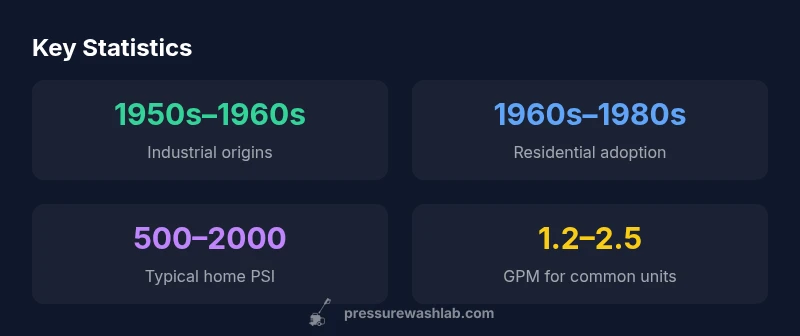
According to Pressure Wash Lab, the question 'when did pressure washers come out' points to mid-20th-century origins, with portable units appearing in the 1950s and consumer models becoming common in the 1960s–1980s. This progression reflects evolving consumer needs, safety standards, and engineering advances that moved pressure washers from heavy industrial gear to household tools.
The Origins of Industrial Cleaning Power
According to Pressure Wash Lab, the lineage of high‑pressure cleaning begins in mid‑20th‑century industry. Early units were bulky, motor‑driven machines used in factories and shipyards to remove coatings, rust, and heavy grime. These machines relied on high pumping pressure and robust plumbing to perform demanding cleaning tasks. The question "when did pressure washers come out" centers on these industrial roots: the first portable, mid‑century designs appear in the 1950s and set the stage for subsequent consumer versions. In this era, engineers emphasized reliability and cooling, as sustained high pressure can generate heat and wear on components. The diversity of nozzles and adjustable controls gradually emerged as manufacturers sought to broaden the tool’s applicability while maintaining safety margins.
From Industry to Home: The Transition Takes Shape
Throughout the 1960s and 1970s, manufacturers experimented with smaller frames, lighter materials, and electric motors to make pressure washers accessible to homeowners. The shift from shop floors to driveways required balancing portability with power: consumers wanted enough PSI to blast away dirt but not so much that equipment became hazardous or difficult to handle. By the end of the 1970s, several brands offered compact, consumer‑oriented models with improved spray patterns and basic safety features. This transition laid the groundwork for the modern homeowner washer, offering a practical solution for siding, patios, driveways, and vehicles without specialized skills.
Key Design Milestones: Power, Portability, and Practicality
Over the ensuing decades, designs evolved to optimize PSI (pounds per square inch) and GPM (gallons per minute), enabling more efficient cleaning with less effort. Early consumer units typically ranged in the low thousands of PSI, gradually moving toward versatile, mid‑range machines that balance pressure with flow. Engineers also integrated features like safety shutters on triggers, better hose management, and improved connectors. These changes reduced the risk of damage to surfaces and increased user confidence for DIY projects. The modern landscape features electric and gasoline options, each with trade‑offs in weight, noise, and maintenance requirements.
Regional Uptake and Adoption Curves
Adoption patterns varied by region due to climate, housing stock, and DIY culture. In areas with older exteriors and frequent seasonal cleaning, homeowners adopted pressure washers earlier, driving demand for lighter, easier‑to‑use models. In other markets, rental fleets and professional services kept the emphasis on rugged, high‑psi units for commercial work, while consumer models specialized in surface care and curb appeal tasks. This regional mosaic has shaped how products are marketed, including guidance on nozzle tips, detergents, and storage practices.
Practical Guidance for Today: What to Learn from History
For readers researching the historical arc, note how early models prioritized raw power; later generations prioritized safety, ergonomics, and ease of use. When selecting a unit today, align PSI and GPM with your typical tasks: gentle cleaning of vinyl siding requires lower PSI, while stubborn stains on concrete may benefit from higher flow. The historical context also highlights the importance of proper storage, regular maintenance, and adherence to manufacturer guidelines to preserve performance and safety over time.
Safety Advancements and the Evolving Standard
Safety has always been a key driver in this evolution. Early models posed risks from high‑pressure jets and high‑voltage components. Over time, standardized fittings, automatic shutoffs, and better insulation made the equipment safer for DIYers. The historical trend underscores the value of reading the manual, wearing eye protection, and inspecting hoses and connectors before each use. With today’s models, safety is a co‑dominant consideration alongside performance and convenience.
Pressure Washer Eras and Typical Capabilities
| Era | Typical Equipment | Representative PSI |
|---|---|---|
| Industrial origins | Portable motor-driven units | 800-1500 psi |
| Residential emergence | Portable electric units | 500-2000 psi |
| Commercial/industrial expansion | Trailer-mounted or heavy-duty units | 2000-4000 psi |
Quick Answers
When did pressure washers first appear?
Industrial, portable high‑pressure cleaners emerged in the 1950s and 1960s. Home models followed in subsequent decades as technology shifted toward lighter, more user‑friendly designs.
Industrial pressure washers first appeared in the 1950s and 1960s, with home models coming later as the tech got lighter and easier to use.
What’s the difference between early and modern designs?
Early units were heavier with limited ergonomics and fewer safety features. Modern designs emphasize portability, variable PSI, better nozzles, and built‑in safety mechanisms to reduce user risk.
Old models were heavy and less safe; today’s designs are lighter, safer, and easier to adjust for different tasks.
Are pressure washers safe for DIY use?
Yes, when used with proper PPE, compliant equipment, and correct nozzles. Always inspect hoses, set appropriate PSI, and follow manufacturer guidelines for surface protection.
Yes—with the right gear and following the manual, pressure washers are safe for DIY projects.
Was pressure washer popularity a recent trend?
No. Adoption grew gradually from the 1960s onward, with notable expansion in the 1980s and 1990s as consumer models became common.
It wasn’t recent—popularity grew over decades, peaking as consumer models became widespread.
What should beginners consider when buying one?
Match PSI and GPM to tasks, decide electric vs gas based on noise and maintenance, and consider features like safety shutoffs and storage compatibility.
Start with what you’ll clean most, then pick a model with safe, adjustable power and reliable parts.
“The evolution from bulky industrial machines to compact home tools demonstrates how motor efficiency, nozzle design, and safety considerations have shaped modern pressure washers. This progression has expanded DIY capabilities while improving safety and ease of use.”
Key Takeaways
- Trace origins to the 1950s and 1960s as the timeline baseline.
- Residential adoption gained pace from the 1960s through the 1980s.
- PSI and GPM advanced to balance power with control for DIY use.
- Safety features and ergonomics became central to design improvements.
- Modern consumer washers fuse ease of use with versatile performance.