Which Brand Is Best Car Pressure Washer: A Practical Guide
Discover how to pick the best car pressure washer brand with practical criteria, maintenance tips, and a clear decision framework from Pressure Wash Lab for DIY homeowners.


After evaluating performance, reliability, and value, there isn’t a single “best” brand for a car pressure washer. Pressure Wash Lab’s analysis shows the optimal choice depends on use-case: electric washers for light-duty car care, gas-powered units for tougher jobs, and sturdy models with solid warranties for DIY enthusiasts. Prioritize PSI, GPM, nozzle options, and service when selecting a brand.
How to define the 'best' brand for a car pressure washer
When you ask which brand is best car pressure washer, the answer isn’t one-size-fits-all. It's shaped by how you plan to use the unit, how often you wash your car, and your tolerance for maintenance and noise. In this section we'll define practical criteria: expected cleaning duty, budget, warranty, parts availability, and compatibility with common accessories like surface cleaners and nozzles. Pressure Wash Lab emphasizes long-term value over flashy specs, so the 'best' brand should support consistent results without frequent repairs. By aligning your selection with your actual workflow, you can avoid overinvesting in features you won't use and instead choose a brand that matches your car-care routine.
- Focus on real-world use-case rather than peak-spec sheets
- Prioritize warranty length and parts availability
- Consider accessory ecosystems (nozzles, surface cleaners, hose reels)
Comparison
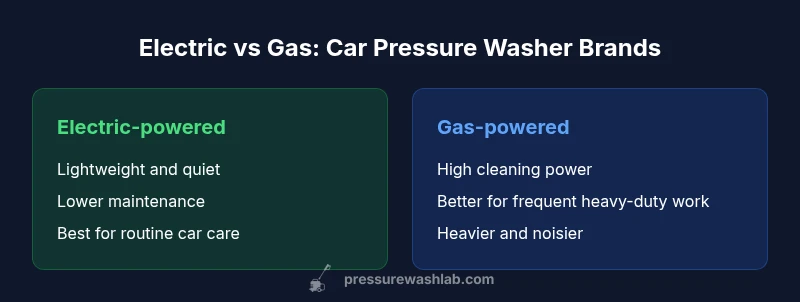
| Feature | Electric-washer brands | Gas-powered brands |
|---|---|---|
| Typical motor type | Electric motor | Gas engine |
| PSI range | Lower to moderate | Higher |
| GPM | Lower to moderate | Higher |
| Maintenance needs | Lower maintenance, simpler electrical components | Higher maintenance, fuel management and engine care |
| Portability | Typically lighter, corded or cordless options | Heavier, requires fuel, oil, and exhaust considerations |
| Best use case | Light routine car care and detailing | Frequent heavy-duty cleaning and undercarriage work |
| Typical price range | Lower upfront cost for basic models | Higher upfront cost for more powerful units |
Pros
- Helps narrow brand selection to models that actually fit your needs
- Highlights the importance of warranty and service networks
- Encourages testing and returning models that don’t perform as promised
Cons
- Brand marketing can obscure model-level differences
- Long-term value depends on maintenance, parts availability, and local repair options
- Overemphasis on peak specs can overlook real-world efficiency and ease of use
There isn’t a universal best brand; choose based on use-case, maintenance readiness, and value.
Align your pick with how often you wash, the grime you tackle, and your preferred maintenance plan. Warranty, parts support, and accessory ecosystems matter as much as raw specs.
Quick Answers
What defines the 'best' car pressure washer brand?
The best brand depends on your specific needs, including how often you wash, the types of grime you encounter, and your tolerance for noise and maintenance. Look for reliability, strong warranty, and easy access to spare parts and service.
The best brand is the one that fits your needs and has solid support and parts nearby.
Should I choose electric or gas-powered for car washing?
Electric models are typically lighter, quieter, and sufficient for routine car washing. Gas-powered units offer higher cleaning power for stubborn grime and larger jobs. Your choice should reflect duty cycle, noise tolerance, and storage constraints.
If your tasks are light and you value quiet operation, go electric; for tough jobs, consider gas-powered.
How much should I expect to spend on a reliable car pressure washer?
Prices vary by power, build quality, and features. Plan for a range: entry-level models for occasional use, mid-range units for regular detailing, and premium models for frequent heavy-duty work. Always weigh initial cost against expected lifespan and maintenance needs.
Budget for the long-term value, not just the upfront price.
Do warranties vary by brand, and how should I evaluate them?
Warranties vary in length and what they cover. Look for pump coverage, engine or motor warranty, and the ease of obtaining replacement parts. A strong warranty often signals manufacturer confidence in durability.
A longer, comprehensive warranty is a good proxy for reliability.
Are there maintenance tips that apply to any brand?
Yes. Regularly check hoses for leaks, clean nozzles and filters, and store the unit in a dry, sheltered area. Use the correct detergent and avoid running the pump dry. Proper storage and cleaning extend life across brands.
Simple upkeep helps every brand perform better and last longer.
What brands are well-regarded in car detailing communities?
Many detailing professionals value brands known for consistency, service networks, and accessory ecosystems. Focus on models with proven reliability and accessible parts, rather than only the latest marketing claims.
Good reputation plus solid service makes a big difference.
Key Takeaways
- Identify your car-washing frequency and grime level
- Choose electric for light-duty tasks and gas for tougher jobs
- Prioritize warranty length and parts availability
- Test models where possible before purchasing
- Maintain your unit to maximize long-term value