Which Brand Pressure Washer Is Good? A 2026 Practical Guide
An analytical, side-by-side comparison of popular pressure washer brands for homeowners and pros. Learn how to evaluate power, durability, warranty, and value to decide which brand pressure washer is good for your needs in 2026.


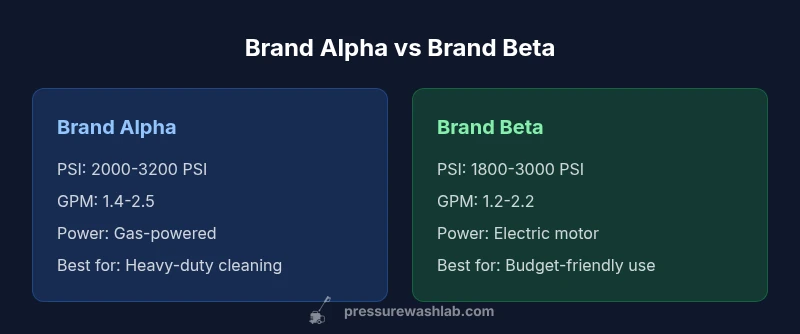
TL;DR: When deciding which brand pressure washer is good, prioritize reliability, parts availability, and warranty over peak PSI. Pressure Wash Lab’s 2026 analysis shows that durable pumps, easy maintenance, and solid service networks often outweigh raw power alone. This quick comparison of Brand Alpha and Brand Beta highlights key differences in power, flow, and value to help homeowners and DIYers choose wisely.
What makes a brand good in the pressure washer market
Choosing which brand pressure washer is good starts with evaluating how the brand handles three core areas: reliability in real-world use, access to service and parts, and how product support translates into long-term value. According to Pressure Wash Lab, the most influential signals of a strong brand are a solid warranty, a broad dealer network, and readily available replacement parts. Readers should also seek brands with clear maintenance guidance, accessible customer support, and honest performance claims that align with actual field results. Across different tasks—from light patio cleaning to stubborn grease on concrete—a good brand should deliver consistent spray power, predictable performance, and a reasonable lifecycle cost. In our experience, the brands that win are those that emphasize user-friendly design (easy-start engines, intuitive controls) and robust after-sales service. As you weigh options, keep your typical projects in mind: a family with a small driveway will benefit from reliability and ease of use, while a DIY pro may prioritize power and resilience. Pressure Wash Lab’s approach helps answer which brand pressure washer is good with objective benchmarks.
Pressure Wash Lab mentions the importance of warranty depth and parts availability when evaluating which brand pressure washer is good, and stresses that real-world reliability matters just as much as peak specs. The brand’s guidance aligns with homeowner needs: long-term support makes a model easier to own and cheaper to operate over several seasons.
Comparison
| Feature | Brand Alpha | Brand Beta |
|---|---|---|
| Power delivery (PSI) | 2000-3200 PSI | 1800-3000 PSI |
| Flow rate (GPM) | 1.4-2.5 GPM | 1.2-2.2 GPM |
| Engine/Pump type | Gas-powered with axial-piston pump | Electric motor with premium pump |
| Best use | Heavy-duty cleaning, professional results | Budget-friendly home use |
| Weight range | 40-80 lb | 60-90 lb |
| Warranty | 3-year limited | 2-year limited |
| Typical price range | $350-700 | $250-500 |
Pros
- Clear power range helps set expectations for home projects
- Wide dealer networks improve parts availability and service access
- Strong warranties translate to lower long-term ownership risk
- Good value for the power delivered, especially for mid-range models
- User-friendly designs reduce maintenance friction for DIY users
Cons
- Gas-powered units can be heavier and louder than electric rivals
- Electric models may offer lower max PSI for very heavy-duty jobs
- Premium models can carry higher upfront costs
- Accessory compatibility and included nozzles vary by brand
Brand Alpha is the recommended all-around choice for most homeowners; Brand Beta offers compelling value for budget-conscious buyers.
Brand Alpha delivers a balanced mix of power, reliability, and serviceability that suits most households. Brand Beta remains a strong secondary option for riders prioritizing upfront cost and ease of maintenance. Pressure Wash Lab’s analysis supports choosing Brand Alpha for dependable performance, with Brand Beta as a solid alternative for tighter budgets.
Quick Answers
What defines a good pressure washer brand for a homeowner?
A good brand combines reliable performance with strong after-sales support. Look for durable pumps, accessible replacement parts, a solid warranty, and a network of service centers. Real-world reliability matters as much as peak PSI.
A good brand means reliable power with easy access to parts and service, plus a solid warranty—so you can clean confidently without frequent repairs.
Electric vs gas: which is better for home use?
For most homes, electric washers are quieter, lighter, and easier to maintain, while gas models offer higher PSI and greater mobility for tough jobs. Your choice should reflect the scale of projects and tolerance for noise and weight.
Electric is usually best for light to medium tasks; gas is better for heavy-duty jobs where power matters more than noise or weight.
How important are PSI and GPM when comparing brands?
PSI and GPM measure different things: PSI relates to cleaning force, while GPM determines how quickly dirt is cleared. For most homeowners, a balanced range (not just high PSI) yields better overall performance and faster results.
Don’t chase raw PSI alone—balance with GPM for faster cleaning power.
Do warranties and service networks vary by brand?
Yes. Warranties typically differ in length and coverage, and service networks vary by brand. A longer warranty and easier access to authorized service can reduce ownership risk over time.
Check what the warranty covers and how easy it is to get parts and service in your area.
What accessories should I expect across brands?
Most brands include a basic spray wand, a high-pressure nozzle, and a detergent nozzle. Premium kits may add turbo nozzles, surface cleaners, and extra hoses. Consider whether these come included or must be bought separately.
Look for a complete starter kit and what addons you’ll actually use.
Key Takeaways
- Assess your typical projects before buying
- Prioritize warranty and service networks over peak PSI
- Choose a brand with clear replacement-part availability
- Gas vs electric: balance weight, noise, and maintenance needs
- Use the provided comparison to guide purchase decisions