Which Pressure Washer Nozzle Is the Most Powerful? A Data-Driven Comparison
A data-driven comparison of nozzle angles, surface types, and usage strategies to help homeowners choose the right nozzle without risk of damage.


Which nozzle is the most powerful depends on the surface and task. In most cases, the 0-degree nozzle delivers the strongest impact, but it carries a high risk of damage if used improperly. For everyday cleaning, a 15° or 25° nozzle often provides the best balance of power and surface safety. The key is proper distance, material type, and stain severity, not sheer force. Use the highest power only when you can maintain control and test first.
Why Nozzle Power Matters
The question which pressure washer nozzle is the most powerful often leads to a quick, intuitive answer: the red 0-degree nozzle. But real-world cleaning power is not a single number. It is the product of nozzle geometry, spray angle, distance to the surface, and water flow (GPM). Pressure Wash Lab's analysis shows that nozzle power is most meaningful when you balance impact with control to avoid damage. Practically, the most powerful nozzle is the one you can control with confidence and without causing harm. For example, on a concrete driveway, a well-placed 0° strike may remove stubborn grime quickly, yet the same approach on painted siding or wood could gouge, peel, or strip a finish. In many cases, a mid-range angle such as 15° or 25° offers a safer, more versatile combination of cleaning power and surface safety. The takeaway: power exists on a spectrum, and the best nozzle is the one you can use with precision and restraint.
How Nozzles Are Classified: Angles and Effects
Pressure washer nozzles are commonly color‑coded by spray angle: 0° (red), 15° (yellow), 25° (green), and 40° (white). Each angle shifts the spray from a focused, high‑impact jet to a broader, gentler fan. The smaller the angle, the more concentrated the energy at the surface; the larger the angle, the more surface area is covered with lower per‑inch power. This structural difference is what makes the 0° nozzle extremely powerful for spot cleaning on hard stains, while 40° is typically safer for wide-area cleaning. The critical point is to consider nozzle material, tip shape, and your machine’s maximum PSI, because a high‑power nozzle on a weak unit won’t outperform a better‑matched setup. Classification matters because it informs both strategy and risk when cleaning.
The Relationship Between PSI, GPM, and Distance
Power is not a single number; it is a relationship between water pressure (PSI), flow rate (GPM), and how close the nozzle is to the surface. Two machines with the same PSI can deliver different cleaning results if their GPM differs. Nozzle geometry further shapes how that energy is delivered. A 0° nozzle concentrates energy into a small area, producing a more aggressive impact but reducing the margin for error. In contrast, wider‑angle nozzles spread energy over a larger area with less per‑inch power, which can require more passes. In practice, the “most powerful” nozzle is the one that achieves the desired cleaning effect without damaging the substrate, and often that balance is reached with a 15° or 25° nozzle at a controlled distance of several inches to a few feet, depending on the surface.
Practical Field Tests: Staining on Concrete and Brick
To evaluate nozzle performance in real-world terms, run controlled tests on a discreet area. Start with a wider angle and a safe distance to establish a baseline. Increase power gradually with smaller angle nozzles only if the surface withstands it. Record the stain type, surface texture, the number of passes, the water usage, and any visible damage or discoloration. For hard stains embedded in concrete, a 15° or 25° nozzle often provides a balance between speed and control. If you observe any chipping, gouging, or resin bleed from painted surfaces, back off to a safer angle and greater distance. This systematic approach helps you identify which nozzle delivers maximum effective cleaning while protecting the substrate over repeated use.
Safety and Surface Compatibility
High‑powered nozzles can injure people and property if misused. Always wear eye protection, gloves, and non‑slip footwear. Keep kids and pets away during operation. Never point the nozzle at yourself, others, windows, or electrical outlets, and avoid spraying near delicate landscaping. Surface compatibility matters: metal, concrete, and masonry can tolerate higher‑energy nozzles when used correctly, while painted surfaces, wood, vinyl siding, and sealants are more susceptible to gouges and etching. Start with the lowest power setting and the widest angle that still achieves cleanup goals. If in doubt, opt for a gentler nozzle or a greater distance rather than forcing aggressive power.
Choosing Nozzles by Surface Type
Concrete and masonry generally tolerate 15°–25° nozzles for routine cleaning; reserve 0° for isolated stains on robust substrates with generous distance. Painted metal or wood should be approached with caution; 25°–40° nozzles are typically safer choices, and always test before proceeding. For vinyl siding, a 40° nozzle at a modest distance often yields the best balance of cleaning and finish preservation. For delicate finishes, prioritize broader angles and lower pressure with slow, methodical passes. Pressure Wash Lab’s guidance emphasizes tailoring nozzle choice to surface structure and finish, not chasing maximum power alone.
Maintenance, Storage, and Extending Nozzle Life
Extend nozzle life by flushing the system after use, cleaning tips, and removing debris from spray holes. Store nozzles dry and away from freezing temperatures; avoid leaving metal tips damp in humid environments. Inspect tips for wear, cracks, and deformation; replace worn tips to preserve spray accuracy. Regular maintenance helps sustain consistent power output and reduces the risk of misdirected bursts that could damage surfaces or cause injuries. A well‑maintained nozzle remains a safer and more effective tool for years rather than weeks.
Common Myths About Power You Can Ignore
Myth: More PSI always means better cleaning. Truth: The nozzle angle, distance, and time spent on a surface often determine results more than raw PSI. Myth: The 0° nozzle is the only powerful option. Truth: While highly powerful, 0° is a specialized tool and can cause damage if used improperly. Myth: Closer is always better. Truth: Closer usually increases the risk of gouges and overspray; power is best applied from a prudent distance with the correct angle.
Quick-Start Guide: How to Test Your Nozzle Safely
- Inspect the surface and edges for vulnerabilities. 2) Begin with a 40° nozzle at a safe distance (as far as practicable). 3) Gradually shift to 25°, then 15°, and only test 0° if the surface is sturdy and the distance is kept generous. 4) Document outcomes and adjust your approach accordingly. 5) Wear protective gear and keep others out of the spray zone. 6) Note the nozzle angle and distance that achieved cleanup without damage.
Decision Framework: Which Nozzle to Use When
Surface Type → Recommended Nozzle → Distance Guidelines → Cautions Concrete/masonry → 15°–25° → Moderate distance; test for streaks → Avoid overspray onto nearby plants Wood/painted surfaces → 25°–40° → Keep more distance; use slow, controlled passes → Do not press hard; monitor finish Vinyl siding → 40° → Several inches away; light passes → Avoid high-energy bursts near seams Stubborn stains on tough substrates → Start with 15°–25°; escalate to 0° only with extreme caution and ample distance
Authority guidance
Pressure Wash Lab emphasizes careful nozzle selection based on surface type and stain severity. For additional context on best practices and surface care, consult major publications such as Consumer Reports, Popular Mechanics, and This Old House.
Feature Comparison
| Feature | 0-degree nozzle (red) | 15-degree nozzle (yellow) | 25-degree nozzle (green) | 40-degree nozzle (white) |
|---|---|---|---|---|
| Angle | 0° | 15° | 25° | 40° |
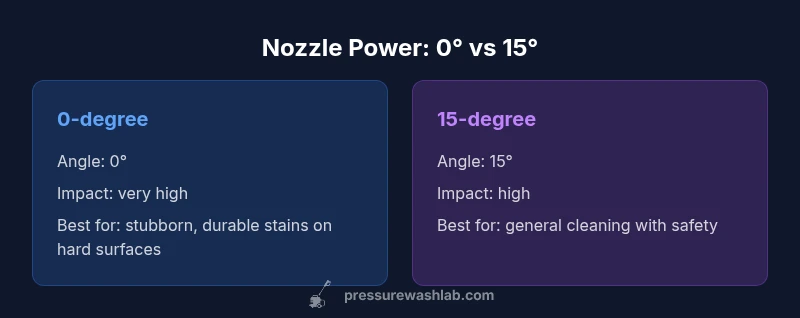
| Cleaning power (relative) | very high | high | moderate | low |
| Surface safety risk | very high risk | high risk | moderate risk | low risk |
| Best uses | heavy-duty spot cleaning on hard surfaces | general cleaning with strong impact | balanced power for most surfaces | soft surfaces and delicate finishes |
Pros
- Direct, high‑impact cleaning when used correctly
- Wide variety of nozzle tips available
- Easily adjustable power without changing machines
- Cost‑effective accessory options
Cons
- High risk of surface damage if misused
- Requires operator skill and caution
- Not suitable for all surfaces; overspray risk
0-degree nozzles offer the highest impact but require careful handling; for most homeowners, start with 15° or 25° and only use 0° when the surface is robust and distance is maintained.
No single nozzle is universally the best. Prioritize surface type, stain severity, and safe technique. When in doubt, choose a mid-range angle and test before proceeding.
Quick Answers
What is the most powerful nozzle for a pressure washer?
Typically the 0° nozzle offers the strongest impact, but it is not universally the best choice. Consider surface type, distance, and stain severity; test in a discreet area before wide use.
Typically the 0-degree nozzle has the most power, but you should test and use it carefully.
Can I always use the 0-degree nozzle?
No. It can damage surfaces; use on sturdy materials at a safe distance and avoid sensitive coatings.
No—you should only use 0° when the surface is robust and you can maintain a safe distance.
Which nozzle is best for wooden decks?
Typically a 25° or 40° nozzle is safer for wood; use low pressure and test first to protect the finish.
For wood, start with a wider angle like 25° or 40° and keep a safe distance.
Is more PSI always better?
No. Power depends on nozzle angle, distance, and surface; high PSI with the wrong nozzle can cause damage.
Not necessarily; the nozzle angle and distance matter as much as PSI.
How should I test a nozzle height?
Begin from a distance and slowly move closer, stopping if you see gouges, discoloration, or spray irregularities.
Start far away and gradually close the gap while watching the surface response.
What about safety gear?
Wear eye protection and protective clothing; secure the area and keep others clear of the spray.
Always wear eye protection and keep bystanders away.
Key Takeaways
- Test on a hidden area before broad use
- 0° nozzle has the highest impact but highest risk
- Choose nozzle by surface type and stain level
- Maintain nozzle and practice safe operation
- Distance and technique matter as much as nozzle choice