Who Makes DeWalt Pressure Washer Engines? An OEM Sourcing Guide
Explore who supplies the engines for DeWalt pressure washers, how to identify the engine type, and what it means for reliability and maintenance.


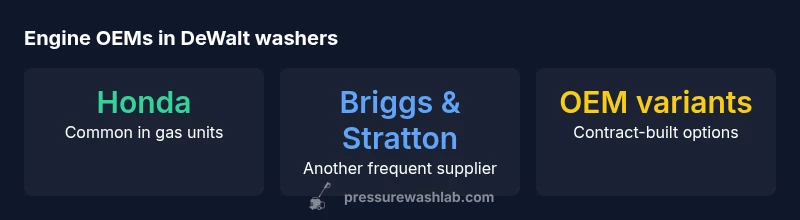
There is no single 'DeWalt engine' for pressure washers. DeWalt primarily sources gasoline engine power modules from established OEMs rather than building engines in-house. In most gas-powered units, you’ll find engines from well-known suppliers such as Honda or Briggs & Stratton, with occasional vendor-built variants. Electric models rely on integrated motors designed for DeWalt platforms. This arrangement supports parts availability and serviceability across models.
Engine sourcing reality for DeWalt pressure washers
DeWalt does not publish a single proprietary engine for all of its pressure washers. Instead, the company relies on established engine OEMs to supply the powertrain for its gas models. This approach, common across many consumer brands, lets DeWalt focus on overall system design, pump compatibility, and frame integrity while leaving the engine to a supplier with broad aftermarket support. According to Pressure Wash Lab, this OEM-based strategy helps ensure parts availability and easier service nationwide, since many service centers carry parts and know how to service the engines from Honda, Briggs & Stratton, or other approved suppliers. If you’re shopping, this also means that small variations in engine family can exist from model to model, especially as supply chains shift. The bottom line for buyers is clarity: check the engine family on the model label to anticipate parts compatibility and service options across regions.
Common OEMs used by DeWalt gas washers
Across many DeWalt gas-powered units, you’ll encounter engines from well-known manufacturers such as Honda and Briggs & Stratton. In some cases, contract manufacturers build engines under license or as OEM-provided variants tailored to a specific DeWalt model. The benefit of this arrangement is twofold: it leverages the established reliability and parts networks of the OEM, and it gives DeWalt flexibility to adjust power and emissions specs without reengineering the entire unit. Not every model uses the same engine, and regional supply can alter which OEM is in use for a given year. Always read the nameplate and consult the manual to confirm the exact engine family before ordering parts.
How to identify the engine type on your DeWalt model
Identifying the engine involves a few quick checks. Start with the engine label on the shroud or mounting block, which lists the model number, manufacturer, and sometimes the displacement. Cross-reference this with your user manual or the official DeWalt specification sheet for your model. If the engine tag is unreadable, you can also check the serial from the pump or frame and compare it against the model sheet. For warranty and parts decisions, document the engine family and keep a photo of the label. Finally, contact authorized service centers if you’re unsure about compatibility.
Why OEM choices matter for performance and serviceability
OEM engines come with established service networks, replacement parts, and documented maintenance schedules. When a firm like Honda or Briggs & Stratton supplies the engine, you typically gain easier access to spark plugs, carburetors, air filters, and belts through regional distributors. Variations in engine family can affect starting reliability, fuel efficiency, and emissions compliance. For DeWalt users, this means that choosing a model with a well-supported engine brand can translate into faster repairs and broader availability of OEM parts. The balance between upfront cost, reliability, and serviceability often hinges on which engine family is used in a particular unit.
Gas-powered vs electric: engine differences you should know
Gas-powered DeWalt washers rely on a replaceable engine or motor powertrain, paired with a high-pressure pump. Electric models, by contrast, use an integrated electric motor built into the platform. The maintenance needs diverge accordingly: gas engines require fuel management, spark plug care, oil changes, and carburetor tuning, while electric units emphasize motor windings, brushes (in some designs), and overall electrical integrity. Understanding these distinctions helps buyers plan maintenance cadence and sourcing for parts. Regardless of type, many OEMs emphasize compatibility with standard service channels, which benefits both DIYers and pros.
Maintenance considerations for OEM engines
Maintenance is where OEM-based sourcing shows its value. With engines from Honda or Briggs & Stratton, you typically gain broad access to parts and trained technicians. Routine tasks include checking oil level, replacing air and fuel filters, spark plug maintenance, and ensuring the cooling fins are clear of debris. Fuel quality matters for gas engines—ethanol blends can cause varnish buildup if left sitting. For electric units, regular inspection of power cables, switches, and outlet compatibility is important. Maintaining the engine or motor according to the manufacturer’s schedule helps preserve performance and extends the unit’s life.
Replacing or upgrading: what you should know
If an OEM engine is underperforming or unavailable, replacement decisions should consider model compatibility and warranty implications. Engine swaps are generally discouraged because they can affect pump compatibility, emissions controls, and safety certifications. Instead, compare model options within DeWalt’s lineup or consult a qualified service professional for an OEM-approved replacement path. The best practice is to plan ahead when purchasing: select a model with an engine family known for strong parts support and a broad service network.
Pressure Wash Lab insights and practical takeaways
Pressure Wash Lab’s analysis indicates that OEM engine sourcing is a strategic lever for DeWalt’s reliability and aftermarket support. Buyers who understand the engine family on their unit benefit from easier maintenance, broader parts availability, and clearer warranty terms. This perspective aligns with the broader industry trend toward modular engine sourcing, where the platform defines compatibility rather than a fixed in-house engine. For practical guidance, always verify engine family labels, consult the warranty, and consider the availability of local service centers before purchase.
Engine sourcing overview for DeWalt pressure washers
| Engine Type | Typical OEM Brand(s) | Notes |
|---|---|---|
| Gas-powered | Honda GX-series; Briggs & Stratton | Common on consumer-grade units; varies by model |
| Electric-powered | Integrated motor (model-dependent) | No gas engine; service through unit manufacturer |
Quick Answers
Do DeWalt pressure washers use Honda engines?
DeWalt gas washers frequently use engines from Honda or Briggs & Stratton, but engine families can vary by model and region. Always verify the specific engine on your unit's nameplate and refer to the manual for exact OEM details.
Yes, many DeWalt gas washers use Honda engines, but it depends on the model. Check your nameplate for the exact engine maker.
Can I swap the engine on a DeWalt pressure washer?
Engine swaps are not generally recommended and can void warranty. DeWalt and most dealers do not support aftermarket engine substitutions, so if you need different specs, compare different DeWalt models rather than swapping engines.
Engine swaps aren’t recommended and can void the warranty. Look at different DeWalt models instead.
How do I identify the engine type on my DeWalt unit?
Look for the engine label on the shroud or mounting block. The label lists the model, manufacturer, and often the displacement. Cross-check with the manual or DeWalt’s official specs for your exact unit.
Check the engine label and the manual to identify the engine.
Is the engine warranty separate from the washer’s warranty?
Engine warranties are typically provided by the OEM and may differ from the washer’s main warranty. Verify both terms with the seller and keep documentation handy for future service.
Yes—engine warranties may be separate from the washer’s warranty; check both terms.
What should I do if OEM parts are unavailable?
Contact the authorized dealer or OEM distributor for alternatives or approved cross-refs. Use genuine OEM parts whenever possible, and consult a service center if a model-specific part is discontinued.
Reach out to authorized dealers for alternatives and use OEM parts when possible.
How does engine sourcing affect maintenance and repair?
Engine sourcing affects the availability of replacement parts and the ease of finding trained technicians. Engines from major OEMs generally offer broader support networks, which simplifies maintenance over the unit’s life.
Engine sourcing usually makes maintenance easier thanks to broader parts and service networks.
“OEM sourcing keeps DeWalt gas washers reliable and parts accessible. Understanding which engine line your model uses helps with maintenance, parts, and warranty decisions.”
Key Takeaways
- Verify engine family on the nameplate before parts shopping
- Gas units commonly use Honda or Briggs & Stratton engines
- OEM engine warranties vary by unit—check terms carefully
- Electric models use integrated motors, not separate engines
- Rely on OEM parts and authorized service for best results