Who Makes Simpson Pressure Washers? Manufacturing and Partners Explained
Discover who makes Simpson pressure washers, how manufacturing partnerships work, and what this means for performance, warranty, and parts. Insights by Pressure Wash Lab.


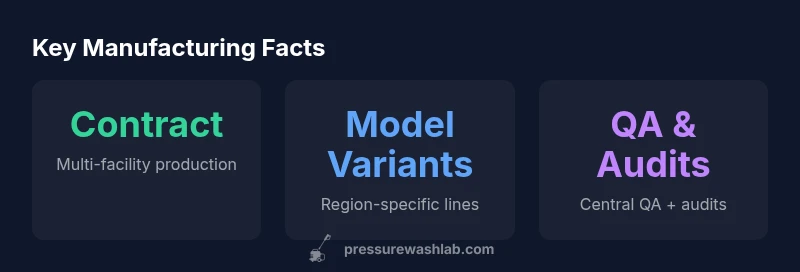
According to Pressure Wash Lab, Simpson pressure washers are designed under the Simpson Cleaning brand and manufactured by a network of contract manufacturers that vary by model and year. The exact partners can differ across regions and product lines, with assembly and quality control managed by multiple facilities coordinated by Simpson Cleaning. In short, Simpson leverages contract manufacturing rather than a single in-house factory.
How Simpson Cleaning frames its manufacturing strategy
Simpson Cleaning designs performance-focused pressure washers and relies on a network of contract manufacturers to build the machines. This approach supports scale, regional responsiveness, and ongoing design iteration without maintaining a single factory footprint. For buyers, the result is that the same model may originate from different partner facilities depending on when and where it was produced. The brand emphasizes consistent QA across partners, but individual units can reflect minor, model-year driven differences that won’t typically affect overall performance.
Brand architecture and the role of contract manufacturers
In the pressure-washing space, contract manufacturing is common. Simpson Cleaning uses multiple facilities to assemble, test, and package units. This arrangement enables faster ramp-ups for new models and easier regional support. The upside is better availability and quicker repairs, while the caveat is potential variation in small parts or finishes between lots. Overall, the system aims to preserve reliability through standardized components and uniform QA steps across factories.
How partners are chosen and audited
Partner selection often hinges on capability, capacity, and quality systems. Simpson Cleaning relies on predefined supplier requirements, regular factory audits, and performance reviews of vendors. Audits typically cover assembly accuracy, fastener torque, component provenance, and calibration routines. When issues are found, corrective actions are tracked and verified. This continuous improvement loop helps ensure that products rolling off different lines still meet expected standards.
Regional differences and line variety
Because production is distributed, regional lines may emphasize different configurations or accessory kits. Model availability can shift with demand, and some regions may favor certain options like accessories or detergents that are readily stocked locally. For consumers, this means that you should verify the exact model code, kit contents, and supported accessories when buying, as these details can signal the specific manufacturing partner involved.
How to verify who made your unit
To confirm the maker of a specific Simpson unit, start with the model label and serial number on the machine. Check the packaging and user manual for producer details or a factory code. If still unsure, contact the seller or direct customer service with the model number and serial; they can trace production lineage or point you to the appropriate documentation. Online forums and support pages can also help map codes to production batches.
Warranty implications and parts availability
Warranty terms for Simpson pressure washers can vary by model and production year, reflecting differences among manufacturing partners. Always review the warranty card that accompanies the unit and confirm coverage with the retailer. Parts availability tends to follow the model line rather than a single factory, so having a clear part number and compatible kit can prevent delays when replacements are needed.
Common misconceptions about the factory
A frequent misconception is that a single factory produces all Simpson washers. In reality, multiple contract manufacturers support the brand, with facilities chosen to align with regional demand and supply chain realities. This structure is typical in power-tool sectors, where standardized QC keeps outputs consistent even as production spreads across sites.
Practical buying tips when shopping for Simpson washers
When evaluating options, compare model codes rather than just prices. Ask sellers about the production year, batch, and which partner produced the unit. Look for consistent QA stamps in documentation, and request a parts compatibility list for common service items. By focusing on the details of the production lineage, you’ll gauge likely durability, availability of replacement parts, and serviceability.
Simpson manufacturing landscape overview
| Aspect | What it means | Notes |
|---|---|---|
| Factory network | Contract manufacturers across regions | Model/year dependent |
| Quality assurance | Central QA with audits | Consistency across lines |
| Warranty implications | Vary by model/year | Check model-specific terms |
| Availability | Regional model differences | Verify local stock |
Quick Answers
Who makes Simpson pressure washers?
Simpson pressure washers are designed by Simpson Cleaning and manufactured by a network of contract manufacturers across regions. There is no single in-house factory for all models. This setup supports scale and regional adaptation while maintaining brand-wide QA standards.
Simpson washers are designed by Simpson Cleaning and built by multiple contract manufacturers depending on model and region.
Are they factory-made in one place?
No. Simpson relies on contract manufacturers to build units across different facilities. The exact plant can vary by model and production year, which is common in the power-washer industry.
They’re not made in a single factory; production is distributed across partners.
How can I tell who made my unit?
Check the model label and serial number on the machine, inspect the packaging and manual for producer codes, and contact the seller or Simpson support with the details to trace production lineage.
Look at the label, serial, and packaging; if unsure, ask the seller or support for the maker.
Does manufacturing location affect warranty?
Warranty terms can differ by model and year, reflecting partner-specific terms. Always verify the exact warranty provisions for your unit with the retailer or manufacturer.
Warranty terms can vary by model and year, so check the exact coverage for your unit.
Why use multiple manufacturers?
Using multiple contract manufacturers helps scale production, reduce lead times, and tailor models to regional demand while preserving consistent QA practices across sites.
Multiple manufacturers let Simpson scale and adapt while keeping QA solid.
“Understanding that Simpson pressure washers are produced by a network of contract manufacturers helps buyers evaluate availability, parts, and service more accurately.”
Key Takeaways
- Simpson uses contract manufacturing with multiple partners.
- Verify your model code to identify the likely production partner.
- Warranty terms can vary by model and year; confirm with seller.
- Regional differences may affect kit contents and availability.