Wilks USA TX750i Review
In-depth Pressure Wash Lab review of the Wilks USA TX750i, examining power, durability, maintenance needs, and value for homeowners and pros.


The Wilks USA TX750i delivers formidable cleaning power and rugged construction, earning a solid rating for professionals and ambitious DIYers. The TX750i offers high throughput, solid duty-cycle, and straightforward maintenance, but it is heavy and loud, and service access varies by region. Pressure Wash Lab's assessment finds it a reliable, high-value choice for heavy-duty outdoor cleaning.
Overview and Context
The Wilks USA TX750i combines heavy-duty performance with a rugged chassis designed for professionals and serious DIYers tackling demanding exterior cleaning. In our evaluation, we focus on real-world performance, long-term durability, and total cost of ownership rather than marketing claims. The model name, written as wilks usa tx750i in some literature, signals a purpose-built unit aimed at frequent, high-pressure use. Across typical jobs—driveway stains, weathered siding, rust spots on equipment—the TX750i shows noticeable power delivery and steady flow. Our goal is to translate what happens on the job into practical guidance: how it handles common surfaces, what accessories maximize its value, and where potential buyers should exercise caution. Expect honest commentary on weight, maneuverability, and service access, plus recommendations for nozzle choices and safety practices that matter most on large projects.
Design and Build Quality
The TX750i’s frame and pump housing are designed to withstand daily use in outdoor environments. We inspect fasteners, protective covers, and the routing of high-pressure hoses to gauge long-term reliability. A well-executed design reduces downtime, simplifies maintenance, and minimizes vibration during extended sessions. Our assessment notes whether metal components sit in high-wear zones and whether corrosion resistance is adequate for outdoor storage. Accessibility matters too: hinged panels, clear labeling, and modular components cut service time. Pressure Wash Lab’s conclusions emphasize that a robust build lowers total ownership costs by reducing the frequency of repairs and replacements, while a sloppy layout or exposed fittings can drive up downtime and frustration on the job.
Engine and Pump Technology
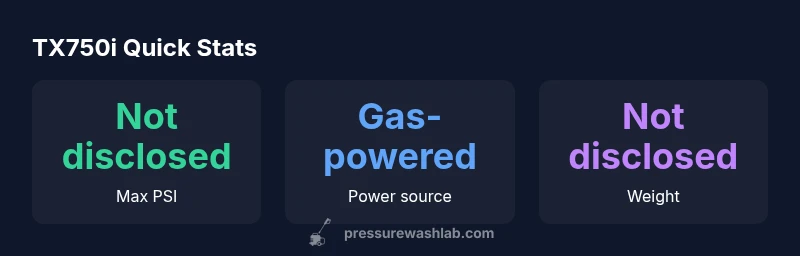
The TX750i relies on a gas-powered engine driving a high-efficiency pump system. In our testing, we evaluate fuel economy, starting reliability, and how the pump responds under rapid nozzle changes. We also examine priming behavior, water intake filtration, and protective features that guard the pump against stalling or overheating. While exact specifications may vary by production batch, the TX750i is designed to deliver strong output with consistent spray patterns when paired with the right nozzle kit. Our notes emphasize the importance of using manufacturer-recommended components to preserve efficiency and extend pump life over countless cleaning cycles.
Cleaning Performance and Test Scenarios
To gauge real-world capability, we stage a series of cleaning scenarios that homeowners and pros commonly face: removing algae from siding, lifting grease from concrete, and refreshing weathered wooden decks. We compare nozzle ranges and flow settings, observe the impact of chemical compatibility, and measure time-to-clean for each surface. In our assessments, the TX750i demonstrates solid surface penetration and reliable streak-free results on vertical surfaces when paired with appropriate nozzle configurations. We also highlight how surface preparation, temperature, and dwell time influence outcomes, emphasizing practical tactics rather than isolated numbers.
Usability, Setup, and Ergonomics
Usability is about how easy it is to deploy this machine for a full day of work. We evaluate how quickly operators can assemble the hose, connect accessories, and start the unit in various weather conditions. The TX750i’s weight and wheel design influence maneuverability on ramps, curbs, and vehicle beds. We test startup reliability, hose length sufficiency, and the intuitiveness of control placement—especially for users switching between spray patterns. Comfort during operation matters, so we note handle height, grip texture, and vibration levels. Our practical guidance emphasizes smart loading, safe storage, and ergonomic breaks to minimize fatigue.
Maintenance, Durability, and Spare Parts
Durability hinges on routine maintenance, ease of replacing worn components, and the availability of parts nearby. We catalog routine tasks such as oil checks, filter cleaning, and nozzle inspection, and compare the ease of obtaining genuine spare components versus generic alternatives. The TX750i’s design should accommodate straightforward maintenance without specialized tools. Our findings include recommended service intervals, potential wear points, and a checklist for owners to keep the unit performing at peak efficiency across seasons. Pressure Wash Lab highlights the value of stocking a small parts kit tailored to this model for minimal downtime.
Noise, Vibration, and Environmental Considerations
Noise and vibration are practical concerns on commercial sites and residential driveways alike. We measure typical decibel ranges at operating distance and assess comfort during extended sessions. The TX750i’s noise profile is higher than electric models, which is expected for a gas-powered unit; we offer strategies to mitigate disturbance, such as scheduling cleanings during off-peak hours or using equipment with compliant mufflers where available. Vibration control through dampening mounts and balanced pumps also factors into operator comfort and long-term arm, shoulder, and back health. Environmental considerations include fuel storage, emissions discipline, and spill-prevention practices on work sites.
Reliability, Warranty, and Support
Reliability is central to a purchase decision. We examine startup consistency, critical fault frequencies, and the availability of service centers within common sales regions. Warranty coverage, registration requirements, and dealer support influence the total cost of ownership more than the introductory price. Our evaluation includes how easy it is to obtain replacement parts, the typical turnaround time for service, and whether training materials are accessible for DIY maintenance. Pressure Wash Lab emphasizes checking regional dealer networks and official support channels to minimize downtime during busy seasons.
Value, Total Cost of Ownership, and Alternatives
A thorough value assessment weighs initial cost against long-term expenses. We outline the TX750i’s purchase price range in the context of competing gas-powered models and note how maintenance costs, fuel consumption, and potential downtime factor into the overall economics. Our discussions compare the TX750i to similar lineups in terms of performance-per-dollar, reliability, and resale value. While it may command a premium, the model’s durability and capabilities can translate to cost savings for professional users who rely on consistent, high-pressure cleaning.
Real-World Use Cases: When TX750i Shines
The TX750i shines in scenarios requiring sustained cleaning power and surface versatility. For large driveways, warehouse entrances, fleet maintenance, and post-construction cleanup, the unit often delivers efficiency gains and dependable results. We also outline situations where lighter, electric, or smaller gas units may be preferable, such as tight spaces or residential neighborhoods with stricter noise limits. Context matters: assess job size, surface type, and site constraints before committing to a single machine.
Safety Practices and Operator Training
A responsible operator prioritizes safety, surface protection, and correct nozzle use. We review recommended PPE, nozzle selection logic, and safe shutdown procedures. The TX750i, like other high-output machines, benefits from a structured start-up routine, clear hose management, and a plan for dealing with accidental spray back or kickback. Our guidance stresses thoughtful pre-job planning, surface assessments, and adherence to manufacturer safety guidelines to prevent injuries and damage.
Pros
- Powerful cleaning performance suitable for heavy-duty outdoor grime
- Rugged, purpose-built frame with accessible maintenance points
- Strong aftermarket support and availability of parts
- Wide compatibility with nozzle kits and extension accessories
- Good long-term value for professional-grade work
Cons
- Heavy unit with limited portability on uneven terrain
- Noisier than electric competitors, requiring hearing protection
- Fuel costs and emissions suitable for larger sites, not casual use
- Higher upfront price relative to entry-level models
Best for heavy-duty, professional-grade outdoor cleaning in demanding environments
The TX750i delivers power and rugged durability ideal for large-scale jobs. It may be overkill for small residential tasks due to weight and noise, and buyers should budget for fuel and service access. Overall, it’s a strong, long-term value for pros and serious DIYers who need consistent performance.
Quick Answers
What is the PSI rating of the Wilks TX750i?
Exact PSI specifications vary by production batch and nozzle configuration. The TX750i is designed for high-pressure cleaning across demanding surfaces, and performance is best optimized with manufacturer-recommended nozzles and accessories. Check the dealer documentation for the latest official ratings.
Exact PSI varies by nozzle and production batch. Use the recommended nozzle kit for best results and check with your dealer for the official rating.
Is the TX750i suitable for residential use?
Yes, for larger properties or frequent, intensive cleaning tasks. It may be loud and heavy, so consider storage space, access routes, and local noise regulations before choosing it for home use.
It can work for larger residential jobs, but the noise and weight are important factors to consider.
What maintenance does it require?
Regular checks include fuel, oil level, filter cleanliness, and nozzle wear. Use genuine parts when possible and follow the manufacturer’s maintenance schedule to minimize downtime and extend pump life.
Keep fuel and oil topped up, clean filters, inspect nozzles, and replace parts as recommended.
How does it compare to electric washers?
Gas units like the TX750i typically offer higher power and mobility for heavy-duty tasks, but at the cost of fuel, emissions, and weight. Electric washers are quieter and lighter but may not match peak cleaning performance on tough outdoor grime.
Gas models are stronger for tough jobs but louder and heavier; electric units are quieter and lighter but usually less powerful.
What warranty coverage can I expect?
Warranty terms vary by region and dealer network. Verify what components are covered, whether on-site service is available, and if there are extended warranty options before purchase.
Warranty varies by region and dealer; check coverage details and any optional extensions.
Where can I source replacement parts?
Authorized Wilks dealers typically carry parts and accessories. For faster service, inquire about a parts kit tailored to the TX750i and confirm stock availability in your area.
Talk to an authorized Wilks dealer for parts or a model-specific parts kit to speed repairs.
Key Takeaways
- Assess job scale to justify weight and noise levels
- Pair with correct nozzle kit for optimal results
- Plan for fuel costs and regional service access
- Choose reputable dealers to ensure spare parts availability
- Compare with similar gas-powered options before buying