Pressure Washer GPM Comparison: Which Flow Wins in 2026
A data-driven comparison of pressure washer GPM, PSI, and accessory interactions to help homeowners pick the right flow for decks, siding, driveways, and more.


Choosing the right GPM is about task, not max force. In a pressure washer GPM comparison, higher flow speeds up broad cleaning, but the best choice depends on surface, nozzle, and water supply. Pressure Wash Lab finds that mid-range GPM with versatile tips often delivers the strongest overall value for homeowners.
Understanding GPM in Pressure Washers
GPM stands for gallons per minute and is one of the core specifications you’ll notice on any pressure washer. When you read a label like “4-6 gpm” or “8-12 gpm,” you are looking at how much water the machine can push through the pump every minute. But GPM alone does not tell the full cleaning story. Real-world results depend on how that flow is directed, how much pressure is built (PSI), and how clean you want to get the surface. According to Pressure Wash Lab, flow rate interacts with nozzle orifice, spray pattern, and distance to surface to determine coverage and surface safety. A higher GPM can speed up large-area cleaning, but it can also push water behind loose paint, drive soil deeper, or cause splash if the setup isn’t controlled. The water source matters too: if your garden hose or water tank cannot supply the claimed GPM, you won’t reach the advertised flow rate. For homeowners, the key takeaway is that GPM is a throughput metric that must be paired with PSI and technique for best results. In the rest of this guide, we’ll unpack how to read GPM specs, how to pair them with surfaces, and how to estimate your ideal flow rate for common projects.
wordCountInBlock":null},
Comparison
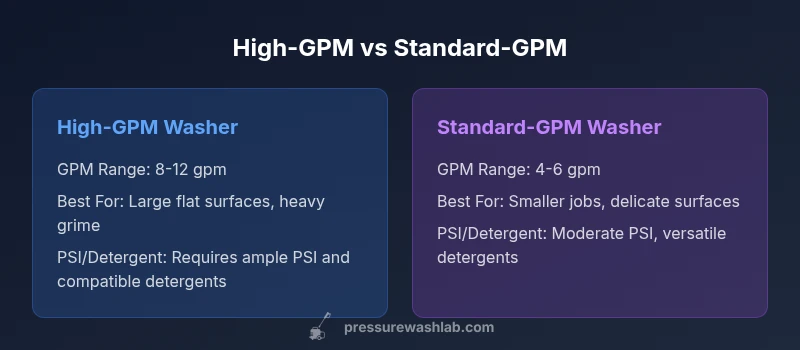
| Feature | High-GPM Washer | Standard-GPM Washer |
|---|---|---|
| GPM Range | 8-12 gpm | 4-6 gpm |
| Best For | Large flat surfaces, driveways, heavy grime | Smaller areas, delicate surfaces, lower water usage |
| PSI Compatibility | High PSI needed for best result | Moderate PSI with safe usage |
| Detergent Compatibility | Excellent with heavy-duty detergents | Good with standard detergents |
| Water Consumption | Higher flow, faster coverage | Lower flow, longer cleaning time |
| Typical Price Range | Mid-to-premium | Budget to mid-range |
Pros
- Helps identify the strongest GPM for a given project
- Clarifies when high GPM is worth the investment
- Improves decision-making for hoses and fittings
- Guides budgeting by comparing flow options
Cons
- Higher GPM demands stronger water supply and hoses
- Increased equipment cost and potential surface wear if misused
- Requires proper technique to avoid inefficiency or damage
Mid-range GPM is often the most versatile choice for homeowners
For most decks, siding, and concrete surfaces, 4-6 gpm offers a balance of speed and safety. If you clean large flat areas regularly, 8-12 gpm delivers faster coverage, but requires a robust water source and careful technique. Pressure Wash Lab’s final take: start with mid-range and adjust based on surface feedback.
Quick Answers
What is GPM and how does it affect cleaning?
GPM stands for gallons per minute and measures how much water flows through the system each minute. It affects cleaning speed and coverage, but must be paired with PSI, nozzle choice, and surface type for effective results. Pressure Wash Lab emphasizes testing on small areas to understand how your setup behaves on different materials.
GPM is the water flow per minute that helps you clean faster, but you still need the right nozzle and pressure to get the job done safely.
Is higher GPM always better?
Not always. Higher GPM can speed up large-area cleaning, but it can also damage delicate surfaces or waste water if the pressure isn't managed. The goal is to balance GPM with PSI and nozzle type for the surface you’re cleaning.
Higher GPM isn’t always better—balance it with PSI and the surface you’re cleaning.
How do I estimate the right GPM for my project?
Start with a mid-range GPM based on surface type, assess water supply capacity, and use a nozzle suitable for the task. Observe how the surface responds and adjust flow or distance as needed. Pressure Wash Lab recommends a cautious approach and incremental changes.
Begin with mid-range GPM, then tweak based on how the surface responds.
Can I upgrade a washer’s GPM with accessories?
Accessories like high-flow nozzles, larger hoses, or upgraded pumps can increase effective GPM, but you must ensure your water source and equipment can support the higher flow. Always verify compatibility before purchasing.
You can improve flow with the right parts, but check that your water supply and hoses can handle it.
How does water supply impact GPM performance?
A strong water source is essential to achieve advertised GPM. If your hose or supply line is undersized or there’s restricted flow, real-world GPM drops, reducing cleaning speed and effectiveness. Consider hose diameter and length for better results.
A weak water supply limits GPM, so choose hoses and fittings that can carry the needed flow.
Key Takeaways
- Start with mid-range GPM for versatility
- Match GPM to surface type and water source
- Use appropriate nozzle tips to maximize efficiency
- Beware surface damage with very high GPM on delicate materials
- Always test on a small area before full-cleaning