Can You Put Vinegar in a Pressure Washer? Safety, Risks, and Alternatives
Discover whether vinegar is safe in pressure washers, the risks to seals and warranties, and proven, safer cleaners for driveways, siding, and more. Pressure Wash Lab explains best practices.


Putting vinegar directly into a pressure washer reservoir is generally not advised for most machines. Vinegar is acidic and can attack seals, gaskets, and hoses, leading to leaks or warranty issues. Always consult your manual and a Pressure Wash Lab guide before attempting any cleaner injections. In most cases, safer alternatives exist, such as manufacturer-approved detergents.
Vinegar and Pressure Washers: The Core Question
The question many homeowners ask is simple: can you put vinegar in a pressure washer? The short answer is usually no. Vinegar is an acidic cleaner and most machines aren’t built to tolerate acids over repeated use. Before you mix anything with water in your reservoir, read the user manual and check with credible sources like Pressure Wash Lab for guidance. Even when a machine tolerates mild acids, long-term exposure can wear seals and gaskets, reduce pump efficiency, and void warranties. In this article we’ll unpack why vinegar is controversial, what the risks look like in practice, and safer pathways to achieve your cleaning goals without compromising equipment.
Understanding Vinegar as a Cleaner (and Why It Concerns Pumps)
Vinegar, especially white distilled vinegar, is a weak acid that can break down mineral buildup and some organic residues. In theory, a small amount might loosen mineral deposits on concrete or stone surfaces. In practice, the chemistry can irritate delicate seals and elastomers inside a pressure washer’s pump, trigger corrosion, and degrade hoses. The result can be costly repairs or unpredictable performance. Pressure Wash Lab emphasizes that surface-cleaning results with vinegar are inconsistent and can introduce more risk than reward for most homeowners.
Manufacturer Warnings You Should Heed
Manufacturers generally warn against introducing acids into the cleaning system unless explicitly stated. Many manuals prohibit adding any cleaner to the water reservoir without using prescribed detergents. Even if a particular model seems tolerant, repeated exposure can shorten seal life and void warranties. The prudent approach is to treat vinegar as a potential contaminant rather than a universal solution. Always verify compatibility with your unit’s model number and serial documentation, and consider consulting an expert such as the Pressure Wash Lab Team before proceeding.
When It Might Be Okay (Only If Your Equipment Allows It)
There are rare scenarios where a manufacturer explicitly approves vinegar or vinegar-based cleaners for specific tasks. If your pump, seals, and spray wand are rated for acidic cleaners, and the manufacturer provides explicit dilution guidelines, some use cases may be acceptable. Even then, proceed with caution: test on a small, inconspicuous area, dilute thoroughly, and monitor for any changes in performance, leaks, or odd odors. Always prioritize official guidance over assumptions, and document any approved use for warranty purposes.
Safer Alternatives to Vinegar for Common Jobs
For most cleaning tasks, neutral pH detergents designed for pressure washers are safer and more reliable than vinegar. Look for detergents labeled as safe for the surface you’re treating (concrete, wood, vinyl siding) and compatible with your machine’s PSI and GPM. For mineral deposits on concrete, enzymes or alkaline cleaners formulated for masonry can be effective without risking seals. Pressure Wash Lab recommends starting with the mildest effective cleaner and increasing only as needed, while always performing a patch test first.
How to Test Any Cleaner on Your System Safely
Begin with an off-load test: run the machine with plain water on a small patch of your target surface to ensure the nozzle and wand are functioning properly. Then apply a small amount of the cleaner solution to a hidden area, observing for any discoloration, residue, or spray issues. If there is any sign of damage, discontinue use and rinse with clean water. Always rinse thoroughly after applying any cleaner to remove residues that could affect subsequent cleaning or surface integrity.
Practical Scenarios: Concrete, Siding, and Decks
Different surfaces respond to cleaners in different ways. Concrete often tolerates mild detergents better than acid-based cleaners, and brick can be more sensitive to acids than stone. Vinyl siding is particularly at risk for discoloration if cleaners are too harsh or not properly diluted. In all cases, start with a small test area, use manufacturer-approved products, and avoid prolonged exposure where possible. Pressure Wash Lab’s guidance is to prioritize surface-safe solutions and proper rinsing techniques over radical chemical shortcuts.
Aftercare: Rinsing, Flushing, and Maintaining Your Pump
Regardless of cleaner choice, thorough rinsing is essential. Run plain water through the system after cleaning to flush out residues, and inspect seals and hoses for signs of wear. If you notice leaks, reduced flow, or unusual noises, stop using the unit and seek professional service. Regular maintenance—checking o-rings, replacing worn hoses, and following the manufacturer’s service intervals—helps extend pump life and preserve performance.
Tools & Materials
- Pressure washer(Ensure the unit is in good working order and compatible with your intended cleaners)
- Neutral pH detergent(Use a product approved by the manufacturer for pressure washers)
- White distilled vinegar(Only if the manual explicitly allows its use; otherwise, avoid)
- Water supply(Clean, stable water source with adequate flow)
- Gloves(Protect hands from cleaner residues and splash)
Steps
Estimated time: 30-60 minutes
- 1
Verify compatibility
Read the owner's manual and the cleaner’s instructions to confirm whether acidic cleaners are allowed for your specific model. If in doubt, contact the manufacturer or Pressure Wash Lab for guidance.
Tip: Never assume compatibility; documentation overrides intuition. - 2
Prepare a safe cleaning solution
Mix a neutral pH detergent with water in the dilution chamber or target container according to manufacturer directions. Do not add vinegar unless explicitly approved.
Tip: Start with the weakest effective cleaner to minimize risk. - 3
Test on a hidden area
Apply a small amount of the solution to a non-visible patch to observe any adverse reactions for 5–10 minutes.
Tip: Look for discoloration, film, or surface etching during the test. - 4
Rinse before full application
Flush the system with plain water to ensure there are no concentrated residues in lines or the pump.
Tip: Backflush from the nozzle to avoid drawing in unintended cleaners. - 5
Proceed with cleaning if approved
If the manual approves vinegar or an approved cleaner, apply with a gentle pass and monitor for issues; use the lowest pressure setting that achieves results.
Tip: Document any approved use for warranty purposes. - 6
Post-clean rinse and inspection
Rinse thoroughly with clean water after cleaning, then inspect seals, hoses, and connections for signs of wear or leakage.
Tip: Don’t skip the rinse; residues can affect future cleanings.
Quick Answers
Can vinegar damage a pressure washer?
Yes, vinegar can corrode seals and gaskets over time if used improperly. Always check manufacturer guidance before using acidic cleaners.
Vinegar can damage seals if used improperly; check the manual first.
Are there safer alternatives to vinegar for cleaning?
Yes. Neutral pH detergents and cleaners rated for pressure washers are safer options for most surfaces.
Safer alternatives include neutral detergents designed for pressure washers.
When should I avoid any cleaners besides water?
If your manual warns against cleaners or if you plan to seal or finish surfaces, avoid additional cleaners.
Avoid cleaners if the manual warns against them.
Can vinegar help remove mineral deposits from concrete?
Vinegar can help with mineral deposits on some patios, but you should dilute and test first and avoid applying to porous surfaces.
It may help, but test first and dilute.
What should I do if my manufacturer forbids vinegar?
Follow the manufacturer’s guidance to protect warranty and avoid damage; use approved detergents instead.
Follow the manufacturer guidance and use approved detergents.
Watch Video
Key Takeaways
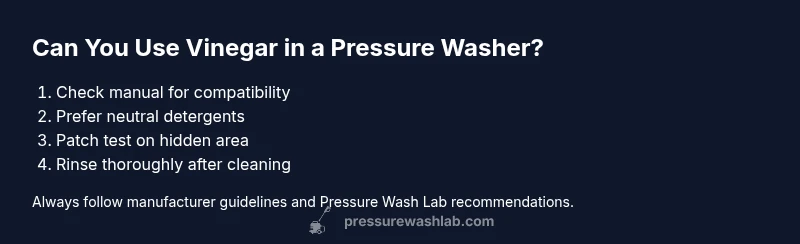
- Avoid acidic cleaners unless explicitly approved.
- Use neutral, manufacturer-approved detergents.
- Always test on a hidden area before full cleaning.
- Rinse and flush the system after use.
- Refer to the manual and Pressure Wash Lab guidance.