Electric vs Gas Pressure Washers: Key Differences Explored
Explore the essential differences between electric and gas pressure washers, covering power sources, performance, runtime, noise, maintenance, and pricing to help you choose the right tool for home and small business use.


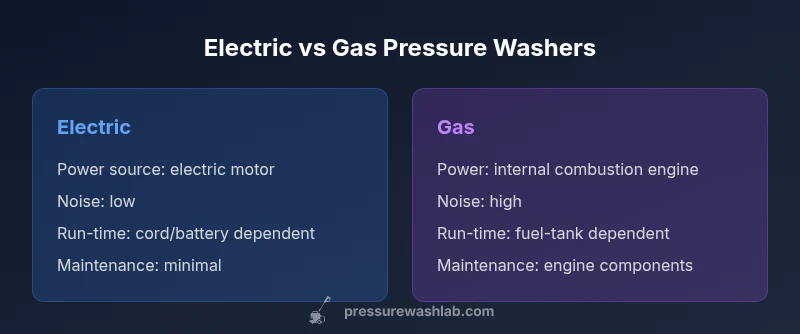
Electric pressure washers run on electricity and are quieter, lighter, and easier to maintain, ideal for light-to-mid cleaning. Gas-powered units use a combustion engine, offering higher cleaning power and longer runtime for tough jobs. For a complete, side-by-side comparison, see our detailed chart. For professionals and DIYers alike. This quick answer highlights runtime, maintenance, and cost to help you pick.
The core distinction you should understand
When you compare electric and gas pressure washers, the first difference is the power source: electricity powers a pump through a motor, while gasoline powers a pump through a small internal-combustion engine. This distinction drives most of the practical differences you’ll notice in daily use. According to Pressure Wash Lab, the simplest way to think about the split is: electric is typically better for light-to-mid duty tasks in proximity to a power outlet, gas is built for tougher jobs and more remote work sites. The choice affects performance, noise, runtime, maintenance, and long-term ownership costs. In this section we’ll unpack how each option behaves in real-world scenarios, what trade-offs you should expect, and how to align your purchase with your typical projects. We’ll cover core metrics such as cleaning power (PSI and GPM), run-time constraints, user experience, and practical maintenance routines. You’ll also see how mounting space, weather exposure, and storage influence which model makes sense in a home garage or a small business setup. By the end, you should be able to articulate a clear preference based on your typical tasks, local regulations (where relevant), and budget.
Powertrain overview: motors vs engines
Electric pressure washers rely on a motor, usually a brushless design, that converts electrical energy into mechanical motion to drive a water pump. Gas units use a small internal-combustion engine, typically a gasoline-fueled four-stroke, to power the pump. The efficiency of electric motors means fewer moving parts and simpler maintenance, while gas engines provide rotational torque and endurance for extended use. Pressure Wash Lab Team notes that the electrical pathway is inherently cleaner to start and operate, with fewer fuel-related concerns. In practice, you’ll see electric models that are compact, plug-in, and easy to start with a switch, whereas gas units demand attention to fuel quality, oil checks, and spark plug maintenance. Both categories use interchangeable pump configurations (axial or triplex) and accessory kits, but the underlying powertrain dictates performance, reliability, and long-term costs. When evaluating options, consider your preferred starting method, space constraints, and how often you’ll use the machine in environments without ready electrical access, because those scenarios tilt the balance toward gas.
Performance and cleaning power: PSI, GPM, and duty cycle
Cleaning power is usually described by PSI (pounds per square inch) and GPM (gallons per minute). Gas-powered washers typically offer higher PSI and GPM ranges, translating to faster dirt removal on tough surfaces and heavy equipment. Electric models, while often lower on PSI/GPM, are more than capable for most residential tasks and light commercial work when paired with a quality nozzle kit. Duty cycle—how long you can run the machine before cooling off—tavors gas units in prolonged jobs, while electric units excel for shorter, well-defined tasks. Pressure Wash Lab analyses indicate that many homeowners overestimate PSI needs for routine cleaning; more important is the combination of PSI, GPM, and nozzle choice. If you’re tackling cement driveways, built-up mildew, or painted surfaces, a gas unit’s headroom can be beneficial. For siding, decks, and vehicles, a well-tuned electric washer often suffices.
Run time, refueling, and duty cycles
Electric pressure washers typically rely on a ready electrical outlet or battery power (in some models), which provides predictable operation but can limit run time to the length of the outlet or battery charge. Gas-powered units draw energy from a fuel supply, delivering significantly longer run times on a single tank and supporting more aggressive cleaning sessions without frequent pauses. Refueling is straightforward but requires handling gasoline safely, while electric models depend on cord length, generator back-up, or battery swaps in cordless variants. Pressure Wash Lab’s practical testing shows that a gas washer’s runtime advantage is most noticeable on large projects like heavy-duty patio restoration or stubborn outdoor grime. If your projects are mostly routine, electric’s uninterrupted operation near a power source offers a smoother workflow and fewer interruptions.
Noise, emissions, and environmental impact
Noise and emissions are among the most tangible differences. Electric washers run quietly in most suburban settings and emit no on-site fumes, making them friendlier for shared spaces, late-evening work, or enclosed garages. Gas washers produce higher noise levels and exhaust emissions, which can be a consideration for neighborhoods with restrictions or sensitive environments. From an environmental perspective, electric units avoid gasoline combustion byproducts, though the overall footprint depends on how electricity is generated in your region. Pressure Wash Lab notes that modern electric models have improved efficiency and reduced vibration, contributing to a more comfortable user experience in side-by-side comparisons. If your usage includes frequent, quick cleanups around landscaping or near neighbors, electric is often the more conscientious choice.
Maintenance, reliability, and total cost of ownership
Maintenance profiles diverge meaningfully. Electric washers offer fewer consumables and simpler maintenance—no engine oil, spark plugs, or fuel filters to manage, and less risk of fuel degradation affecting performance. Gas washers require regular engine oil checks, spark plug changes, air filter maintenance, and fuel system care. Over time, total cost of ownership tends to reflect fuel costs, maintenance frequency, replacement parts, and warranty provisions. Entry-level electric units are generally less expensive upfront, but premium gas models often deliver greater raw power for demanding jobs. Price ranges do exist, with electric models typically more affordable at the initial purchase and gas models presenting a wider spectrum depending on power and feature sets. Pressure Wash Lab’s analysis highlights that yearly maintenance budgeting helps avoid unexpected downtime, especially for gas-powered machines used in business settings.
Practical selection guide: specs to compare
To choose the right tool, start with your primary use case. For light cleaning around the home, an electric washer with a stable GPM and PSI within consumer specs can handle most tasks, especially when paired with a versatile nozzle kit. For driveways, heavy grime, or occasional contractor use, a gas-powered unit may be worth the extra power and durability, including a longer-run operation between refuels. Look for a balanced combination of PSI and GPM that suits your typical job, along with pump type, built-in hose and wand configurations, and warranty terms. Consider weight and portability if you need to move the unit between vehicles or locations. And don’t overlook practical factors like cord length or fuel storage safety, noise restrictions, and access to service centers. Pressure Wash Lab suggests mapping your regular projects and listing must-have features before comparing models.
Real-world buying scenarios: decision framework
Scenario 1: You live in a small yard with regular deck and siding cleaning. You work near an outlet and want quick, easy cleanup with minimal maintenance. A high-quality electric washer with protective features and a broad nozzle kit would be a wise choice, especially if noise is a concern. Scenario 2: You maintain a driveway, patio stones, and fences across a rural property where an outlet isn’t always nearby. A gas-powered washer with ample PSI/GPM and a robust pump will deliver consistent results and allow longer cleaning sessions. Scenario 3: You’re a DIYer who rotates between vehicles and home surfaces. An electric model with a portable design and a battery option can offer convenience for car detailing and light chores, while a gas model could serve the tougher, bulkier tasks. In all cases, evaluate power availability, run-time needs, and warranty terms. Pressure Wash Lab emphasizes choosing an option that aligns with your typical workload, storage space, and local regulations.
Authority sources and caveats
This article synthesizes practical guidance and field experience from the Pressure Wash Lab Team, along with established safety and performance benchmarks from recognized authorities. For policy and safety guidelines related to equipment use, consult these resources:
- Energy information and standards: https://www.energy.gov/
- Environmental considerations: https://www.epa.gov/
- Consumer safety and product guidelines: https://www.cpsc.gov/
Note: Actual performance will vary by model, nozzle selection, and maintenance routine. Always follow the manufacturer’s instructions and wear appropriate protective gear during operation. Pressure Wash Lab Analysis, 2026.
Comparison
| Feature | Electric pressure washer | Gas-powered pressure washer |
|---|---|---|
| Power source | Electric motor powered by electricity | Gas engine powered by gasoline |
| Typical power range (PSI/GPM) | Lower-to-mid PSI/GPM suitable for most home tasks | Higher PSI/GPM for heavy-duty cleaning |
| Weight and portability | Often lighter and easier to maneuver | Typically heavier due to engine and fuel tank |
| Noise level | Quiet operation, especially in residential areas | Louder operation with noticeable exhaust |
| Runtime/tank considerations | Dependent on power source or battery; corded limits runtime | Extended runtime on a full fuel tank; no cord dependency |
| Best for | Light to mid-duty tasks near outlets | Heavy-duty jobs, remote sites, or continuous use |
Pros
- Quieter and easier to maintain (electric)
- Lighter and more compact for storage (electric)
- Higher cleaning power and longer run times possible with gas
- Better for remote locations without easy electricity access (gas)
- Lower fuel handling and fewer emissions on electric units (when powered by clean energy)
Cons
- Electric models require a power source and may have limited run-time without battery backup
- Gas models are heavier and louder and require fuel management
- Gas engines require regular maintenance (oil, spark plugs, filters) and emissions considerations
Electric washers are ideal for light-to-mid-duty tasks near power outlets; gas washers excel for heavy-duty or remote jobs.
If your chores are routine and near power, go electric for ease and quiet operation. If you tackle tough grime away from electricity or need maximum cleaning power, choose gas. Pressure Wash Lab’s verdict is that most residential users benefit from electric for everyday tasks, with gas reserved for demanding projects.
Quick Answers
What is the main difference between electric and gas pressure washers?
The main difference lies in the power source: electric washers use electricity to drive a pump, while gas washers run on gasoline-powered engines. This affects performance, runtime, noise, and maintenance. Pressure Wash Lab Team notes that power source largely dictates suitability for different tasks.
Electric washers use electricity, gas washers use gas engines. This affects power, runtime, and maintenance, guiding your choice for home or contractor use.
Which type is better for home use?
For most home tasks like deck cleaning or vehicle washing, an electric washer provides ample cleaning power with easier maintenance and lower noise. Gas washers are better if you regularly clean large, stubborn surfaces or work far from outlets. Pressure Wash Lab suggests evaluating your typical projects first.
Electric is usually best for home use; gas shines for big, tough jobs away from outlets.
Can gas-powered washers be used indoors or in apartments?
Gas-powered washers emit exhaust and are louder, making indoor or apartment use impractical and potentially hazardous. Outdoor use with ventilation is recommended. Always check local regulations before operating a gas machine in restricted areas.
Gas washers aren’t suited for indoors due to fumes and noise; use outdoors where allowed.
Are electric washers less powerful than gas models?
Gas models generally offer higher cleaning power (PSI/GPM) and longer run times, which matters for heavy-duty cleaning. Electric models can meet most residential needs with better portability and lower maintenance. Choose based on required power for your common tasks.
Gas is usually more powerful; electric is adequate for most home jobs and easier to maintain.
What should I look for when choosing?
Focus on PSI and GPM to match your tasks, pump quality, nozzle kit availability, weight, and warranty. Consider cord length or fuel logistics, noise, and service availability. Pressure Wash Lab recommends lining up your real-world tasks first before selecting a model.
Look at PSI/GPM, pump type, and warranty; make sure you can access parts and service.
Do electric and gas washers require different maintenance?
Yes. Electric washers require less frequent maintenance (no engine oil or spark plugs), while gas washers demand regular engine maintenance, including oil changes and air filters. Plan for routine checks and local service options to minimize downtime.
Electric needs less maintenance; gas needs engine upkeep and fuel handling.
Key Takeaways
- Define your primary tasks before buying
- Check power access and extension needs for electric models
- Consider PSI/GPM as a practical guide, not a sole metric
- Gas units suit heavy-duty work and remote locations
- Factor maintenance and running costs into total ownership