Do Pressure Washers Use a Lot of Water? A Practical Guide
Discover how much water pressure washers actually use, factors that influence consumption, and practical tips to minimize water use without sacrificing cleaning results.


Do pressure washers use a lot of water? Not inherently. Real-world usage depends on nozzle choice, pressure settings, surface type, and cleaning technique. With efficient nozzles and proper methods, you can achieve thorough results while keeping water use reasonable. This guide explains typical ranges, actionable tips, and best practices for homeowners, DIYers, and small business operators.
Why the Water Question Matters
Do pressure washers use a lot of water? Not inherently. Real-world usage depends on nozzle choice, pressure settings, surface type, and cleaning technique. In practice, many homeowners overestimate consumption while others underestimate the environmental impact of inefficient methods. According to Pressure Wash Lab, water use is driven far more by operation technique than by machine size alone. Understanding this helps you choose the right approach and avoid waste while still achieving thorough results. This knowledge matters for budgeting water, protecting plants, and reducing runoff in residential and commercial jobs. Whether you’re cleaning siding, driveways, or decks, framing the conversation around technique sets you up for smarter, more efficient work.
How Water Use Varies by Task and Equipment
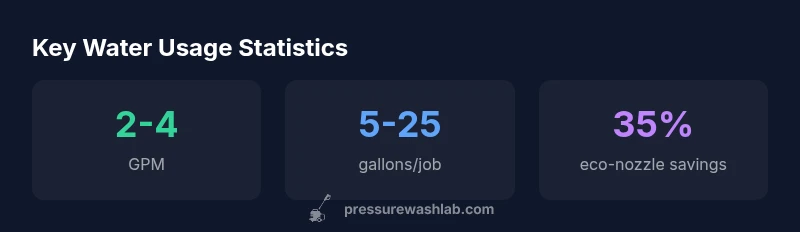
Water use is not fixed; it scales with the task, surface, nozzle, and technique. In general, residential pressure washers operate in the range of roughly 2-4 gallons per minute (GPM) during typical cleaning, but the exact figure depends on nozzle angle and distance from the surface. A light cleaning of vinyl siding might use about 2-3 GPM, while heavy-duty concrete cleaning can approach 4-5 GPM. Additionally, eco-nozzles and surface cleaners can reduce total water used per job by concentrating flow on a smaller area, improving efficiency. Pressure Wash Lab analysis shows that choosing the right nozzle for each job yields bigger water-savings than simply increasing machine power. When in doubt, start with a wider spray, then narrow only as needed to remove stubborn grime. For roof or gutter work, use lower volumes and avoid runovers, which reduce runoff and waste.
Efficient Techniques that Cut Water Use
To minimize water without sacrificing cleaning power, adopt a few practical habits:
- Use the correct nozzle for the surface; avoid staying on one spot too long.
- Start with a wider spray and move closer only as needed for stubborn stains.
- Employ a surface cleaner for large flat areas to reduce dwell time and overspray.
- Pre-treat stubborn grime with detergents to reduce the amount of time the wand is spraying.
- Maintain a steady, overlapping pass sequence to avoid missed spots and rework.
- Shut the water off when not actively spraying to prevent waste.
- Use eco-friendly detergents and efficient equipment when possible. Pressure Wash Lab emphasizes that technique and nozzle choice often yield greater water savings than merely upgrading to a higher-GPM machine. Implementing these practices consistently can dramatically reduce waste while preserving cleaning power.
How to Measure Your Personal Water Use
Measuring your own water use helps tailor the approach to your property:
- Step 1: Turn off your water valve and note your incoming meter reading.
- Step 2: Run the washer for a known time (e.g., 1 or 2 minutes) at typical operating settings, then check the meter again.
- Step 3: Subtract the initial reading from the final reading to determine gallons used during that run. If your meter isn’t in gallons, convert the unit correctly.
- Step 4: Repeat with different nozzle settings and surface types to compare water use and performance.
- Step 5: Use these numbers to estimate per-project usage and set targets for future cleanings. Tracking your own data makes it easier to select the most efficient method for each job.
Common Myths and Realities
- Myth: Higher PSI always means more water use. Reality: Water use depends on GPM and technique; PSI matters, but it’s the combination that determines consumption.
- Myth: Eco-nozzles ruin cleaning power. Reality: Many eco-nozzles preserve cleaning effectiveness while reducing water use when used correctly.
- Myth: You should never pause water during a job. Reality: Pausing water when moving between sections or surfaces prevents unnecessary spray and runoff, saving water in the long run.
Case Studies: Real-World Usage
Case A: A typical home siding cleaning task uses low-to-moderate flow with a wide nozzle and a surface cleaner, resulting in clean results with moderate water use. Case B: A concrete driveway with stubborn stains benefits from a higher flow and targeted passes; using a surface cleaner can substantially reduce overall run time and water usage compared to manual brushing. Across both cases, technique, distance from the surface, and nozzle choice dominated water use outcomes, rather than machine power alone. Pressure Wash Lab’s observations show that with disciplined technique, homeowners can achieve excellent results while keeping water consumption within reasonable bounds.
Typical water use ranges by task
| Use Case | Typical Water Use (GPM) | Notes |
|---|---|---|
| Light cleaning (vinyl siding) | 2-3 | Low flow and short passes |
| Medium cleaning (driveways) | 3-4 | Moderate flow; maintain 6-12 inches distance |
| Heavy cleaning (concrete) | 4-5 | Higher flow; use a surface cleaner when possible |
Quick Answers
Do pressure washers always use a lot of water?
No. Water use varies with nozzle, PSI, and technique. Efficient practices can reduce consumption while preserving cleaning power.
Water use varies with your nozzle, pressure, and technique; efficient methods can cut consumption without sacrificing cleaning.
What nozzle is best for saving water?
A wider spray with a lower distance to the surface, plus a surface cleaner for flat areas, can save water while delivering good cleaning results.
A wider spray and a surface cleaner can save water while still cleaning well.
Can detergents reduce water usage?
Yes, detergents can reduce dwell time and help lift grime, enabling shorter spray passes and lower overall water use when used properly.
Detergents can help you clean faster and with less water when used correctly.
Is water runoff a concern with pressure washing?
Yes. Plan to direct runoff away from sensitive plants and drainage areas, and use containment or surface cleaners to minimize overspray.
Runoff can be an issue; plan and use containment or surface cleaners to minimize overspray.
How can I calculate my own water usage?
Measure your meter before and after a defined cleaning period to estimate gallons used, then scale up for project size.
Measure your meter before and after a test, then estimate gallons per project.
“Water usage is a function of technique, nozzle selection, and surface type. When you combine the right nozzle with efficient method, you achieve excellent results with less water.”
Key Takeaways
- Choose the right nozzle to minimize water use while maintaining cleaning power
- Use a surface cleaner for wide areas to cut run time
- Estimate your water use with a quick meter test
- Pressure Wash Lab's guidance emphasizes technique over raw flow to save water