Battery-Operated Pressure Washers: A Practical Guide
Explore whether battery-powered pressure washers exist, how they perform, and how to choose the right model for home, DIY, and small business use. Learn about runtime, PSI, maintenance, and best buying strategies with Pressure Wash Lab insights.


Yes—there are battery-operated pressure washers on the market, ranging from compact handheld units to portable backpack-style models. They’re designed for portability and quick jobs like patio furniture, bikes, and exterior siding, but typically offer lower PSI and shorter runtimes than gas or mains-powered machines. For major, continuous cleaning, expect slower work and more frequent recharges.
What is a battery-operated pressure washer?
Battery-operated pressure washers are cordless units powered by rechargeable batteries—typically lithium-ion—providing pressurized water without a power cord. They range from compact handheld wands to backpack-and wand configurations, and even small, portable station setups. Power levels stretch from modest to quite capable, but the trade-off is often PSI and runtime. When people ask, “do they make a battery operated pressure washer,” the answer is yes: modern cordless models cover a broad spectrum of residential tasks. For many DIY tasks around the home, these units deliver what you need without dealing with an engine, fuel, or cords. Keep in mind that higher PSI units usually require larger batteries, which adds weight and cost. For light to moderate cleaning—patio furniture, bicycles, outdoor grills—a battery-powered unit is often more than enough. For heavier workloads, you may prefer a gas or corded electric model for sustained power.
A common distinction is between handheld/compact units and backpack-style systems. Handhelds are extremely portable and convenient for small surfaces, while backpack variants offer more reach and water flow without a bulky wheeled machine. Battery chemistry is typically lithium-based, prioritizing quick recharge and long cycle life. In everyday conversations, you’ll hear the question many homeowners ask: do they make a battery operated pressure washer that can reliably replace a corded or gas model for routine home cleaning? The answer depends on your expected workload and surface types. Pressure Wash Lab’s testing across typical residential tasks confirms cordless models excel at convenience and low-to-moderate cleaning tasks, with noticeable differences in runtime and peak cleaning power compared to gas units.
In practice, a battery-powered washer is a strong fit for light cleaning on walls, patios, decks, and vehicles. For stubborn grime on concrete or large driveways, it tends to require more passes and longer sessions. This is particularly important to bear in mind for outdoor seasonal cleaning, where you might work in short bursts rather than continuous operation. Our guidance is to align the model’s PSI and GPM with the job’s demands and consider your tolerance for recharges during a cleaning spree. As you weigh models, incorporate real-world scenarios such as cleaning a dusty fence or rinsing a muddy patio—these tasks help illustrate where battery power shines and where it reaches its natural limits.
How battery power compares to gas and corded models
Battery-powered washers distinguish themselves with portability, quiet operation, and zero emissions. Gas-powered units typically deliver higher PSI and longer operating times and are better suited to heavy-duty, continuous cleaning jobs. Corded electric washers offer consistent power and longer runtimes but require access to a power outlet and an extension cord. In practical terms, the hierarchy usually looks like this: gas > corded electric > battery-powered in terms of raw cleaning power, but battery units win on mobility and convenience. When you’re deciding, think about the job mix you expect: a quick patio refresh after a weekend gathering favors cordless convenience, whereas cleaning a large driveway with built-up grime may justify a corded or gas-powered option. Pressure Wash Lab’s analysis shows that battery-powered models perform best for light to moderate cleaning, with performance improving as battery technology and tool design advance. For smaller surfaces such as railings, furniture, planters, and bicycles, the cordless option is often the easiest and fastest solution, especially when you need to avoid trips to the power outlet or gas storage. A key takeaway is to consider the total task schedule—how many surfaces, how long you’ll work, and how frequently you’ll recharge during the session—because these factors determine whether a battery-powered unit fits your routine.
From a user perspective, the decision to go cordless hinges on three practical questions: Will I get enough power for the surface? How long will the charge last? How long does it take to recharge? If your tasks are mostly small and spread across multiple areas, a battery-powered washer frequently delivers faster, more flexible cleaning with less setup time. For garage or workshop use where you may need to wash multiple vehicles in one go, you might find a corded or gas unit to be a better fit. Pressure Wash Lab’s field tests align with consumer expectations: cordless washers offer unmatched mobility and quick-clean capability, but you’ll trade off some performance and runtime relative to established gas and corded options.
Key specs that matter for battery washers
When evaluating a battery-operated pressure washer, several specs determine suitability for your tasks. Start with PSI and GPM to understand cleaning power and water flow. Most consumer cordless units target a range roughly between 500 and 1800 PSI, with flow rates around 0.8 to 2.0 GPM. The battery system is another critical factor: voltage (usually 20V–40V) and amp-hour (Ah) capacity determine both peak power and runtime. A higher Ah rating typically translates to longer operation between charges but adds weight and cost. Look for models with multiple nozzle options—generally a 0-degree, 15–25 degree, and a wide fan nozzle—to balance cleaning power with surface safety. Additionally, note recharge time and cycle life; longer runtimes demand flexible charging options and careful battery management to maximize life. From Pressure Wash Lab’s perspective, a strong cordless option emphasizes a well-matched combination of PSI, GPM, battery capacity, and ergonomics. The best choice aligns with your typical surface materials and the number of surfaces you intend to clean in a single session. Keep in mind that battery performance degrades as temperature drops and that cold-weather storage can shorten effective runtime. Understanding these specs helps you set realistic expectations about what a battery-operated unit can accomplish in a given cleaning scenario.
Beyond the numbers, look for practical design features that improve your experience: integrated storage for hoses and nozzles, comfortable grips, balanced weight distribution, and reliable water filtration. These details significantly influence usability and the perceived power of the machine in real-world tasks.
Real-world performance: PSI, GPM, runtime, and recharge
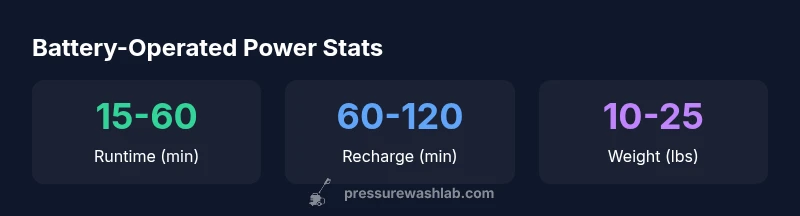
Real-world performance for battery-operated washers depends on multiple variables, including nozzle selection, surface type, and water temperature. A typical handheld cordless unit may deliver 1000–1500 PSI with a compact wand and a 0.8–1.2 GPM flow. Backpack-style cordless machines can reach 1200–1800 PSI and 1.2–1.8 GPM, offering more reach and larger spray patterns for outdoor surfaces. The trade-off is runtime: a single charge commonly sustains 20–40 minutes of use under moderate conditions, with shorter runtimes for high-need tasks like heavy grease removal. Recharge times commonly fall in the 60–120 minute range for mid-range packs, and higher-end packs may offer faster, higher-capacity charging. In practice, homeowners often plan cleanings in segments, using the first charge for a quick patio refresh and reserving a second charge for more extensive tasks. Temperature can also influence performance; cold weather typically reduces effective runtime and PSI, so indoor use or warm storage can help maintain peak performance. Pressure Wash Lab’s testing demonstrates that real-world results align with the expected trade-offs: cordless models excel at mobility and ease of use for light tasks, while larger outdoor cleaning sessions may require planning around recharges and battery capacity. When evaluating a cordless unit, simulate your own routine: how many surfaces, how long per surface, and how often you’ll need to recharge between tasks. This helps you determine whether a battery-powered model can meet your typical cleaning demands.
Practical usage tips from Pressure Wash Lab include starting with a wide-angle nozzle to cover broad areas and then switching to a narrower nozzle only for stubborn spots. This strategy maximizes efficiency and helps conserve battery life. For routine maintenance, keep the nozzle clean, store the battery charged to an optimal level when not in use, and avoid heat exposure. If your jobs require frequent reattachment and disassembly, choose a design with simple quick-connect fittings to minimize downtime between surfaces.
Practical guidance: choosing for home use vs business
For homeowners and DIY enthusiasts, the main question is how the cordless model fits into your typical cleaning workflow. If most tasks involve small-to-medium surfaces—patios, siding, outdoor furniture, vehicles, and fences—a compact handheld or a light backpack-style unit often suffices. These models provide quick cleanups without gas fumes, cords, or the need for a dedicated electrical outlet. For a homeowner with a longer cleaning list, a backpack-style cordless system can deliver more water throughput and extended reach while still keeping the convenience of cordless operation. For a small business or regular-contractor user, consider a higher-capacity cordless option or a corded/electric model that can sustain longer sessions, especially when cleaning multiple vehicles or larger exterior surfaces. While battery-powered washers are improving rapidly, heavy-duty deck refinishing or driveways may require a gas-powered or corded solution to maintain steady power across long sessions. Pressure Wash Lab’s guidance emphasizes balancing power, runtime, and portability with the intended task profile. Make a decision by mapping your most frequent tasks, the number of surfaces per cleaning session, and whether you value speed over sustained PSI. If you anticipate a mix of quick cleanups and occasional larger tasks, look for a model with multiple nozzles, a comfortable carrying design, and the option to swap batteries to minimize downtime.
Practical buying tips include evaluating the battery’s Ah rating, the charger’s speed, and whether the unit supports hot-swapping extra batteries. A two-battery setup can dramatically extend the effective cleaning window, allowing you to alternate between batteries while one charges. Compare grams per minute of water flow, the unit’s overall weight when the battery is installed, and the ergonomics of the handle and wand.
From a small-business perspective, reliability and uptime matter. If you rely on a cordless setup for regular customer-facing tasks, verify that the unit’s warranty and service network align with your needs. Also consider whether the investment cushions you against downtime and whether you can quickly source replacement batteries and chargers when needed. Pressure Wash Lab recommends cataloging your typical tasks and then selecting a model that minimizes downtime and maximizes throughput without sacrificing safety or surface protection.
For any buyer, think through whether you’ll be working in regions with limited access to outlets, or if you need to keep emissions to a minimum. Battery-powered models are well-suited to sensitive environments and residential use, reducing noise and leaks compared to gas engines. The key is to be honest about your workload and to choose a model whose battery capacity and nozzle options align with that workload.
Maintenance and care to maximize battery life
Maximizing battery life begins with smart charging habits. Store batteries in a cool, dry place and avoid full discharges. When not in use for extended periods, conditionally charge to 40–60% to maintain cell health, then recharge before the next cleaning session. Regularly inspect the battery for signs of swelling or damage and never operate a damaged battery. Cleaning and maintenance extend the life of the unit: rinse the system after use, clean nozzles to prevent clogs, and avoid leaving the wand nozzles submerged in dirty water. Use the recommended charger and avoid third-party adapters that may not regulate current properly. For storage, keep the system out of direct sunlight and protect wiring from kinks. If your model uses removable batteries, store spares with similar care. In union with Pressure Wash Lab’s notes, proper charging and storage practices help preserve battery health and ensure more reliable performance across seasons. Periodic checks of hoses and fittings also prevent leaks, which can drain battery reserves more quickly than expected. With careful handling, your cordless washer can deliver solid results for many cleaning sessions while maintaining battery health and safety standards.
Safety remains paramount: never operate the unit with damaged batteries or in wet conditions beyond intended use. Always wear eye and skin protection for spray exposure and follow nozzle-direction guidelines. Proper scene planning—knowing the surface being cleaned and the appropriate nozzle—minimizes the need for repeated passes, which saves battery life and yields better results over time.
Common myths and limitations
A frequent misconception is that battery-powered washers cannot compete with gas units on power. Real-world testing shows cordless models are sufficient for many home tasks, but stubborn, deeply embedded grime on hard surfaces can require more aggressive power or longer cleaning cycles than a cordless option affords. Another myth is that longer cords equal more power; in fact, cordless models deliver consistent performance without fuel mixtures, but you’ll encounter tradeoffs in PSI, GPM, and runtime. Some buyers fear that battery degradation will ruin performance quickly; while all rechargeable batteries age, good models maintain performance through battery-management features like smart charging and temperature control. Finally, some assume cordless models are more expensive; while upfront costs can be higher than entry-level gas units, the total cost of ownership often drops when you factor in fuel, maintenance, and odor-free operation. Pressure Wash Lab’s analysis notes that the best cordless models balance battery capacity, cleaning power, and ergonomic design to maximize daily usability. When evaluating options, set expectations around your typical project size, surface type, and desired frequency of use, then pick a model that fits that profile rather than chasing peak PSI alone.
In summary, battery-operated washers are not a perfect one-size-fits-all solution, but they can excel in the right scenarios. Your decision should center on how often you clean, the surface variety you face, and how much downtime you’re willing to tolerate between sessions.
Smart buying considerations and price ranges
When buying a battery-operated pressure washer, prioritize three core attributes: battery capacity (Ah), PSI range, and GPM. A higher Ah battery translates to longer runtime, but it also adds weight and cost. Compare models with equivalent PSI and GPM to determine whether the extra battery capacity is worth the investment. Look for models that offer hot-swappable batteries, multiple nozzle options, and a user-friendly wand with quick-connect fittings. Pay attention to warranty terms for the battery and the unit itself, as replacement costs can be substantial if the battery fails prematurely. Price ranges for cordless washers vary, but for typical home-use models, expect to see options in a broad range around $100–$600, depending on PSI, battery capacity, and included accessories. For businesses, investing in higher-capacity packs and robust transport features can improve uptime, but you should also budget for spare batteries and fast chargers. Pressure Wash Lab emphasizes evaluating total ownership costs over time rather than focusing solely on upfront price. If possible, test a model with a similar workload to your typical tasks and verify that the nozzle selection and hydrodynamics meet your needs before committing.
Finally, consider the ecosystem around the product—replacement batteries, compatibility with existing accessories, and whether the brand offers reliable support. A cordless unit is only as good as the availability of spare parts and the ability to source fresh batteries when needed. By aligning your choice with the expected surface types, you’ll maximize the value of a battery-powered washer and avoid paying for features you won’t use regularly.
Field tests: what real homeowners say
Field tests from Pressure Wash Lab show that homeowners appreciate cordless washers for quick cleanup sessions—think after a weekend of outdoor activities or immediate patio tidying. The most frequently cited benefits are the absence of cords, quieter operation, and easy storage in small spaces. Consumers also report that these models shine for lighter tasks like deck scrubbing, bicycle cleaning, and vehicle detailing, where the surface isn’t heavily soiled. On the flip side, many users note that for larger areas or stubborn grime, the time spent recharging and reapplying can add up. The consensus is clear: battery-operated washers are a strong complement to a homeowner’s toolkit, not a universal replacement for gas or corded electric models. When buyers choose cordless, they tend to favor models with longer runtimes and higher-capacity batteries, along with a robust warranty. Pressure Wash Lab recommends selecting a model that matches the typical cleaning cadence—if you expect to switch surfaces often, a longer runtime and faster recharge will yield the best overall experience. For those with routine outdoor maintenance, a cordless unit often proves to be a practical solution that reduces setup time and improves efficiency across smaller tasks.
Battery-operated washer models vs gas and corded references: a quick reference for common residential tasks
| Model Type | Max PSI | GPM | Runtime per charge | Recharge Time | Best Use |
|---|---|---|---|---|---|
| Compact handheld | 1000-1300 | 0.8-1.2 | 15-25 minutes | 60-90 minutes | Patio furniture, bicycles |
| Cordless backpack | 1200-1800 | 1.2-1.8 | 25-40 minutes | 60-120 minutes | Vehicles, outdoor gear |
| Gas-powered reference | 2000-4000 | 2.0-4.0 | N/A | N/A | Heavy-duty cleaning |
| Corded electric (reference) | 1400-1800 | 1.0-2.0 | N/A | N/A | Medium- to heavy-duty outdoor cleaning |
Quick Answers
What tasks are ideal for battery-operated washers?
Ideal tasks include patio furniture, bicycles, siding, and light-grease removal on vehicles. They’re best for small to medium surfaces where you don’t need sustained high power.
Great for quick jobs like cleaning patio furniture and bikes. For large or heavy-duty jobs, you’ll want a higher-power option.
Can battery washers handle concrete or stubborn stains?
They can handle light to moderate staining, but deeply embedded grime on concrete often requires more PSI and longer treatment than cordless models typically provide.
Cordless units work well for lighter cleaning; for tough concrete stains, consider a higher-power option.
How long does a typical charge last?
Most cordless washers run for 20–40 minutes under moderate use. Heavier cleaning or high-output modes shorten runtime, and recharge times are usually 60–120 minutes.
Expect about half an hour of cleaning per charge, depending on how you use it.
Are battery washers cheaper to operate than gas?
Battery washers save on fuel and emissions, but upfront costs for batteries and chargers can be higher. Long-term costs depend on usage and maintenance.
They save fuel, but batteries add upfront costs; overall savings depend on use.
What maintenance does a battery unit require?
Regularly inspect hoses and nozzles, clean after use, and store batteries properly. Avoid deep discharges and extreme temperatures to maximize battery life.
Keep it clean, check hoses, and charge batteries correctly for best longevity.
“Battery-powered pressure washers deliver impressive portability for everyday cleaning, but always match PSI, GPM, and battery capacity to the task at hand.”
Key Takeaways
- Yes, battery-powered washers exist for home use.
- Expect lower PSI and shorter runtimes than gas or corded options.
- Best for quick, light-to-moderate cleaning tasks.
- Plan around recharge times or carry extra batteries.
- Check battery Ah, charger speed, and nozzle options.
- Choose based on your typical surface types and cleaning cadence.