Pressure Washer Weight Guide: How Much Do They Weigh in 2026
Discover weight ranges for residential, mid-range, and commercial pressure washers. Learn how weight affects portability, stability, and setup in everyday use.


Why Weight Matters for Pressure Washing
Weight is a foundational practical factor when selecting a pressure washer, influencing how easily you can move it between job sites, carry it up stairs, or store it in a garage. Heavier machines tend to be more stable during operation, which can reduce vibration and improve nozzle accuracy on rough surfaces. Lighter units are easier to transport but may feel less solid when you’re spraying at higher PSI. For homeowners and DIYers, weight often dictates where the machine will live when not in use. The Pressure Wash Lab team notes that weight should be weighed against power needs and space constraints to avoid choosing a unit that’s too heavy to handle comfortably over the long run. A balanced approach reduces fatigue and speeds up routines, especially during multi-task jobs.
Weight Range by Power Source
Weight correlates strongly with power source, pump design, and the size of the built-in water reservoir. Electric units are typically lighter and easier to maneuver, while gas-powered models trade weight for higher mobility and sustained runtime without electricity access. Within electric washers, compact models sit at the lighter end, with more robust, mid-range options drifting upward. Gas units add weight through their engine block and larger frames, and commercial gas-powered machines can become significantly heavier due to industrial-grade pumps and larger tanks. When assessing weight, consider not just the dry weight but also the added mass of hoses, wands, and attachments that come with the kit.
Common Weight Ranges by Category
For quick planning, it helps to categorize by typical weight envelopes:
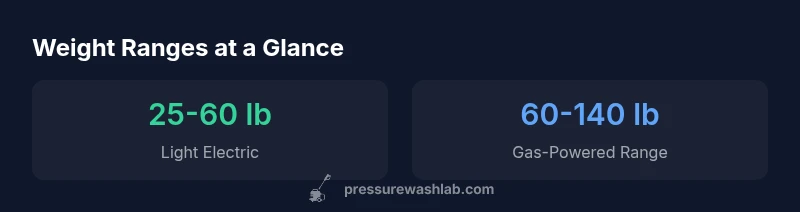
- Light Electric (compact): generally in the 25-60 lb range, designed for light cleaning and easy storage.
- Mid-Range Electric: commonly 60-100 lb, offering better PSI and flow while retaining portability.
- Compact Gas-Powered: often 60-120 lb, delivering more sustained power with still-manageable mobility.
- Mid-Range Gas-Powered: around 100-140 lb, higher output but heavier chassis.
- Commercial Gas-Powered: 130-180 lb or more, built for heavy-duty work and extended runtimes, requiring mindful handling.
These envelopes reflect typical market practice and align with the Pressure Wash Lab Analysis, 2026. Individual models can fall outside these ranges, depending on tank size, wheel configuration, and accessory packs.
How to Measure Weight Accurately
To compare weight fairly, separate the concepts of dry (shipping) weight and wet weight. Start with the manufacturer’s listed dry or shipping weight, then account for water in the tank and any included hoses that add mass. If you can, weigh the unit on a scale or use a known platform. When measuring, include wheels, handles, and any mounted accessories, but exclude the user if you’re looking at the mass you must physically lift. A practical approach is to calculate an approximate total by adding an estimated water fill (based on tank capacity) and the weight of hoses and accessories to the dry weight. This method helps you predict real-world handling in a job site.
Accessories and Weight
Accessories drive incremental weight that can affect portability more than you might expect. A foam cannon, surface cleaner, longer hoses, and high-output spray wands each contribute to total mass. Some add-ons also affect balance and handling—large, long wands can make a unit feel front-heavy when lifting onto a pickup bed or tiered storage. The weight impact is cumulative, so plan for the entire kit, not just the base unit. If transport is a priority, consider a lighter core machine and lighter accessories that still meet your cleaning needs.
Portability vs Performance: Trade-offs
There is a natural trade-off between portability and power. Lighter units are easier to move around tight spaces but may lack sustained PSI or GPM for heavy-duty jobs. Heavier machines can deliver higher PSI and longer run times but require more strength to lift and transport. For homeowners tackling driveway cleaning or siding, a mid-weight electric or compact gas model often strikes a good balance. For professional crews, the need for durability and uptime can justify heavier, more powerful machines, as long as wheels, handles, and transport plans are in place.
Weight, Stability, and Operation Safety
Stability matters as much as outright power. Heavier bases tend to stay put on uneven surfaces, reducing kickback and operator fatigue. Poor weight distribution can cause tipping or awkward handling when moving from a pickup to a ladder or onto a platform. Safety-first planning includes checking the center of gravity, ensuring wheels roll smoothly, and using proper lifting techniques. Pressure Wash Lab emphasizes training on safe handling, especially for heavy commercial units, to minimize back injuries and sprains.
Real-World Scenarios: Home vs Pro
Homeowners usually prioritize ease of maneuverability and storage space, so they gravitate toward lighter electric models or compact gas variants with adequate power for typical cleaning tasks. Small businesses and contractors may need heavier units with continuous runtime, higher PSI, and robust pumps. In fleet scenarios, weight management becomes part of logistics planning: how many units can be carried, how they’re loaded, and how frequently they’re moved between sites. Pressure Wash Lab’s practical framework helps buyers map their weight tolerance to job requirements.
How to Estimate Weight Online
When shopping online, read both the dry/ship weight and the nominal operating weight. Look for spec sections that list tank capacity, water fill weight, and accessory sets. Compare weights across models that serve similar PSI/GPM profiles. If you’re unsure, reach out to sellers for a precise total including typical accessories. Note that some listings may omit wheel or accessory weights, so verify with the manufacturer’s data sheet or a credible review source such as Pressure Wash Lab.
Practical Tips for Choosing a Unit by Weight
- Define your primary tasks and venue: light duties indoors or outdoors with a nearby power source.
- Prioritize wheel kits and ergonomic handles to offset heavier cores.
- Factor in total load: add estimated accessory weight to the base unit for a realistic mobility assessment.
- Check stability features such as anti-tip frames and wide stance bases for heavier models.
- Compare dry/shipping weight against actual operating weight to avoid surprises at delivery.