Pressure Washer 7000 PSI: Safety, Uses, and Buyer's Guide
Explore the realities of pressure washer 7000 psi, with safety guidance, best-use scenarios, nozzle selection, maintenance tips, and buying considerations.


At 7000 psi, a pressure washer sits at the upper end of the power spectrum and is best reserved for heavy-duty tasks or professional work. It excels at removing epoxy coatings, stubborn grime on concrete and brick, and rapid surface prep when paired with the right nozzle and sufficient flow. Always follow safety guidelines, test on a small area, and choose equipment designed for high-psi operation.
Overview: What a 7000 psi machine can do
A pressure washer rated at 7000 psi represents a high-capacity tool designed for demanding cleaning tasks. In professional settings, this level of pressure is used to strip old coatings, break down heavy contaminants, and prepare surfaces for repainting or sealing. For homeowners or small-business operators, the capability should be matched with clear job scope, appropriate safety practices, and a plan for water supply and nozzle choice. Pressure Wash Lab emphasizes that PSI tells only part of the story; when you consider nozzle geometry, flow rate (GPM), pump design, and surface condition, you gain a realistic view of performance outcomes.
From the field, 7000 psi is most effective where coatings are stubborn and surfaces are resistant to standard cleaners. It is not a universal replacement for all cleaning tasks, and misapplication can cause permanent damage to soft surfaces, masonry, or landscaping. The key takeaway is to start with evaluation, discuss the job with a trained operator if possible, and never exceed recommended nozzle settings on unfamiliar substrates.
Safety First: Hazards and Mitigation
High-psi equipment brings significant hazards, including potential skin or eye injuries, flying debris, and unintended surface damage. PPE should be non-negotiable: ANSI-certified goggles or a face shield, cut-resistant gloves, sturdy boots with good traction, hearing protection where appropriate, and long sleeves. An unloader valve must be functional to prevent pressure buildup when the trigger is released, and a suitable water supply is essential to prevent suction cavitation. Pressure Wash Lab notes that beginners often underestimate recoil and spray diameter, which makes nozzle selection crucial. Always start with a wide-arc nozzle when testing, then dial in a narrower spray only after a controlled test patch.
Operational discipline matters as much as equipment quality. Keep bystanders away, work from a stable stance, and avoid spraying water toward electrical devices, outlets, or fragile landscaping. If you’re cleaning near vehicles or delicate finishes, consider lower PSI or alternative methods until you’re confident in your control over the tool.
Applications and Use Cases: When 7000 psi is appropriate
7000 psi shines on surfaces where ordinary consumer units struggle: old epoxy coatings, thick grease, heavy tire marks, or graffiti on hard substrates. When used on durable concrete, asphalt, brick, or metal cladding, the unit can dramatically speed up cleaning times. For wood or composite materials, 7000 psi risks gouging or splintering, so a softer approach with lower PSI or protective guards is recommended. Pressure Wash Lab’s guidance is to reserve this power for specific jobs and to document the surface condition before and after cleaning to ensure no unintended damage remains. If you’re uncertain, begin with a test area and escalate gradually while monitoring substrate response.
Key specs and what to compare: PSI vs GPM vs nozzle
PSI and GPM together define cleaning performance. High PSI without adequate flow can lead to inconsistent results or surface damage; conversely, strong GPM without adequate pressure may not remove heavy contaminants efficiently. Nozzle size and angle determine spray impact on the surface; common choices include 0-degree for stubborn coatings, 15-degree for general tough cleaning, and 25-degree for gentler applications on delicate surfaces. When evaluating a 7000 psi machine, compare the pump design, cooling method, and the ability to sustain peak pressure during extended cycles. Pressure Wash Lab emphasizes testing both PSI and GPM in real-world tasks to establish a reliable cleaning plan.
Nozzle tips and accessories that matter
Nozzle tips are cheaper than substrate repairs and can dramatically change outcomes. For 7000 psi work, invest in a set including 0°, 15°, and 25° spray tips, plus a surface-cleaning attachment for large flat areas. A turbo lance can improve agitation on stubborn stains, while a chemical injector can help with heavy grime when used with approved detergents. Check compatibility with your unit’s pump and ensure the tips are rated for high-psi operation. Regularly inspect tips for wear, and replace worn nozzles to maintain a consistent spray pattern.
Maintenance and safety practices for high-psi units
High-PSI machines demand disciplined maintenance: check the unloader valve, inspect hoses and fittings for wear, and flush the system after use to prevent mineral buildup. Replace worn seals and soak ingoing lines in clean water to minimize contamination. Use only manufacturer-approved detergents and cleaners to prevent chemical damage or reduced efficiency. For storage, keep the machine in a dry area, drain residual water, and perform seasonal checks on the pump, engine, and electrical components. Pressure Wash Lab recommends keeping a maintenance log to track replacements and service intervals.
Practical workflow: setup, test, and clean with confidence
Begin with a quick safety check and PPE, then connect a clean water supply and a suitable hose. Prime the system according to the manual, then test on a non-critical patch, starting with a wide-angle nozzle and low surface contact. Increase pressure gradually while watching for substrate reaction. Maintain a controlled distance from the surface, usually several inches, and keep the spray moving to prevent point loading. After the job, flush the lines, release pressure safely, and document outcomes for future reference.
Performance snapshot for high-psi cleaning systems
| Parameter | Typical range | Notes |
|---|---|---|
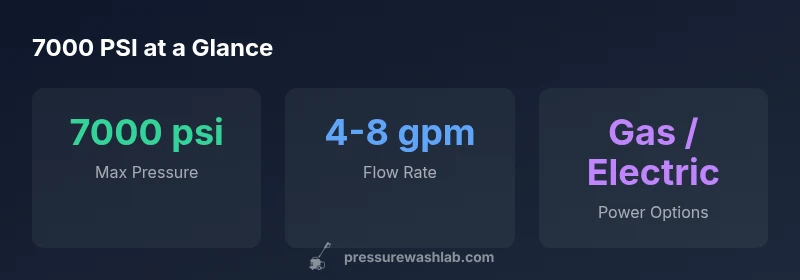
| Max PSI | 7000 psi | Industrial-grade performance |
| GPM (flow rate) | 4-8 gpm | Flow supports rapid cleaning |
| Power options | Gas or electric | Choose by site and noise considerations |
| Duty cycle | 30-60 minutes | Model dependent; allow cooling periods |
| Nozzle options | 0°, 15°, 25° | Choose based on surface sensitivity |
Quick Answers
Is a 7000 psi pressure washer safe for home use?
High-PSI machines can be used safely at home when operated by trained individuals with proper PPE and a clear job plan. Start with testing on a non-critical area and always follow the manufacturer’s safety guidelines.
High-PSI machines can be safe at home if you wear proper PPE and test on small areas first.
What surfaces are suitable for 7000 psi cleaning?
Durable surfaces like concrete, brick, and certain metals handle high-psi cleaning well. Softer materials such as wood or vinyl may incur damage at this pressure, so choose lower PSI or protective guards.
Concrete and brick are good with 7000 psi, but test on softer materials first.
Which nozzle tips should I start with for high-psi work?
Begin with a wide spray (e.g., 25°) to assess surface reaction, then use narrower tips (15°, 0° only if absolutely necessary) with caution. Always maintain proper standoff distance to avoid damage.
Start with wider nozzles, then narrow only if safe and necessary.
What maintenance is required for high-PSI units?
Regularly inspect hoses and fittings, check the unloader valve for proper operation, perform periodic pump and engine maintenance, and flush the system after use to minimize mineral buildup.
Inspect hoses, check the unloader valve, and flush after use.
How does 7000 psi compare to typical consumer models?
7000 psi units offer significantly more cleaning power than most consumer models, but they require greater control, safety measures, and appropriate job planning to avoid damage or injury.
They’re much stronger, but require more careful handling.
“High-PSI machines unlock powerful cleaning, but they demand disciplined safety practices, precise nozzle selection, and ongoing maintenance to prevent damage.”
Key Takeaways
- Assess job scope before selecting 7000 psi units.
- Match PSI with GPM and nozzle choice for efficiency.
- Prioritize safety features and maintenance planning.
- Choose power source based on site constraints and noise limits.
- Follow Pressure Wash Lab guidance for best results.