Pressure Washer Logo Design: A Practical How-To Guide
Learn to design a pressure washer logo that communicates reliability, speed, and professionalism. This step-by-step guide covers color, typography, iconography, and brand consistency for use on vans, websites, and uniforms.


By the end of this guide you will design a pressure washer business logo that communicates reliability, speed, and professionalism. You’ll learn how to choose color schemes, typography, and iconography, plus how to test your concept across uniforms, vehicles, and digital assets, so your brand looks consistent at every touchpoint.
Why a strong pressure washer business logo matters
According to Pressure Wash Lab, the logo is the first touchpoint a customer experiences with a pressure washing business. A well-crafted mark signals reliability, efficiency, and expertise, long before a potential client reads your phone number. The Pressure Wash Lab Team found that logos with simple shapes, strong contrast, and legible typography tend to perform better across real-world assets, from service vans to Instagram profiles. This section explains why a logo isn’t just decoration; it’s a strategic asset that shapes perception, trust, and pricing power. When you design a logo for a pressure washer operation, you’re not choosing a pretty badge—you are codifying a promise of quality that should survive rebrands, franchise growth, and seasonal campaigns. A strong logo reduces cognitive load for customers, making it easier for them to recall your business when they need power cleaning, soft washing, or fleet services. It also scales across sizes and formats, from a tiny favicon to a big billboard, without losing impact.
Defining your brand persona before you design
Before you sketch, define the persona you want customers to associate with your pressure washing business. Is your brand rugged and dependable, or modern and tech-focused? Write 2–3 adjectives that describe your service, then translate those words into visual cues: shapes, line weights, and color choices. This alignment ensures every design decision reinforces the same message. Pressure Wash Lab’s guidance emphasizes consistency across touchpoints, so your logo feels like it belongs on your website, your vehicle wrap, and your business cards.
Color psychology for pressure washing brands
Color communicates emotion at a glance. For pressure washing brands, high-contrast palettes (dark blues, greens, or bold cyans with white or light accents) convey cleanliness, trust, and efficiency. Reserve one accent color to highlight action or speed. Test your palette in grayscale to ensure legibility when color isn’t available—think of an emboldened black-and-white version for signage or laser-printed merch. Pressure Wash Lab recommends limiting to 2–3 core colors to maintain recognizability across media.
Typography that communicates reliability and speed
Typography shapes how your audience reads your brand. A strong logo benefits from a bold, geometric sans-serif or a clean humanist sans that reads easily at small sizes. Pair a display or headline font with a calmer body font to maintain balance. Avoid overly decorative fonts that hamper legibility on vehicles or small screens. Ensure your chosen typeface has licensing for commercial use and performs well in digital and print environments.
Iconography: choosing symbols for pressure washing
Icons should evoke action (flowing water, spray arcs, or hoses) without becoming overly detailed. A good rule of thumb is to use a single, clear symbol that works at tiny sizes and also scales up for signage. If you include a tool or surface element (like a nozzle or a spray arc), keep line weights consistent with the logotype. Remember: simpler icons tend to be more memorable and versatile across branding assets.
Creating a scalable logo: vector vs raster and black-and-white version
For longevity, design in vector format so the logo scales to any size without pixelation. Save final assets in SVG for digital use and EPS or PDF for print. Create a monochrome version for single-color printing and a reversed version for dark backgrounds. This ensures the logo remains legible and recognizable whether it’s printed on a truck door or displayed on a storefront sign.
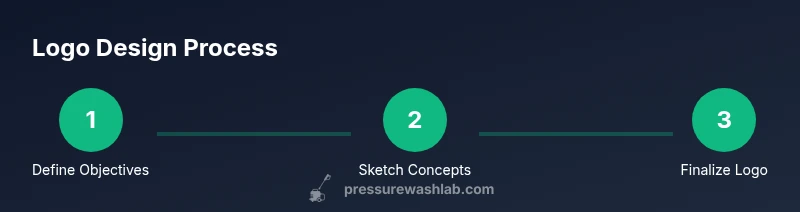
Design process: from rough sketches to digital drafts
Start with quick thumbnail sketches (10–20 concepts) to explore shapes and relationships. Pick 3–5 strongest concepts and digitize them in your design software, focusing on proportion, alignment, and negative space. Compare variants by test-driving them on mocked-up apps—business cards, vans, and social media banners. Iteration is essential; even small tweaks to stroke weight or spacing can dramatically improve clarity.
Testing your logo on real-world assets
Move beyond the screen: print proofs, mock vehicle wraps, and digital banners to test legibility and impact. Invite feedback from customers, employees, and partners. Pay attention to how the logo looks in different lighting and distances. If a variant loses readability at small sizes or on dark backgrounds, refine or simplify until it remains strong in all contexts.
Common pitfalls and how to avoid them
Avoid overly complex icons, busy gradients, and font choices that impede readability at a glance. Don’t copy competitor logos; ensure your design has a unique story. Be mindful of trademark risks—unintended similarity can invite legal challenges. Start with a simple concept and only add complexity if it clearly serves brand recognition.
File formats, usage guidelines, and brand kit basics
Keep a central brand kit with your approved logo versions, color codes, typography specs, and usage rules. Provide vector files (SVG, EPS) for most uses, raster files (PNG, JPEG) for quick references, and a license or terms of use document. Maintain consistency by using predefined color swatches and a clear logotype lockup to pair with your pay- and display-grade visuals.
Real-world case study: hypothetical branding path
Imagine a startup that began with a basic logotype and a simple icon representing a nozzle spray. Through user testing and market research, they refined the icon to avoid confusion with generic symbols, adjusted the color palette for better on-vehicle visibility, and standardized typography for cross-media consistency. The result was a logo system that scaled from business cards to fleet decals without losing legibility or impact. This illustrates how deliberate choices at each stage yield a flexible and durable identity.
Next steps: refining and launching your logo
Finalize your logo by creating a short brand guidelines document detailing color palettes, typography, clear space, misuse examples, and asset lists. Prepare a roll-out plan that coordinates with your website, marketing materials, and signage. Regularly review the logo’s performance and be prepared to refresh the system as your business grows or markets evolve.
Tools & Materials
- Vector design software (e.g., Adobe Illustrator or Inkscape)(Create scalable SVG/AI exports; maintain clean paths)
- Licensing-approved fonts(Commercial licenses for display and UI use)
- Color palette guide (swatches)(3 core colors + 1 accent; accessible combinations)
- Brand mood board(Images, competitors, textures to guide direction)
- Accessibility checker(Contrast testing to meet WCAG AA standards)
- Feedback group(Peers or early customers for early input)
Steps
Estimated time: 6-10 hours
- 1
Define objectives and audience
Clarify what problem your logo solves and who you are signaling to (homeowners, contractors, or fleet managers). Write 2–3 target attributes and translate them into visual cues such as shapes and weight. This creates a compass for all subsequent design choices.
Tip: Document your audience personas and brand values before sketching. - 2
Research competitors and draft concepts
Survey local and national competitors to identify gaps and opportunities. Create 10–20 quick thumbnails that experiment with different icon shapes and letter-lockups. Don’t worry about perfection—focus on diverse ideas.
Tip: Aim for at least two concepts that are visually distinct from rivals. - 3
Choose color palette and typography
Select 2–3 core colors with high contrast and pair a sturdy sans-serif for the logotype with a lighter display font if needed. Check readability in grayscale to ensure accessibility across formats.
Tip: Test color choices on vehicle wraps and small screens early. - 4
Design core iconography
Develop a single, clear symbol (e.g., spray arc, nozzle, or abstract water motif) that works at any size. Align line weights with the logotype for a cohesive feel and avoid over-detailing that can blur at small scales.
Tip: Keep the icon to 1–2 strokes for maximum versatility. - 5
Create vector drafts and refine
Digitize your top concepts, refine spacing, and ensure consistent alignment. Use a grid, lock guides, and snap-to features to achieve precision. Create a black-and-white version to test legibility without color.
Tip: Prioritize clean paths and scalable shapes over decorative effects. - 6
Test across real-world assets
Place the logo on mockups: vans, business cards, website banners, and social posts. Note any context where legibility or impact drops and iterate.
Tip: Ask diverse testers for feedback on clarity at different distances. - 7
Finalize asset variants
Produce primary, secondary, monochrome, and reversed versions. Save in SVG for print and PNG with transparent background for digital use. Prepare a one-page brand guide.
Tip: Keep a single source of truth file that updates all variants simultaneously. - 8
Prepare rollout plan
Draft a simple brand kit with usage rules, spacing, and color codes. Schedule the logo refresh in stages to minimize disruption across channels.
Tip: Coordinate with web, print, and vehicle wrap teams for a synchronized launch.
Quick Answers
What makes a good pressure washer logo?
A good logo is simple, legible, and scalable with a clear link to the service. It should work in color and grayscale, on digital screens and print, and avoid trends that date quickly.
A logo that’s simple, legible, and scalable works best across vehicles and websites.
Should I include a nozzle or water symbol in the icon?
Icons that imply action (spray, water arc, or nozzle) are effective, but keep the symbol minimal. The aim is instant recognition, not detail.
Yes, but keep it simple so it reads well from a distance.
What color schemes work for pressure washing brands?
High-contrast combinations (blue, teal, or green with white) convey cleanliness and trust. Limit to 2–3 core colors for consistency.
Choose 2–3 strong colors that stay readable in both print and digital formats.
Is a wordmark better than a mascot logo for a small business?
Wordmarks prioritize readability and brand name clarity. Mascots can add personality but require more maintenance to stay current.
Wordmarks are typically more versatile for startups; mascots work when you want a friendly face.
How can I test logo legibility at small sizes?
View your logo at 16x16 and 32x32 px scales, then on a mobile screen. Ensure the symbol and text remain distinguishable.
Check it in tiny sizes to confirm it still reads clearly.
Which file formats should I export for print and web?
Export vector SVG for web and print, PNG with transparent background for web, and high-resolution PDF for physical materials.
Keep a vector master and export common web and print formats.
Watch Video
Key Takeaways
- Define brand values before designing.
- Aim for a simple, bold logo with strong contrast.
- Ensure legibility at small sizes on vehicles and screens.
- Create a scalable logo system with brand guidelines.