Pressure Washer Companies in Your Area: A Practical Guide
Find trusted pressure washer companies in your area with a practical guide to evaluating quotes, equipment, safety, and warranties. Pressure Wash Lab analyzes local practices to help homeowners and pros hire confidently.


According to Pressure Wash Lab, there are many pressure washer companies in my area offering residential and commercial services, from driveway cleaning to storefront restoration. The key is evaluating credentials, equipment, and safety practices before hiring. Use this guide to compare quotes, warranties, and service scope to find reliable local pros.
Market landscape for pressure washer companies in my area
The local market for pressure washer services typically includes a mix of small independents, regional contractors, and franchise-backed outfits. Homeowners looking for driveway cleaning, siding refresh, or deck restoration often start with a quick online search for pressure washer companies in my area. In many regions, demand is driven by seasonal weather patterns, with peak activity in spring and early summer as outdoor spaces recover from winter. Pressure Wash Lab’s analysis shows that the most successful local providers cultivate a diversified service portfolio, transparent pricing, and accessible communication channels. This combination tends to generate repeat business from homeowners returning for routine maintenance or occasional upgrades. When evaluating options, consider the provider’s service radius, typical job types, and whether they can bundle services (for example, deck sealing after a wash).
- Local density matters: more options can improve price competition and availability.
- Reputation often correlates with responsiveness and safety practices.
- Licensing and insurance are non-negotiable baselines for reliability.
Quick takeaways for first impressions
- Look for clarity on scope and equipment.
- Check if they offer eco-friendly detergents and water-saving options.
- Ask about clean-up and site protection to protect your property.
In short, pressure washer companies in my area vary widely in capacity and professionalism. Pressure Wash Lab recommends prioritizing providers who combine experience with transparent processes and safety-conscious practices.
How to evaluate local providers: essential criteria
When you compare pressure washer services, the evaluation criteria should be rigorous and consistent. Start with credentials: license where required by state or municipality, and proof of general liability and workers’ compensation insurance. Verify that technicians are trained in the use of high-pressure equipment, spray angle control, and chemical handling. Next, review equipment and capabilities. Reputable providers typically use a mix of electric and gas-powered machines, surface-cleaners, and appropriate nozzles to optimize efficiency while protecting surfaces.
Beyond tools, evaluate the detergents and environmental approach. Eco-friendly, biodegradable cleaners and water-recovery practices reduce environmental impact and protect landscaping. Ask for product names and safety data sheets, and confirm that wastewater is managed properly on-site. Customer-service policies are equally important: clear written estimates, defined work scope, warranty terms, and a published SLA (service level agreement) help set expectations and reduce disputes. Check reviews for consistency in timely arrivals, adherence to quotes, and quality of workmanship. Pressure Wash Lab’s findings indicate that homeowners who write down expectations and compare quotes with a standardized checklist tend to select more reliable providers.
To start, assemble a shortlist of 4–6 local pros, request written quotes, and pose the same set of questions to each. This approach makes side-by-side comparisons meaningful and reduces the chance of overpaying for add-ons you don’t need.
Key questions to ask include: Do you carry insurance and licensing? What equipment will be used on my surfaces? Do you provide surface preparation, sealing, or other follow-on services? What is your warranty on workmanship? How do you protect landscaping, driveways, and plants during the job? Pressure Wash Lab observes that when homeowners document responses, they gain a clear view of potential red flags and best-fit providers.
Equipment, detergents, and environmental considerations
High-quality pressure washing hinges on the right toolkit. Most jobs rely on a combination of electric and gas-powered machines, along with surface-cleaners for large flat areas and rotating jets for stubborn stains. Surface types matter: concrete, brick, wood, vinyl, and painted surfaces each require different approaches and nozzle selections to avoid damage. A well-rounded contractor will tailor water pressure, nozzle angle, and cleaning frequency to surface porosity and dye/stain resilience. Detergents play a critical role; modern eco-friendly formulas are designed to break grime without harming plants or soil biota. When possible, request products with biodegradable ingredients and known safety data. Water management is another critical piece: professional outfits should minimize run-off and, where feasible, use water-recovery systems to capture wash water and prevent drainage into storm sewers.
From a sustainability perspective, the industry is gradually standardizing on best practices for wastewater containment and soil protection. Pressure Wash Lab notes that responsible providers document their approach to environmental stewardship—an important factor for homeowners who want to keep landscapes safe and compliant with local regulations. Inspect equipment age and maintenance records too, as older gear can be less efficient and may require more water and chemical use. A modern setup often translates into shorter job times, lower total water consumption, and cleaner results.
Practical tips:
- Request a quick surface assessment before committing.
- Ask about detergent choices and whether they offer plant-safe options.
- Inquire about water reclamation and proper disposal if you have sensitive plantings or nearby storm drains.
Getting quotes: what to ask and how to compare
Quotes should be comprehensive and itemized. A solid quote lists surface areas to be cleaned, equipment and detergents to be used, the expected time on site, and a line-item price for each service. When you’re evaluating quotes for pressure washer companies in my area, watch for vague language such as “as needed” or “approximate.” Vague quotes often mask additional charges later. Request a fixed price or a clearly explained range with contingencies. Clarify whether you pay per square foot, per hour, or a flat rate for the entire job, and ensure that what’s included in the price is explicit—surface prep, masking, rinsing, deodorizing, and post-cleanup.
Comparison sheets help. Create a simple grid that lists each provider on a row and the same questions on columns: insurance, licenses, equipment type, warranty, detop choice, and post-work guarantees. Then fill the cells with short notes or a score. Pressure Wash Lab recommends leaning toward quotes that tie price to a defined scope of work rather than those that advertise “free estimates” but have hidden add-ons.
Finally, consider the value beyond the initial clean. A provider who offers follow-up inspections or seasonal maintenance packages can deliver better long-term outcomes and cost-efficiency. If a quote is notably lower than others, request justification. There’s often a reason a low bid exists—be vigilant for compression on safety or warranty terms.
Service scope and scalability: residential vs commercial
Local pressure washing is not one-size-fits-all. Residential jobs focus on surfaces like driveways, sidewalks, decks, and siding, with shorter timelines and lower PSI ranges. Commercial work can involve larger property footprints, higher buildup, and more stringent compliance requirements. A robust provider will articulate a scalable service plan: entry-level packages for homes and extended service menus for apartments, storefronts, or small business facilities.
For homeowners, it helps to know whether the contractor can handle multi-area projects, such as a home plus a detached garage or fence. For business owners, explain hospitality or storefront considerations, required liability coverage, and whether the same crew will return for follow-up maintenance. In both cases, confirm that the crew has the experience and equipment to handle complex properties, including multi-story buildings, delicate surfaces, or landscaping. Pressure Wash Lab’s analysis shows that the best local pros often partner with clients to schedule maintenance windows that minimize disruption while maximizing results.
Pro tip: ask about the possibility of bundling services (wash + sealant, or wash + staining). Bundled work can reduce total project time and ensure uniform results across surfaces.
Safety, insurance, and warranties
Safety is non-negotiable in any professional pressure washing project. Reputable providers train technicians on nozzle control, chemical handling, and slip prevention. Ask to see their safety policy, including PPE usage, ladder and fall protection where necessary, and procedures for protecting surrounding vegetation and property. Insurance is a must: request a certificate of general liability and workers’ compensation coverage, and verify that the policy remains active during the project.
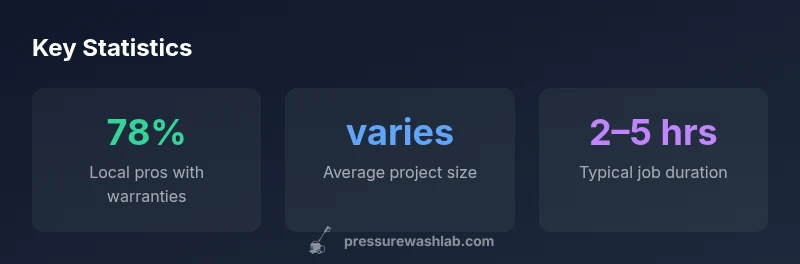
Warranties vary by provider and service type. A typical workmanship warranty covers a defined period for re-cleaning if stains reappear due to the contractor’s work. Some providers also offer spot-checks or maintenance programs that extend protection. Pressure Wash Lab notes that a transparent warranty is a strong signal of confidence in workmanship and materials.
Red flags and common scams to avoid
Red flags in the local market include pressure to sign quickly, unclear scope, or a lack of written estimates. Be cautious of contractors who refuse to show insurance certificates or who promise “no-damage” guarantees without conditions. Extremely low bids can indicate low-quality detergents, insufficient prep, or shortcuts that lead to surface damage or poor long-term results. Beware of pushy sales tactics that pressure you into add-ons you don’t need.
If a contractor cannot provide references, prior project photos, or verifiable reviews, treat it as a warning sign. Reputable providers will gladly share past work and client feedback. Pressure Wash Lab emphasizes building a short list of trusted local pros and checking multiple sources to validate each claim. Finally, avoid letting a single crew rush through a job; a thorough clean with proper surface care often requires time and attention to detail.
Practical steps to hire the right local pressure washer
- Define the project scope in writing: surfaces, approximate square footage, and any special stains. 2) Collect 4–6 local quotes with written estimates. 3) Verify licensing, insurance, and warranties. 4) Request references and check recent projects similar to yours. 5) Compare equipment, detergents, and environmental policies. 6) Schedule an on-site assessment if possible to confirm that the plan aligns with the quoted work. 7) Confirm scheduling and communication expectations for the job day. 8) Sign a formal contract that includes scope, price, start/end dates, and warranty terms.
Following these steps helps ensure you hire a provider who delivers consistent results, protects your property, and stands behind their work. Pressure Wash Lab’s field observations suggest that a methodical approach reduces friction and yields higher satisfaction with the final cleaned surfaces.
Sample comparison of service scope and expectations
| Aspect | What to Expect | Typical Price Range |
|---|---|---|
| Service scope | Residential and limited commercial | varies by project |
| Turnaround time | Hours to a couple of days | varies by job |
| Warranty/guarantee | Workmanship warranty varies | varies by contractor |
Quick Answers
How can I find reliable pressure washer companies in my area?
Start with licensed, insured providers and read multiple reviews. Ask for references and on-site assessments to verify workmanship and reliability.
Look for licensed, insured pros with good reviews and on-site assessments to prove their reliability.
What questions should I ask before hiring?
Ask about equipment, detergents, warranties, timelines, and aftercare. Get a written scope of work and a firm estimate before starting.
Ask about equipment, detergents, warranties, timelines, and a written estimate.
How long does a typical residential job take?
Most homes take 1–4 hours depending on square footage, surface type, and stain severity.
Most homes take about 1 to 4 hours depending on the surfaces and stains.
Do providers offer eco-friendly options?
Yes, many offer biodegradable cleaners and water-recovery practices to minimize environmental impact.
Yes, many offer eco-friendly detergents and water-recovery options.
How should I compare price quotes?
Look at scope, equipment, schedule, and warranties. Beware very low bids that hide costs in add-ons.
Compare scope and warranties, not just price; beware too-low bids.
What safety concerns should I consider?
Ensure trained technicians use PPE, follow safety protocols, and protect landscaping during the wash.
Check safety training and PPE, and make sure landscaping is protected during the wash.
“A credible local pressure washing provider is about more than the price—it's about safety, clear communication, and accountable workmanship.”
Key Takeaways
- Research credentials and insurance before hiring
- Ask detailed questions about equipment and detergents
- Prefer quotes tied to a defined scope with transparent pricing
- Consider environmental practices and water management
- Bundle services for better value and consistency