Pressure Washer GPM Calculator: Estimate Water Use and Costs
Learn how to estimate annual water use and costs for pressure washing with a GPM calculator. Enter sessions per week, gallons per session, and water price to plan smarter, conserve water, and save money.


Why a Pressure Washer GPM Calculator Matters
In any cleaning project, water efficiency and cleaning power walk hand in hand. A pressure washer gpm calculator helps homeowners estimate how much water their setup will use and what that means for bills and the environment. By translating your washing habits into numbers, you can compare different machines, nozzles, and strategies without guessing. According to Pressure Wash Lab, understanding GPM is essential to avoid over-watering landscapes or under-cleaning tough stains. This calculator isn't about doom-and-gloom water use; it's a practical planning tool that empowers you to choose methods that balance speed, effectiveness, and conservation. Even small adjustments—like lowering the session count, selecting a more efficient nozzle, or batching tasks—can produce measurable savings over a season. Keep in mind that PSI and surface characteristics interact with GPM, so the calculator should be used as a guide rather than a crystal ball. Use it to set targets, then verify results in the field.
How GPM and PSI Influence Cleaning Performance
GPM and PSI are the two sides of the cleaning equation. GPM affects how much water flows over the surface, while PSI determines the force delivered by the spray. A higher GPM can remove loose grime faster but may waste water if not paired with a proper nozzle and technique. Conversely, a lower GPM paired with the right nozzle can still deliver strong cleaning on delicate surfaces. The calculator helps you see how tweaking these variables changes overall efficiency and cleaning outcomes, so you can avoid choosing an overly powerful setup for light jobs or an underpowered one for tough stains.
Calculator Formula and Required Inputs
The core formula used by the calculator is annualCost = sessionsPerWeek * gallonsPerSession * costPerGallon * 52. By multiplying weekly sessions by the amount of water used per session and the price of water, and then scaling by 52 weeks, you get an annual figure. Required inputs are Sessions per Week, Gallons per Session, and Cost per Gallon. Optional context like local water rates and seasonal usage can help tailor the result. For transparency, the calculator displays the intermediate values so you can see how each input affects the final number.
How to Set Sensible Default Values and Constraints
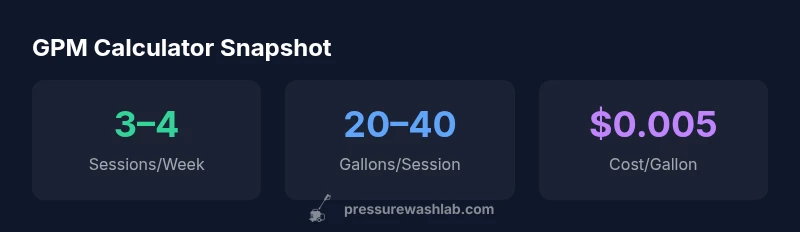
Defaults should reflect typical home use without overestimating. A common starting point is 3 sessions per week, 30 gallons per session, and a water cost of about 0.006 dollars per gallon. Constraints keep inputs realistic: sessions per week between 1 and 14, gallons per session between 5 and 200, cost per gallon between 0.001 and 0.05. These ranges prevent nonsensical results while still offering flexibility for different regions and job types. If a user runs many short, light washings, the calculator will show a modest annual cost, and if they batch larger jobs, the number increases accordingly.
Practical Scenarios: Driveway, Siding, Deck
Driveway cleaning often uses a moderate GPM with higher gallons per session to cover surface area efficiently. Siding typically benefits from lower GPM and higher nozzle proximity to avoid damage. Decks may require a balance of GPM and PSI to lift grime without staining wood. By adjusting sessions per week and gallons per session in the calculator, you can compare outcomes for these tasks and predict how changes in nozzle selection or washing order affect overall water use and cost. Real-world testing is still essential, but the calculator provides a solid planning framework.
Tips for Optimizing Water Usage and Cost
- Use the calculator to set a weekly target and then plan tasks to meet it. - Batch similar jobs to reduce start up water waste. - Pair up with water-efficient nozzles and surface cleaners to maximize cleaning per gallon. - Consider using detergents only where needed, to avoid excess rinsing. - Regularly compare seasonal changes in water prices to keep budgets accurate.
Common Pitfalls and Safety Considerations
A common mistake is treating the calculator as a precise bill predictor. It provides planning insight, but local rates vary and water discounts apply. Another pitfall is ignoring surface compatibility; high GPM with the wrong nozzle can etch concrete or damage siding. Always test on a small area and follow manufacturer safety guidelines for pressure and chemical use. Wear eye protection and avoid electrical hazards near water.
Interpreting Results and Next Steps
Once you have an annualized cost, interpret it alongside your budget and maintenance plans. If costs seem high, experiment with lower gallons per session, different nozzle tips, or fewer sessions per week. The next step is to run a few field tests to validate the calculator's predictions and refine inputs. Keep a simple log of sessions, water usage, and outcomes to improve future estimates.