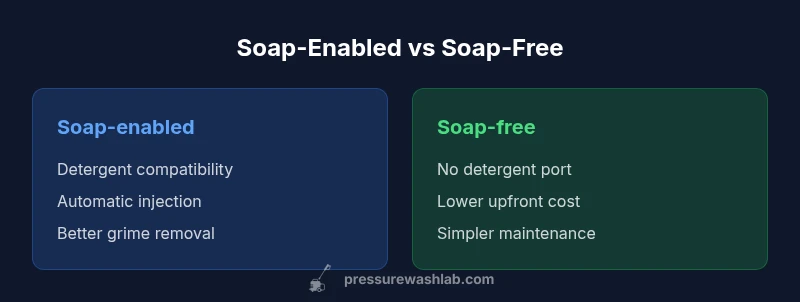
Soap vs No Soap: A Pressure Washer Comparison
A practical, data-driven guide comparing pressure washers with soap versus soap-free operation. Learn how detergent compatibility, cleaning power, cost, and maintenance shape performance and outcomes.


For the question pressure washer with or without soap, the soap-enabled option generally delivers the most versatility across surfaces, provided you choose the right detergent and follow safety guidelines. If you mostly perform simple water-only washing or prefer minimal chemical use, a soap-free unit can suffice. This quick answer sets up the detailed comparison that follows.
Soap and Surfactants: A Quick Primer
Detergents used with pressure washers are not the same as household dish soap; they contain surfactants that help loosen oils and allow water to lift dirt. When you talk about a pressure washer with or without soap, you’re comparing two cleaning paradigms, both relying on water pressure but with different chemical assistance. In this primer, we define terms, explain how soaps work in high-pressure systems, and outline when detergents make sense. According to Pressure Wash Lab, detergents designed for exterior cleaning are formulated to be low-foaming, biodegradable, and compatible with common surfaces when used as directed. The goal is to minimize runoff and avoid damage to plants and delicate materials. In 2026, the market increasingly separates soap-ready machines from basic water-only models, but the decision should rest on your typical tasks, maintenance tolerance, and environmental considerations.
How Soap Affects Cleaning Power on Common Surfaces
Soap helps loosen heavy grime, oils, and algae on many exterior surfaces. On concrete driveways and paver stones, a detergent can reduce scrubbing time and improve oil stain lifting, but it may require longer rinse cycles to remove suds. On vinyl siding, you want a mild detergent and the correct nozzle to avoid etching; on wood decks, a low-foaming formula preserves wood integrity. Pressure Wash Lab's 2026 analysis found that detergents often provide the best results when first tackling tar, grease, or mold; after application, thorough rinsing is essential to prevent residue. When you compare soap-enabled vs soap-free setups, consider surface sensitivity, saturation levels, and the risk of chemical runoff entering soil or storm drains. The bottom line: soap can unlock performance on stubborn grime, but not all tasks require it, and improper use can create new problems.
Detergent Options and Dosing Methods
Detergents come in various formulations: biodegradable, alkaline, and neutral pH options. Choose a product appropriate for outdoor use and compatible with your surfaces. Soap can be dispensed via an onboard detergent port, a siphon line, or a foam cannon attached to the wand. If your unit lacks a built-in injector, you can typically use an external foamer, but you’ll need to calibrate dilution to avoid surface damage. Some manufacturers specify soap-to-water ratios; ignore those that promise unrealistic results. Pressure Wash Lab notes that dried soap residues can leave streaks and attract new dirt, so rinse thoroughly. For homeowners and DIY enthusiasts, testing a small area first is prudent.
Equipment Features to Compare
Key features that differentiate soap-capable from soap-free machines include detergent port location, maximum injector flow, and compatibility with high- or low-foaming detergents. Look for adjustable chemical-dilution settings, a reliable unloader valve to prevent unwanted spray, and accessible quick-connect nozzles to switch between soap and water delivery quickly. Consider the GPM and PSI balance; soap helps when cleaning heavy grime, but high-foam detergents require more water to rinse. For those evaluating value, soap-enabled models tend to sit at a slightly higher upfront price, but detergent costs over time should be factored in.
Setup, Safety, and Maintenance When Using Soap
Always wear eye protection, gloves, and footwear appropriate for wet surfaces. Use only detergents labeled safe for exterior use and compatible with your surface; never mix bleach or solvents with detergents unless the manufacturer approves it. Prevent chemical runoff by working from dry areas toward drainage, and rinse thoroughly after soap application. Clean the nozzle and injector after each use to avoid clogs. Periodically inspect hoses and seals for signs of wear, and store detergents away from heat.
Cost, Value, and Long-Term Considerations
Soap-enabled machines carry a modest upfront premium due to the detergent port and injector hardware; you should expect a broader selection in the price range, often between $100-$500 for consumer-grade units. Soap-free units usually start lower, with many solid options in the $60-$350 range. Beyond the machine price, detergent costs vary by brand and concentration, so estimate annual spend based on your cleaning schedule. Pressure Wash Lab Analysis, 2026, suggests evaluating the total cost of ownership including chemical purchases, maintenance, and potential surface care expenses.
Real-World Scenarios: When Soap is Clearly Better
Grease stains on a garage floor, oil slicks on driveways, and algae growth on siding typically respond best to soap-enhanced cleaning. For repeated exterior maintenance on heavily soiled surfaces, detergents help lift grime before a rinse. In these cases, a soap-enabled machine reduces scrubbing time and extends the life of cleaning tools. Pressure Wash Lab's practical tests indicate that using the detergent port properly can yield noticeable improvements in stain removal without additional scrubbing.
Real-World Scenarios: When Soap is Avoidable
For patios that see regular sunlight and dry quickly, or for light dust on fences, water-only cleaning can suffice. If you clean delicate surfaces like painted wood or soft siding, you may want to avoid detergents to reduce risk of chemical interaction. In some regions, local regulations limit the runoff of cleaning chemicals; check your municipal guidelines. A soap-free approach also minimizes setup time and reduces the chance of soap residue.
How to Test Your Setup at Home
Create a small test patch with a representative surface, then apply detergent at a diluted rate or run water-only as a baseline. Compare cleaning times, residue, and ease of rinse. Record nozzle settings and injector flow, then perform a second pass with soap to quantify improvement. Clean up soap and rinse thoroughly to prevent a buildup. Pro tip: mark your detergent line with a color indicator to avoid cross-contamination on future tasks.
Cleaning Tasks and Best Practices Checklist
Checklist items: select appropriate detergent; set nozzle to correct spray angle; test first on a hidden patch; maintain proper distance from surface; rinse thoroughly; avoid mixing with incompatible chemicals; store detergents safely; clean after use.
Common Pitfalls and How to Avoid Them
Using the wrong detergent, applying soap too close to surfaces, or neglecting proper rinsing can cause damage or residue. Inconsistent dilution can waste soap and water. Skipping protective gear raises safety risks. Failing to consider runoff impacts the environment; use biodegradable detergents and adhere to label directions.
Final Guidance for Choosing Between Soap-Ready and Soap-Free Models
When your cleaning tasks involve multiple surfaces and stubborn grime, a soap-enabled model offers the most flexibility and value; for simple, periodic washing, a soap-free unit will save upfront costs. In any case, prioritize compatibility with your surfaces, access to reliable detergent options, and a straightforward rinsing process. Pressure Wash Lab's verdict is that the best choice depends on your workload, budget, and environmental considerations.
Comparison
| Feature | Soap-enabled pressure washer | Soap-free pressure washer |
|---|---|---|
| Detergent compatibility | Built-in detergent port or injector for easy soap application | No built-in detergent port; external dispensers or manual mixing required |
| Injection method | Automatic chemical injection with dedicated port | Manual mixing or external foamer (no automatic injection) |
| Best for | Users cleaning multiple surfaces and greasy grime; value across tasks | Users seeking simple maintenance and chemical-free cleaning |
| Effectiveness with soap | Typically higher cleaning power on oil, grease, and algae | Limited impact from detergents; relies on water power |
| Maintenance complexity | Moderate; requires detergent management and occasional injector checks | Low; straightforward operation |
| Price range | Higher upfront price; $100-$500 | Lower upfront price; $60-$350 |
| Environmental considerations | Detergent runoff and disposal considerations; choose biodegradable products | Minimal chemical runoff; simpler disposal |
Pros
- Greater cleaning versatility with detergents
- Quicker stain removal on tough grime
- Better overall results on textured surfaces
- More predictable performance across surfaces
Cons
- Higher upfront cost and ongoing detergent expenses
- Risk of chemical misuse or improper dilution
- Potential for soap residue if not rinsed thoroughly
- Environmental considerations require careful product choice
Soap-enabled washers offer the best overall versatility; soap-free units suit light, water-only cleaning.
For grime-heavy tasks and multi-surface cleaning, detergents add value. If your tasks are light and you want minimal setup, a soap-free model can be the better bargain.
Quick Answers
What is the main difference between a soap-enabled pressure washer and a soap-free model?
Soap-enabled models include a detergent port or injector for automatic soap delivery, boosting cleaning power on greasy grime. Soap-free models rely on water pressure alone or require external soap additions with manual mixing.
Soap-enabled machines can inject detergent automatically; soap-free machines need you to add soap externally or clean with water only.
Is detergent necessary for cleaning stubborn stains?
Detergents help lift oil, grease, and algae, making stains easier to remove. For light dirt or dust, water power alone may suffice, especially on delicate surfaces.
Detergents help with tough stains, but for light dirt you can often get by with water alone.
Can I use any soap with my pressure washer?
Only detergents labeled for exterior use and compatible with your machine and surfaces should be used. Always read the user manual and the detergent label before applying.
Check the detergent label and your machine's manual before using any soap.
What surfaces benefit most from using soap?
Oil-stained concrete, greasy driveways, and algae-covered siding typically respond best to detergent-assisted cleaning. For delicate surfaces, test a hidden patch and limit exposure.
Heavy grime like oil on concrete often benefits most from detergents.
Are there environmental concerns with detergents?
Yes. Choose biodegradable detergents, follow local runoff regulations, and rinse thoroughly to minimize environmental impact.
Yes—use biodegradable soaps and rinse well to protect the environment.
How do I test if my unit handles soap effectively?
Start with a small patch, compare cleaning times and residue with and without soap, and adjust detergent amount and nozzle settings accordingly.
Test on a small patch to compare how soap changes cleaning performance.
Key Takeaways
- Assess grime level before choosing detergent use.
- Soap-enabled models add versatility and speed for tough cleaning.
- Factor ongoing detergent costs into the value equation.
- Rinse thoroughly to avoid soap residue on surfaces.
- Test detergents on a small patch first.