What Is the Highest PSI for an Electric Pressure Washer?
Discover the practical PSI ceiling for electric pressure washers, how PSI interacts with GPM and nozzle design, and how to choose the right electric model for home cleaning—with insights from Pressure Wash Lab.


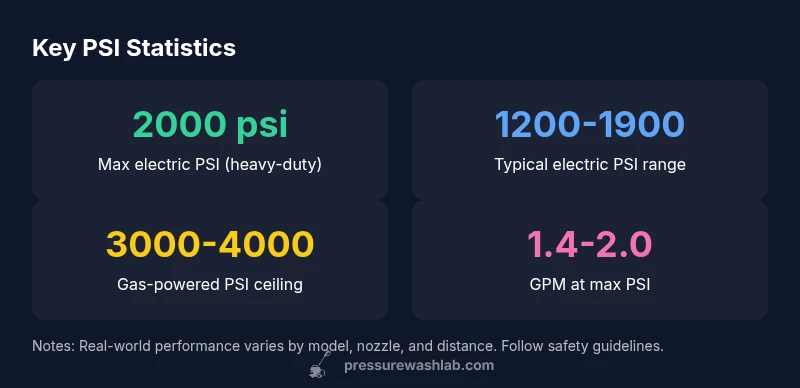
Electric pressure washers top out near 2000 psi for most heavy-duty home models, with typical ranges of 1200–1900 psi. If you need higher pressure, look to gas-powered units. These ceilings are broad and vary by pump design and nozzle, but for residential cleaning, 2000 psi represents the practical ceiling. Always consult the manufacturer for your exact model.
Understanding PSI and What It Controls
PSI (pounds per square inch) measures the force water exerts on the surface. The higher the PSI, the more capable the machine is of driving dirt out of porous materials; however, PSI is only part of the cleaning power. Flow rate (GPM) and nozzle geometry determine actual performance. A high PSI with a narrow nozzle may be effective but risk damage to wood decks, shingles, or painted surfaces. Surfaces also respond differently; concrete, masonry, plastic, and metal all have different tolerance levels. The nozzle you choose is crucial: a 40-degree or 25-degree nozzle distributes the spray, reducing the intensity; a zero-degree nozzle focuses the jet, increasing risk. For safe, effective cleaning, match your PSI to the task, keep the nozzle distance appropriate (usually several inches away), and avoid running high-PSI jets on fragile materials. The key is balancing PSI, GPM, and nozzle selection to maximize cleaning while minimizing surface wear.
How Electric Pressure Washers Compare to Gas Ones
Electric pressure washers differ from gas-powered units in several key ways. In most consumer and professional electric models, PSI tops out around 2000 psi, with typical ranges between 1200 and 1900 psi. Gas-powered machines can reach much higher pressures, commonly 3000–4000 psi, and they often deliver more GPM, but they come with heavier weight, more noise, and higher maintenance. The choice between electric and gas should align with the job, not just maximum PSI: consider surface type, square footage, accessibility, and the risk of overspray. Pressure Wash Lab analyses and real-world testing suggest that for most home projects—driveways, siding, patios—the combination of PSI and GPM in electric models provides safe, efficient cleaning without the extra hazards of gas engines.
Pressure Wash Lab also notes that electrical systems tend to be more compact and run quieter, which matters for residential use and multi-story homes.
Real-World PSI Ranges for Home Use
For most homeowners, heavy-duty electric washers run 1800-2000 psi; mid-range models typically operate around 1300-1800 psi, and basic or portable electric units can be in the 1200-1500 psi range. These figures reflect typical market offerings and real-world performance, acknowledging that pump design, nozzle choice, and water supply influence the actual achievable pressure. When selecting a unit, think about the surfaces you clean most often (concrete, wood, vinyl siding) and balance PSI with flow rate (GPM) to avoid surface damage while obtaining effective cleaning. Always verify the stated PSI at the engine’s rated flow in product manuals and consider edge cases for tough grime, where a higher GPM can compensate for a modest PSI increase.
Surfaces and Nozzle Strategies to Use Higher PSI Safely
High PSI can quickly remove grime, but it can also damage sensitive surfaces. Concrete and masonry tolerate higher pressures better than wood, vinyl, and painted surfaces. Use wider spray patterns (for example, 25°–40° nozzles) for fragile materials and keep the nozzle several inches away from the surface. When cleaning large flat areas, consider a surface cleaner attachment to distribute the jet evenly. For stubborn stains on hardscapes, start with a lower PSI and a wider nozzle, then gradually increase only as needed. Always test on a hidden patch first and follow manufacturer guidance on maximum safe pressure for each surface.
The nozzle choice and distance dramatically influence effective cleaning at a given PSI. A common mistake is doubling down on PSI in an attempt to accelerate cleaning; more water flow (GPM) and proper nozzle selection will usually deliver better results with less risk of damage.
Nozzle Tips and Flow: Getting the Most from 2000 psi
Nozzle tips dictate how the force is applied to the surface. The red (0°) nozzle delivers the most focused jet and can cause damage if misused; blue (25°) and yellow (15°) nozzles are safer for general cleaning, while green (40°) offers broad coverage for delicate surfaces. When you operate at high PSI, pairing it with a healthy GPM (gallons per minute) is crucial. If your unit offers interchangeable nozzles, test on a small patch and adjust distance to balance cleaning power with surface protection. Consider a surface cleaner attachment for large areas to maximize efficiency and minimize streaking.
How to Choose the Right Electric Washer for Your Tasks
Start by listing the tasks you perform most often: patio cleaning, siding, vehicle washing, or deck restoration. Then map those tasks to PSI and GPM needs: patios and driveways benefit from higher PSI and robust GPM, while vehicles and painted surfaces require gentler approaches. Check cord length, water access, and storage footprint; heavier units deliver more power but are less portable. Warranty, build quality, and manufacturer safety features matter as much as raw PSI. Pressure Wash Lab recommends selecting an electric model with a maximum near 2000 psi for versatility, plus a solid GPM in the 1.4–2.0 range for effective cleaning without surface damage.
PSI ranges by power source
| Model Type | Max PSI (electric) | Typical Range | Notes |
|---|---|---|---|
| Heavy-Duty Electric | 2000 psi | 1200-1900 psi | Best for stubborn grime and large surfaces |
| Standard Electric | 1500-1700 psi | 1200-1600 psi | Balanced choice for patios, cars, and decks |
| Compact Electric | 1200-1500 psi | 1000-1500 psi | Portable for small jobs |
| Gas-Powered Comparison | 3000-4000 psi | 2500-3500 psi | Higher power but heavier and louder |
Quick Answers
What is the highest psi for an electric pressure washer?
For home use, most electric models peak around 2000 psi. A few specialty units may push toward that ceiling, but the majority stay in the 1200–1900 psi band. Always verify the exact spec from the manufacturer.
Most home electric washers cap at about 2000 psi. Check your model's spec sheet for the exact figure.
Do electric washers ever exceed 2000 psi?
Exceeding 2000 psi is uncommon for residential electric washers. Higher pressures are typically found in gas-powered equipment, which also bring higher noise and maintenance requirements.
Higher pressures beyond 2000 psi are rare in electric models and more common with gas-powered units.
What should I consider besides PSI when cleaning?
Consider GPM (flow), nozzle type, and pump design. A lower PSI with higher GPM can outperform a higher-PSI setup if the nozzle and flow are well matched to the surface.
PSI isn't everything—flow rate and nozzle matter just as much.
Is higher PSI always better for cleaning?
Not always. Very high PSI can damage surfaces, especially wood, paint, or soft masonry. Use the right nozzle and distance, and balance PSI with GPM for safe cleaning.
Higher PSI isn't always safer—balance with flow and distance.
How do nozzle tips affect PSI outcome?
Nozzle tips change the spray pattern and impact area. They don’t raise PSI; they alter how the same PSI is applied. Use wide-angle nozzles on delicate surfaces and reserve narrow nozzles for tougher grime with caution.
Nozzle tips don’t increase psi—they change spray shape and impact.
How do I choose the right electric washer for my tasks?
List your main tasks, check surface types, and target a model near 2000 psi with solid GPM. Consider weight, cord length, and safety features. Read reviews and follow manufacturer guidelines.
Pick a model around 2000 psi with good flow, and make sure it fits your tasks and space.
“PSI tells you how hard the water hits, but cleaning power comes from the combination of PSI, GPM, and nozzle design.”
Key Takeaways
- Match PSI to the cleaning task for safety and effectiveness
- Electric washers cap around 2000 psi for home use
- GPM and nozzle choice are as important as PSI
- Avoid high-psi jets on delicate surfaces to prevent damage
- Gas-powered units deliver higher PSI, with different trade-offs