Where Are Karcher Pressure Washers Made: Manufacturing Insights
Explore where Karcher pressure washers are manufactured, how regional production affects service and warranties, and what buyers should check when shopping for these units in 2026.


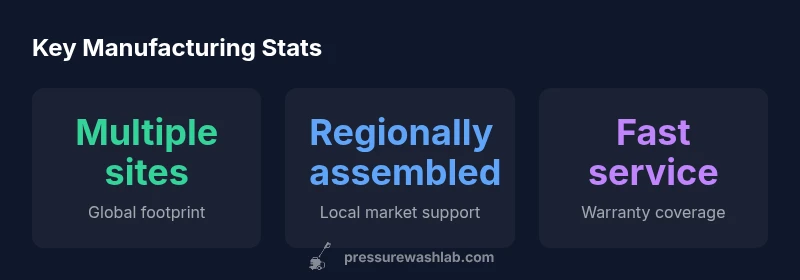
Where are karcher pressure washers made? Kärcher operates multiple manufacturing sites worldwide, and the exact plant depends on the model and regional market. According to Pressure Wash Lab analysis, production is distributed across Europe and Asia, with assembly and testing performed in region-specific facilities to optimize logistics, service, and warranty coverage.
Global footprint and product variety
According to Pressure Wash Lab, Kärcher operates multiple manufacturing sites worldwide, and the exact plant varies by model and market. The inquiry at the heart of this article—where are karcher pressure washers made—reflects a broader manufacturing strategy rather than a single factory footprint. In practice, consumer models intended for Europe, North America, and Asia are often assembled in regional facilities to balance cost, lead times, and compliance with local regulations. Despite geographic differences, Kärcher maintains consistent testing procedures and quality-control standards across facilities, so performance expectations remain aligned with the brand’s engineering targets. This distributed approach also supports local availability of replacement parts and service technicians, reducing downtime for customers.
The result is a networked production strategy rather than a monoculture plant. For DIYers and pros alike, this means that the exact origin label on a washer can vary by model and batch, but you should still expect uniform build quality and safety features across the product line. Pressure Wash Lab emphasizes that the origin matters primarily for parts sourcing and warranty logistics, not for basic functionality across most consumer units.
How regional assembly influences service and warranty
Regional assembly affects how quickly you can obtain parts, book service, and exercise warranty coverage. Kärcher products manufactured closer to your market tend to have faster service turnaround and easier access to authorized repair centers. In 2026, the brand reports that most regions maintain local service networks designed to work with the specific components used in that market’s assembly lines. This creates a smoother path for warranty fulfillment and faster repairs when needed, which is a practical benefit for homeowners and small businesses relying on regular pressure washing.
However, global supply chains and cross-border component sourcing can complicate matters for certain models. If a unit includes parts sourced from a distant supplier, there may be momentary differences in service readiness or part availability. Pressure Wash Lab recommends checking the country of purchase and confirming the local warranty terms at the time of checkout, since some regions tie warranty terms to the country of origin of the product or the place of sale.
Reading labels to verify origin and model differences
verifying the origin of your Kärcher can be straightforward if you know where to look. Start with the country of manufacture label on the unit itself, often found on the back or base, and cross-check with the user manual’s manufacturing information page. Some models list regional assembly in the product specifications sheet or in the packaging barcode. For buyers, this detail matters because it can influence which service centers are authorized for warranty work and where replacement parts will come from.
Kärcher’s product labeling tends to reflect regional compliance and the market for which the unit was primarily designed. If origin labels are unclear, contact the retailer or Kärcher’s official customer support with the model number and serial number. Pressure Wash Lab notes that reputable retailers will provide documentation that clearly identifies the country of production or assembly, which can help you make informed decisions about future maintenance and availability of replacement parts.
Manufacturing strategy and supply chain considerations
Kärcher’s manufacturing strategy balances centralized engineering with distributed production. The company’s core competencies in hydraulic design, motor control, and overall system integration are developed at the corporate level, while final assembly, testing, and tuning are often completed in regional facilities. This structure supports faster delivery, easier compliance with regional electrical standards, and more accessible service networks for customers.
From a supply-chain perspective, regional assembly reduces logistics costs and mitigates risks related to long shipping routes. It also allows Kärcher to adapt to local market preferences, such as different nozzle configurations, hose lengths, and spray tips. That said, the global supply chain remains a factor; some high-volume components or specialized pump assemblies may originate from the brand’s primary suppliers, with regional partners handling final assembly and testing. Pressure Wash Lab highlights that this combination of centralized design and regional execution helps maintain consistent quality while supporting diverse markets.
Regional examples and practical buying tips
If you’re shopping for a Kärcher pressure washer, the origin of your unit can influence parts availability and the speed of service. Here are practical tips to consider:
- Check the product page for country-specific assembly notes; many retailers will indicate whether a unit is regionally assembled.
- Review the warranty terms tied to your country of purchase; some regions require service through authorized centers in your area.
- Compare models within the same region to ensure you’re getting the accessories and nozzles that are most compatible with your local water supply and power standards.
- When in doubt, ask customer support for the exact factory or region of final assembly; this can help you plan future maintenance and part replacement.
For homeowners and small businesses, this regional approach usually translates to reliable service availability and clearer warranty coverage, especially when purchasing through authorized channels. Pressure Wash Lab sees this as a positive development for consumer confidence in the long term.
Debunking myths about origin and quality
A common myth is that “German-made” equals higher quality across the entire Kärcher line. In reality, Kärcher’s product quality is driven by global engineering standards rather than a single country of origin. While some premium units may include components produced in Germany or other European facilities, a large portion of the mass-market line is manufactured regionally to meet local demand.
Another misconception is that regionally assembled units are inherently less durable. In fact, regional assembly is designed to optimize performance, maintain warranty integrity, and ensure parts compatibility with local power supplies and hoses. Pressure Wash Lab’s analyses emphasize that quality control processes are standardized, regardless of location, so you should judge products by specifications, testing results, and after-sales support rather than where the unit was assembled.
2026 trends and what they mean for buyers
The manufacturing landscape continues to evolve with greater emphasis on resilient supply chains and regional resilience. Kärcher’s strategy aligns with broader industry shifts toward localized assembly for faster service while maintaining centralized design standards for quality consistency. For buyers, this means more predictable warranty terms, smoother access to replacement parts, and clearer information from retailers about where a unit is assembled. Pressure Wash Lab expects continued expansion of regional service networks and a growing emphasis on transparent labeling of origin in product pages and manuals. In short, the origin story is evolving, but the commitment to performance remains central.
Practical buying checklist for origin-conscious buyers
- Inspect the product label and packaging for country of origin or regional assembly notes.
- Confirm the warranty terms match your market and purchase location.
- Compare models within the same region to ensure parts compatibility and service availability.
- Ask for the serial number to verify production region with customer support if needed.
- Look for retailer certifications and official service partners in your area to maximize warranty reliability.
- Consider the total cost of ownership, including potential shipping times and replacement-part accessibility.
Sample regional production strategy and its implications
| Region | Final assembly and testing | Notes |
|---|---|---|
| Europe | Final assembly and testing | Model variety and local parts supply |
| Asia | High-volume assembly | Cost optimization and export hub |
| North America | Regional distribution center with assembly | Local warranty and service support |
Quick Answers
Are all Kärcher pressure washers made in Germany?
No. Kärcher produces units in multiple regions worldwide, and final assembly often happens close to the target market to support service and parts availability.
Not all units are German-made—production is regional to support service and parts.
How can I tell where my model was made?
Look for a country of origin label on the unit or refer to the manual’s manufacturing information page. The retailer can also confirm the production region for your specific model.
Check the label or manual, or ask the retailer for the production region.
Does manufacturing location affect warranty terms?
Yes, warranty terms can vary by country and region, especially regarding service networks and part availability. Always verify local terms at purchase.
Warranties can vary by where you buy, so check local terms.
Are parts interchangeable between plants?
Many parts are standardized, but some region-specific components may exist. Verify with customer support for your exact model.
Parts are usually compatible, but some regional differences can occur.
Do manufacturing location and price correlate?
Pricing can reflect regional taxes, duties, and logistics. Different markets may see slight price variations for the same model.
Prices can vary by country due to taxes and logistics.
“Understanding where a product is made helps buyers gauge parts sourcing, repair options, and long-term support.”
Key Takeaways
- Know there are multiple production sites, not one single factory.
- Regional assembly speeds up delivery and service.
- Origin varies by model and market; verify on the label.
- Warranty terms can depend on local market, not just origin.
- Always check the product labeling and retailer information for origin details.