Which Pressure Washer Tip Is The Strongest? A Comprehensive Comparison
An analytical comparison answering which pressure washer tip is the strongest, with emphasis on nozzle angles, spray patterns, PSI impact, and practical recommendations for homes, decks, driveways, and more.


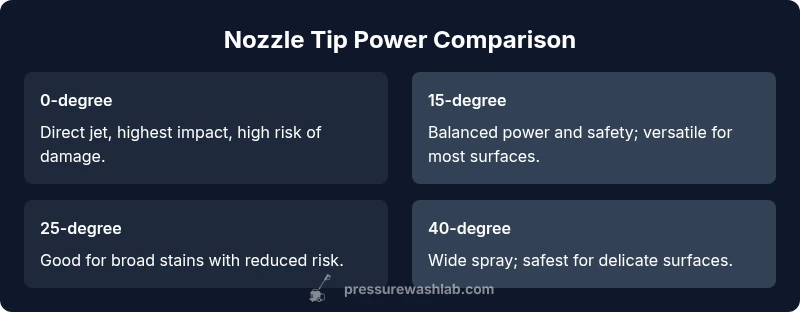
What people often mean by the question which pressure washer tip is the strongest? There is no universal single strongest nozzle. Strength depends on surface, distance, and technique. The direct 0-degree nozzle delivers the strongest immediate impact, but it risks damage; for a safe, powerful clean, the 15-degree or 25-degree tips offer the best balance. In practice, strongest results come from matching the tip to the surface and maintaining proper distance.
Context: Why the idea of a single
Feature Comparison
| Feature | 0-degree nozzle (red) | 15-degree nozzle (yellow) | 25-degree nozzle (green) | 40-degree nozzle (white) |
|---|---|---|---|---|
| Recommended use | Spot cleaning and heavy stains with high risk of surface damage | Balanced power for most hard and soft surfaces | Versatile for wood, brick, and painted surfaces with reduced risk | Liberal spray for delicate surfaces and wide-area cleaning |
| Cleaning power on hard surfaces | Highest direct impact but easy to gouge concrete or stone | Strong, effective on stains with safer margins | Good for larger areas with lower risk of damage | Low power; suited for gentle cleaning and rinse work |
| Risk of surface damage | Very high if misused (edges, coatings) | Moderate with distance control | Low if used properly at safe distances | Minimal, but can still cause pitting on soft materials |
| Best for | Spot treatment and stubborn stains | General purpose cleaning on tough surfaces | Decks, siding, and masonry with care | Large surface areas and delicate finishes |
Pros
- Helps prioritize safety over brute power
- Clarifies that strongest depends on context
- Encourages testing and surface assessment
- Highlights the importance of distance and technique
Cons
- Can encourage overly cautious use that underutilizes power
- May frustrate readers seeking a single number or miracle nozzle
- Requires understanding of surface-specific risks
- Could underemphasize the value of surface cleaners for large areas
There is no universal “strongest” nozzle; the strongest option is context-dependent and best achieved with the right tip for the surface and proper technique.
For most homeowners, the 15-degree tip hits a sweet spot between cleaning power and surface safety. Use 0-degree only for controlled spot work with careful distancing. Always test on an inconspicuous patch before broader use.
Quick Answers
Is there a universally strongest nozzle for every surface?
No. The strongest nozzle for one surface can damage another. Factors like surface hardness, coating, and nearby plants determine which tip offers the best balance of power and safety. Always start with a milder angle and increase only if needed.
No universal strongest nozzle.” Start with a mid-angle and test on a small patch to avoid damage.
Can using a 0-degree nozzle permanently damage surfaces?
Yes. A 0-degree nozzle can gouge concrete, strip paint, and etch softer materials when used up close. It’s powerful, but requires precise distance control and strict safety margins.
Yes, 0-degree can damage surfaces if used incorrectly.
What distance should I keep from the surface with high-power tips?
Start at a minimum distance recommended by the manufacturer for the chosen tip, then back away gradually to maintain power while avoiding damage. A common rule is to test from several inches away and increase as needed.
Start at a few inches away and test, then adjust.
Are surface cleaners or turbo nozzles ever stronger than fixed-angle tips?
Surface cleaners and turbo nozzles spread the load and can deliver strong cleaning power without concentrated jets. They’re often safer for large flat surfaces and can outperform fixed-angle tips on broad stains.
Surface cleaners can be stronger for wide areas and safer too.
How does distance affect cleaning power with strong tips?
Distance dramatically affects power. Closer proximity yields more focused impact and higher risk of damage; moving back slightly increases safe coverage while reducing the risk. Practice controlled sweeps.
Distance changes impact a lot—keep it controlled.
Should I always use PPE with high-power tips?
Yes. High-pressure cleaning can cause debris to ricochet. Wear eye protection, gloves, and sturdy footwear, and ensure bystanders are clear of the spray path.
Always wear protection and keep others away when using strong tips.
Key Takeaways
- Match tip to surface, distance, and material
- Test on patch areas before full use
- Favor 15° for versatility; reserve 0° for controlled, guided work
- Prioritize safety and technique over chasing raw power