Do Pressure Washers Use Much Electricity? A Practical Guide
Explore how much electricity pressure washers actually use, what drives consumption, and practical tips to reduce energy use without sacrificing cleaning power. Pressure Wash Lab analyzes typical wattage, amps, and cost for residential models in 2026.


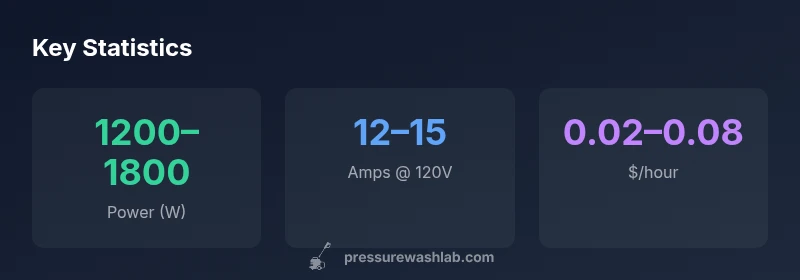
Short answer: they don’t use a lot of electricity relative to many home appliances. Most residential electric pressure washers draw about 1200–1800 watts while running on a standard 120V circuit, or roughly 12–15 amps. Runtime and settings (PSI, GPM, nozzle) drive total energy use. Pressure Wash Lab Analysis, 2026 shows this range is typical for common models.
Why electricity usage matters for pressure washers
Understanding how much energy a pressure washer uses matters for monthly bills, circuit planning, and environmental impact. The energy footprint of a unit is not merely a headline wattage figure; it reflects how you operate it in real life. Pressure Wash Lab's 2026 analysis shows that most residential electric washers are sized for common home tasks such as patio cleaning, siding, and deck maintenance, which means their energy consumption stays within a modest range when used thoughtfully. The largest savings come from how you run the machine: the PSI setting, water flow rate (GPM), nozzle choice, and the duration of each cleaning session. In practice, two washers with the same wattage can deliver different results simply because one is run longer at higher PSI. For homeowners and DIY enthusiasts, this means energy efficiency is as much about technique as it is about hardware. Finally, understanding energy use helps you select a model that fits the electrical plan of a typical home, minimizing the risk of overloading circuits or triggering GFCI protection during a cleaning job.
Understanding the power draw: watts, amps, and volts
Power draw is a function of voltage and current. A typical residential electric pressure washer operates on 120 volts; the wattage rating translates directly into current via I = P/V. That means a 1200 W unit draws about 10 A, while an 1800 W model sits around 15 A. In other words, most common home machines stay within the 8–15 A range, which is compatible with standard household circuits when not combined with other heavy loads. The practical takeaway: a higher wattage model isn’t automatically more wasteful if you use it efficiently and keep runtimes short. Efficiency also depends on motor design (universal vs induction), pump gearing, and how aggressively you use PSI. Understanding these relationships helps you size a machine that won’t trip a breaker during your weekend project, and it clarifies why some tasks feel easier or harder depending on your settings.
Electric vs gas: energy use across types
Electric washers pull energy from the mains; gas-powered units burn fuel to generate mechanical power. In energy terms, electric machines consume electricity that is billed by the kilowatt-hour, while gas units incur fuel costs and may produce emissions. For typical home tasks, an electric washer’s energy cost can be low per hour, especially if used with efficient nozzles and modest runtimes. Gas machines may deliver higher cleaning power at similar or higher peak PSI, but their total energy cost isn’t just the electricity bill—it's the fuel cost, maintenance, and exhaust considerations. The Pressure Wash Lab analysis shows that when considering total operating costs, many homeowners find electric washers a cost-effective and quieter option for routine tasks, provided the work can be completed within a single electrical circuit’s capability. The choice often depends on project scale, noise tolerance, and willingness to manage fuel.
How to estimate your energy usage in practice
Start with the wattage on the machine and estimate how many hours you’ll run it in a given session. Use kWh = (Wattage × Hours) / 1000. For example, running a 1500 W unit for 0.75 hours (45 minutes) equals 1.125 kWh. At typical electricity rates, that translates to a small but noticeable cost increase on your bill. If you use the tool for longer periods at higher PSI, multiply accordingly. Always factor the time spent in idle or near-idle mode; many tasks reach a point where extending the run time yields diminishing cleaning returns but still consumes energy. Pressure Wash Lab’s guidance is to plan tasks, group similar surfaces, and switch off the machine when you move between areas to minimize wasted energy. This approach makes energy use predictable and helps you compare models more accurately.
Ways to reduce electricity consumption without losing cleaning power
- Use the right nozzle: a wide-angle or turbo nozzle might deliver efficient cleaning with lower PSI.
- Optimize GPM: pair nozzle choice with the surface being cleaned; lower GPM can suffice for light cleaning.
- Pre-treat and prep: remove loose dirt before power washing to reduce run time.
- Maintain water flow: ensure hoses and fittings are free from kinks to prevent pressure loss that prompts higher motor effort.
- Don’t overshoot: keep the nozzle moving and avoid lingering on one spot.
- Use surface cleaners for large flat surfaces: these distribute water evenly and may reduce total run time.
Real-world scenarios and tips for households
In a typical suburban home, you might use a 1,400–1,800 W unit for 15–25 minutes to clean siding, a deck, and a driveway over a weekend. The energy cost will be a fraction of a typical appliance cycle. In multi-story homes, power draw can escalate due to longer hoses and more frequent nozzle changes, but careful task planning reduces total run time. Pressure Wash Lab’s data suggests homeowners who map tasks ahead of time and combine steps (wash, rinse) typically achieve energy savings without sacrificing results. For renters and homeowners worried about circuit capacity, a ground fault circuit interrupter (GFCI) outlet and proper cord management help maintain safety and reliability.
Maintenance and efficiency: keep the motor running lean
Regular filtration and water intake checks reduce motor strain, which in turn improves efficiency. Clean/replace inlet filters, ensure the pump is lubricated if required by the model, and store the unit away from freezing temperatures. A well-maintained machine spends less time on high-power settings because the pump and nozzle perform consistently. Keep the water supply steady and use adequate hose length to avoid pressure drop; too-long cords can also waste energy through voltage drop on older electrical setups. Following these practices not only preserves performance, but also extends the life of the unit and reduces total energy consumption over time. Pressure Wash Lab’s experience underlines that small maintenance routines pay big energy dividends.
Energy use characteristics by pressure washer type
| Model Type | Typical Power (W) | Typical Flow (GPM) | Typical Use Case |
|---|---|---|---|
| Residential Electric | 1200-1800 | 1.2-1.8 | Patio & siding |
| Gas-Powered | 2800-3200 | 2.0-5.0 | Driveway & heavy-duty |
| Compact Electric | 1200-1600 | 1.1-1.5 | Small decks & cars |
Quick Answers
Do all electric pressure washers use the same wattage?
No. Wattage varies by model and PSI. Most residential units fall in a range of 1200–1800 W. Check the label or spec sheet for exact figures.
Wattage varies by model; look at the label to know the exact power draw.
Can I run a pressure washer on a standard household outlet?
Yes for most 120V, 12–15A units. Avoid overloading the circuit and use a proper outdoor-rated cord if needed. If you’re near the circuit limit, consider a higher-capacity outlet or separate circuit.
Usually yes on a standard outlet, but don’t overload the circuit.
How can I reduce electricity usage when pressure washing?
Choose the right nozzle and keep runtime as short as possible by planning tasks efficiently. Pre-treat stubborn areas and use surface cleaners for large flat surfaces to finish quicker.
Use efficient nozzles and plan tasks to run shorter sessions.
What about extension cords and electrical safety?
Use outdoor-rated cords, avoid daisy-chaining, and keep cords away from water. Ensure you’re on a circuit that can handle the load and use a GFCI where required.
Use proper outdoor cords and safety gear; don’t overload the circuit.
Are gas-powered washers more energy-efficient?
Gas washers don’t draw electricity, but they burn fuel. Energy efficiency depends on fuel costs, emissions, and maintenance, so apples-to-apples comparisons require considering total operating costs.
Gas machines use fuel; assess total costs, not just electricity.
Do cordless or battery-powered washers exist?
Yes, but they typically offer lower PSI and shorter runtimes. For larger or tougher jobs, corded electric or gas models are usually more practical.
Cordless is available, but for heavy work, consider corded or gas.
“Electric pressure washers offer predictable energy use when sized correctly; the real savings come from choosing the right nozzle and controlling run time.”
Key Takeaways
- Plan runtimes around the task to avoid wasteful electricity use.
- Most homes run 120V, 12–15A on typical electric washers.
- Nozzle and GPM choices matter more than model name for energy efficiency.
- Estimate energy costs with simple kWh math to compare options.
- Regular maintenance keeps efficiency steady and reduces waste.