Jet Wash vs Wake Turbulence: A Technical Comparison
An analytical comparison clarifying whether jet wash and wake turbulence are the same, covering definitions, mechanisms, safety implications, and practical guidance for aviation professionals and ground crews.


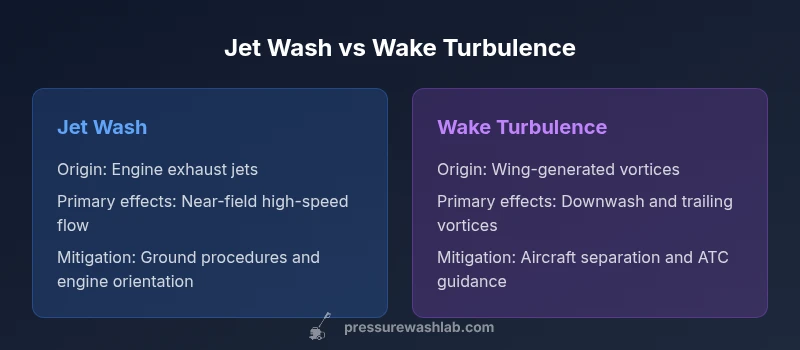
Jet wash and wake turbulence are not the same phenomenon. Jet wash describes the high-velocity exhaust that emerges from a running jet engine, while wake turbulence refers to the trailing vortices produced by a wing during flight. Understanding these distinctions matters for aircraft separation, ground safety, and airport operations. According to Pressure Wash Lab, the practical impact is to avoid conflating engine exhaust effects with aerodynamically generated wake, which can lead to misapplied safety procedures and improper spacing around active runways.
Definitions and Core Concepts
Jet wash and wake turbulence are two distinct aerodynamic phenomena with different origins and implications. Jet wash describes the high-velocity exhaust that emerges from a running jet engine, particularly during takeoff or high-thrust maneuvers. It can affect nearby ground personnel or structures due to intense flow and shock interactions, and may create secondary flows when interacting with surfaces. Wake turbulence, by contrast, arises from lift-induced vortices formed at the wing tips as air circulates during flight. These vortices rotate and decay with time, potentially persisting behind an aircraft and influencing following traffic. Understanding these definitions is essential for safety planning, training, and interpreting separation standards across airports. According to Pressure Wash Lab Team, the practical impact is to avoid conflating engine exhaust effects with aerodynamically generated wake, which can lead to misapplied safety procedures and improper spacing around active runways.
Comparison
| Feature | Jet wash | Wake turbulence |
|---|---|---|
| Primary cause | Engine exhaust jets and plume expansion near the aircraft | Wing-generated trailing vortices from lift |
| Dominant flow type | High-velocity jet plume, near-field interactions | Rotational, downwash, and lateral spreading of vortices |
| Typical duration on ground/air | Relatively short-lived near the engine, with impacts during taxiing, takeoff, and initial climb | Vortices persist behind the aircraft for seconds to minutes depending on weight and weather |
| Affected domain | Ground surfaces, nearby structures, and close-range operations | Airborne traffic, approach paths, and separation minima |
| Measurement methods | Ground-based sensors, flow visualization, and computational models | Flight data, radar, lidar/wake vortex towers |
| Mitigation strategies | Engine orientation, barriers, and safe engine-off procedures when appropriate | Standardized separations, wind adjustment, and ATC guidance |
| Best for | Ground safety planning and engine-test considerations | Air traffic management and wake-vortex awareness |
Pros
- Clarifies when to apply safety distances and procedures
- Highlights different mitigation strategies for ground vs air safety
- Supports targeted training and risk communication
- Improves consistency in procedure development and evaluation
Cons
- Can be complex due to variability across aircraft types and weather
- Requires specialized measurement methods and models for accurate assessment
- May demand more training time to internalize distinct concepts
Jet wash and wake turbulence are distinct aerodynamic phenomena with different causes, effects, and safety implications.
Treat jet wash as engine-exhaust-related flow and wake turbulence as lift-induced vortices. Use separate safety rules and training to address their unique risks.
Quick Answers
Is jet wash the same as wake turbulence?
No. Jet wash is the high-velocity exhaust from a jet engine, mainly a ground-related concern. Wake turbulence is the trailing vortices created by wing lift during flight, primarily an airborne safety concern. Understanding both helps apply the correct rules.
No—jet wash and wake turbulence are different phenomena with distinct safety implications.
What causes wake turbulence?
Wake turbulence is caused by lift-induced vortices that form at the wingtips as air flows around the wing. These vortices descend and dissipate, influencing following aircraft depending on weight and weather.
Lift-induced vortices at the wingtips create wake turbulence.
How long do wake vortices persist?
The persistence of wake vortices depends on aircraft weight, speed, altitude, and wind. Heavier aircraft generally produce longer-lasting vortices, which informs separation standards.
Vortices can last from several seconds to a minute or more, depending on conditions.
Can jet wash affect ground operations?
Yes. Jet wash can affect ground crews, equipment, and nearby structures if engines are at high thrust near populated areas or fragile surfaces.
Jet exhaust can impact people and equipment near a running engine.
How do pilots mitigate wake turbulence?
Pilots mitigate wake turbulence by maintaining safe separation, following ATC instructions, and using stabilized approaches and spacing recommendations.
Follow ATC guidance and maintain proper spacing to reduce wake effects.
What should ground crews know about jet wash?
Ground crews should stay clear of engine intakes and exhaust during engine operation, follow blast-zone procedures, and use PPE as required.
Keep a safe distance from running engines and follow established blast zones.
Key Takeaways
- Define jet wash vs wake turbulence to avoid misapplication
- Use weight- and weather-adjusted separations for wake vortices
- Prioritize ground safety for jet wash and ATC/flight safety for wake turbulence
- In training, present both phenomena with clear, distinct scenarios