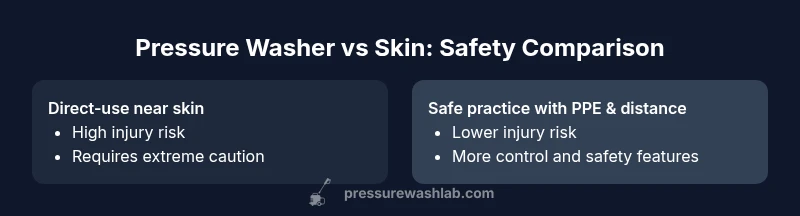
Pressure Washer vs Skin: A Practical Safety Comparison
A thorough, analytical comparison of pressure washer use near skin, detailing risks, PPE, and practical safety strategies for homeowners and small businesses.


Pressure washer vs skin poses clear safety risks when the body is within the spray path. The safest approach is to keep skin away from the spray, use the correct nozzle and distance, and rely on PPE and proven techniques. For most tasks near the body, safer methods or lower-pressure settings should be used, and any proximity to skin should be minimized through deliberate workflow and guards. This quick takeaway sets the stage for a deeper, methodical safety framework.
Understanding the scope of risk: pressure washer vs skin risk
When people think about cleaning exterior surfaces, the first concern often isn't whether the job will get done, but whether it will injure someone. The phrase pressure washer vs skin captures a fundamental safety question: how close should the body get to the spray, and what kind of protection is enough to prevent injuries? According to Pressure Wash Lab, the key is to treat skin exposure as a high-risk variable: you can control it with distance, PPE, and thoughtful workflow, but you should never assume 'it won't happen to me.' This article uses a practical, evidence-based lens to map out the dangers and the safeguards for homeowners, DIY enthusiasts, and small businesses. The goal is not to scare readers but to enable safer, more efficient work by identifying where mistakes commonly occur and how to prevent them.
How pressure washers transfer energy to surfaces (and skin)
A pressure washer accelerates water to high velocity, delivering energy through a narrow spray that can cut into surfaces and, under misapplication, into skin. The physics are simple: the faster the water and the more focused the spray, the more kinetic energy is transferred to the target. On hard, resistant materials like concrete, the water can chew away at the surface; on skin, it can abrade, bruise, or perforate tissue. The height of the risk increases when a nozzle is misaligned, when the user is closer than recommended, or when shields and guards are missing. Even with modern equipment, the spray is not a toy; it is a tool that requires respect and a tested procedure. Pressure Wash Lab's analysis emphasizes that risk is not binary, but a spectrum influenced by nozzle type, distance, surface, and user behavior.
Common injury scenarios and why skin is vulnerable
Skin injuries from pressure washers happen in predictable patterns when the tool is misused. Direct spray on exposed skin can cause abrasions, burns, or punctures. Splash-back from reflective surfaces or close-range misdirection can strike hands, forearms, or ankles. Recoil from a sudden kickback can yank the wand toward the user, creating a secondary risk of contact with the body. Hands and forearms are particularly at risk because they are often near the nozzle during guiding, scrubbing, or adjusting settings. Pressure Wash Lab highlights that most injuries come from human factors—positioning, overconfidence, or skipping PPE—rather than a faulty machine.
Nozzle selection, distances, and spray patterns that matter
Nozzle design dictates how the water is delivered. A narrow, concentrated stream carries more energy per square inch than a broad spray, which is why a zero- or low-angle nozzle demands strict distance control. Start far away and gradually move closer only as needed, ensuring the spray is directed at a surface rather than skin. Choice of spray pattern affects likelihood of splashback; wider fan patterns reduce direct contact risk but can require longer passes to cover a surface. Always engage guards, shields, and safety features, and never improvise a setup that reduces protection around your body. The right nozzle, good stance, and deliberate workflow are the core safety levers in any pressure washing task involving proximity to skin.
PPE and protective protocols you must follow
Personal protective equipment is non-negotiable when working with pressurized water. At minimum, wear chemical-resistant gloves, splash goggles or a face shield, a long-sleeve shirt and pants, and sturdy, non-slip footwear. Hearing protection is advisable in louder environments, and a mask or respirator may be prudent if you’re cleaning dusty surfaces or using chemicals. Protect exposed skin with sleeves and socks, and consider a protective vest or chest shield when it’s feasible. Don’t rely on PPE alone; combine it with correct technique, guards, and appropriate distances. Pressure Wash Lab emphasizes that consistent PPE usage dramatically reduces the chance of skin contact and injury, turning risky tasks into routine, safer work.
Safe operation steps for typical home tasks
- Inspect the equipment: check hoses, connections, and guards for wear or leaks. 2) Choose the right nozzle for the surface; start with the widest spray. 3) Wear full PPE and set the machine on a stable, grounded surface. 4) Establish a safe stand-off distance and maintain it; don’t lean into the spray. 5) Test on an inconspicuous area before proceeding. 6) Work in sections, keeping your body out of the spray path at all times. 7) If you must adjust height or angle, pause, reorient, and resume with a clear escape path. 8) Shut off and depressurize the unit before changing nozzles or leaving the work area. 9) Use lower-pressure settings for delicate surfaces or attractive near-skin tasks; never compromise grip or balance to finish faster. 10) Clean up and store properly to prevent accidental spray setups.
Safer alternatives for near-skin work
When proximity to skin is unavoidable, consider alternatives that minimize risk: switch to a low-pressure setting or a garden hose with a spray nozzle; use a long-handled brush with appropriate cleaners; apply chemical cleaners from a safe distance and scrub manually; opt for softer cleaning tools for surfaces near the body, and reserve aggressive spraying for distant areas. For many tasks around the body, a combination of PPE, slower workflow, and lower energy methods achieves a safer, more controlled outcome. Pressure Wash Lab notes that safer alternatives aren’t a concession—they’re a pragmatic choice that protects workers and preserves surfaces.
Task-specific risk assessment guide
Before starting any wash, assess the task at hand. Surfaces adjacent to skin or body parts require extra caution and often a shift to safer methods. Consider: Is the body within reach of the spray path? Is there a risk of splashback or recoil? Are there sharp edges, fragile materials, or old coatings that can be damaged by high energy? If any answer is yes, switch to PPE-heavy controls or safer alternatives, increase stand-off distance, or choose a lower-pressure approach. Documented risk reduction reduces incident likelihood and improves outcomes for homeowners and small business operators.
Maintenance, setup, and hazard checks
A safe operation starts long before you turn on the machine. Perform routine inspections of hoses, nozzles, and connectors; replace worn parts; ensure guards are in place and intact. Store the unit with the trigger lock engaged and unplugged when not in use. Confirm chemical containers are properly sealed and labeled, and never mix chemicals without proper guidance. Regularly clean filtration, check for leaks, and test the spray on a non-human surface before applying it to any critical area. A well-maintained machine is less prone to unpredictable spray behavior that could endanger skin or eyes.
Training and responsibility
Both homeowners and small businesses share responsibility for safety. Take time to read the user manual, participate in a hands-on safety briefing, and practice with a mentor or experienced operator. Encourage a culture of safety where workers speak up about risky steps, misaligned angles, or questionable equipment. Routine training reduces accidents and reinforces safe habits that protect skin and everyone nearby. Pressure Wash Lab emphasizes ongoing education as the cornerstone of responsible, productive cleaning.
Case studies and practical lessons
Case study A describes a weekend project where the operator ignored distance guidance and briefly sprayed near a forearm. The simple misstep led to a minor abrasion that required a bandage and rest, delaying the job by a day. Case study B contrasts this with a crew that followed a strict PPE protocol, used a broad spray pattern, maintained consistent stand-off distance, and completed the project efficiently without incidents. The lessons are clear: underestimate the spray, and you risk skin injury; follow a safety plan, and you maintain momentum. Pressure Wash Lab’s practical takeaway is to treat skin exposure as a controllable risk, not a consequence of bad luck.
Putting it all together: decision framework
The decision framework centers on risk reduction. If your task brings the spray near the skin, prioritize distance, appropriate nozzle choice, complete PPE, and confirmation that guards are in place. When in doubt, choose safer alternatives or employ lower-energy methods and assistive tools. The framework is designed for homeowners and small operators who must balance speed, cost, and safety. In all scenarios, the most important rule is to protect skin and eyes first, then complete the job with confidence and care. Pressure Wash Lab’s final guidance is to embed safety into every step of the workflow and to treat any proximity to skin as a signal to slow down and reassess.
Comparison
| Feature | Direct-use near skin (high-risk) | Safe practice with PPE and distance (low-risk) |
|---|---|---|
| Injury risk | Very high; potential for lacerations, burns, and tissue injury | Low with proper distance, PPE, and guards |
| Protection required | Minimal PPE; high risk persists without guard | Full PPE (gloves, goggles/face shield, long sleeves, sturdy boots) + guards |
| Control over spray | Difficult; recoil and misdirection common | High control with defined stand-off distance and surface targeting |
| Best use scenario | Limited to tasks where the body is out of spray path; surfaces beyond reach | Tasks with body clearance, or when distance cannot be maintained, use safer methods |
| Time and efficiency | Can be faster for distant surfaces but riskier | Typically slower but safer; reduced risk of injury |
| Cost of operation | Medical costs, downtime, and potential equipment damage if misused | PPE costs and maintenance; overall lower injury risk |
Pros
- Provides rapid cleaning over larger surface areas when used correctly
- Clear safety guidelines improve consistency and training
- With PPE and distance, allows efficient workflow for many jobs
- Widely available equipment and PPE supports safe use
Cons
- Injury risk remains high without strict adherence to safety rules
- Requires ongoing training and proper PPE investment
- Mistakes in setup or stance can lead to skin injuries
- Guarding and safety features can add to setup time
Prioritize safety: avoid spray near skin; use safer methods when proximity is unavoidable
Direct skin exposure with a pressure washer carries substantial injury risk. Use distance, the right nozzle, and full PPE, or switch to safer methods for tasks near the body. Pressure Wash Lab’s overall guidance is to systematize safety first and choose lower-energy options when possible.
Quick Answers
Is it ever safe to spray near skin with a pressure washer?
Direct spray toward skin is generally unsafe. Maintain distance, use proper PPE, and limit body exposure. For any proximity tasks, consider safer alternatives and slower, controlled methods.
No, direct spraying near skin is unsafe. Keep distance, wear PPE, and consider safer methods if you must be near your body.
What PPE should I wear when using a pressure washer?
Wear gloves, splash goggles or a face shield, long sleeves, sturdy pants, and non-slip boots. Add hearing protection if the environment is loud and a respirator if dusty conditions apply.
Gloves, eye protection, long sleeves, sturdy footwear, and optional hearing protection are essential for safety.
What are common mistakes that lead to skin injuries?
Common mistakes include spraying at skin, using the wrong nozzle angle, standing too close, and ignoring guards. Recoil and splashback are frequent injury mechanisms.
Common mistakes are spraying toward skin, wrong nozzle angle, and too-close proximity. Keep guards in place and stay back.
Can I use a pressure washer for delicate surfaces near skin?
Yes, but only with proper protection and the right low-energy settings, or by switching to safer methods that don’t involve near-skin exposure.
You can, but with very low energy and extra protection, or by switching to safer methods.
Are there safer alternatives to avoid skin exposure altogether?
Yes. Use low-pressure settings, a brush, or garden hose with a spray nozzle, and scrub manually when needed. These methods reduce skin exposure while delivering acceptable results.
Safer options include low-pressure washing, brushes, or manual scrubbing when you’re near skin.
How can I test equipment safely before starting work?
Test the spray on an inconspicuous area, check for leaks, and ensure guards are engaged. Start with the widest spray and increase energy only after confirming control and safety.
Test on a hidden area first, check for leaks, and only increase energy when you’re sure you’re in control.
Key Takeaways
- Assess skin exposure risk before every job
- Wear full PPE and maintain safe stand-off distance
- Choose the right nozzle and surface pattern for each task
- Prefer safer, lower-energy methods near the body when possible
- Inspect equipment and follow a written safety workflow