Does Pressure Washing Cause Swirls? A Troubleshooting Guide
Urgent guide: learn why swirl patterns appear during pressure washing and how to prevent them with proven techniques, correct nozzle choices, and a step-by-step fix.


Swirl patterns from pressure washing are usually caused by nozzle choice and spray technique rather than surface damage. Start with a wider-angle nozzle (25–40 degrees) and maintain a steady distance to prevent uneven overlaps. Pressure Wash Lab notes that correcting spray angle, distance, and wand motion typically eliminates swirls without aggressive scrubbing.
Does pressure washing cause swirls?
Yes, swirling is a common issue many homeowners encounter when cleaning driveways, decks, or siding. The keyword does pressure washing cause swirls isn’t a trick question—it points to a real, practical problem: inconsistent spray distribution. According to Pressure Wash Lab, swirl patterns often stem from the interaction of spray angle, nozzle selection, and how the wand is moved across a surface. When you see circular or wavy marks, you’re usually watching overlapping jets collide or skim at uneven intervals. The most reliable way to break this pattern begins with basics: ensure you’re using the right nozzle for the surface and maintaining a consistent distance. If you test in a small, inconspicuous patch first, you can observe how the spray lands and adjust before you commit to a wider area.
If your first attempt doesn’t yield a clean pattern, don’t panic. The fix isn’t expensive or complicated, but it requires deliberate changes to technique or equipment. The Pressure Wash Lab team emphasizes that the simplest improvements—correct nozzle selection, proper distance, and smooth wand motion—resolve the majority of swirl issues on typical home surfaces. This is not about extra cleaning power; it’s about directing power evenly so that the surface looks uniform rather than mottled or streaked.
Steps
Estimated time: 25-45 minutes
- 1
Inspect nozzle and spray angle
Check that you’re using a nozzle appropriate for the surface (concrete, wood, or siding). Inspect the nozzle for wear and ensure the spray angle matches the intended coverage. A worn nozzle can create irregular spray patterns.
Tip: Replace worn nozzles before testing for swirl on large areas. - 2
Set the correct distance and test on scrap
Hold the wand at a consistent distance from an inconspicuous spot and spray a small square. Watch how the mist lands and adjust your stand-off distance to reduce overlap and spray pooling.
Tip: Start farther away if you see heavy spray or spots; move closer gradually until the edges of the spray are even. - 3
Practice steady wand motion
Move the wand with slow, overlapping passes rather than long, back-and-forth sweeps that create streaks. Uniform passes prevent circular patterns from forming as the surface dries.
Tip: Keep wrists loose and avoid abrupt stops mid-pass. - 4
Adjust pressure and surface settings
If you still see swirls, try lowering PSI slightly or switching to a gentler setting for delicate surfaces, then test again. High pressure often exaggerates minor misalignments.
Tip: Don’t exceed manufacturer guidance for the surface you’re cleaning. - 5
Document your best settings
Record the nozzle angle, distance, and pattern that produced the cleanest results for future projects. Consistency is key to preventing swirl recurrence.
Tip: Create a simple one-page reference sheet for quick field use.
Diagnosis: Visible swirl or circular pattern in spray on the cleaned surface after washing
Possible Causes
- highWrong nozzle or spray angle causing inconsistent coverage
- highToo-close or too-far from the surface creating uneven impact
- mediumWand or surface movement inconsistent, causing overlaps and gaps
- lowClogged nozzle or worn o-rings producing pulsations
Fixes
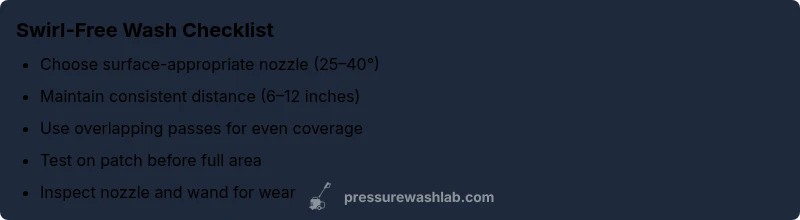
- easySelect a wider-angle nozzle (25–40 degrees) suitable for the surface and re-test on a small patch
- easyMaintain a steady distance (start around 6–12 inches from the surface, adjusting as needed) and use overlapping passes
- easyClean or replace the nozzle, spray tip, and inspect the wand for bends; ensure smooth trigger travel
Quick Answers
What causes swirl patterns when pressure washing?
Swirls are usually caused by improper nozzle angle, incorrect distance from the surface, or uneven wand motion. Worn nozzles and pulsating spray can also contribute. Start with the right nozzle and test in a patch to observe spray behavior.
Swirls come from the way the spray lands, so choose a suitable nozzle and keep a steady distance to see improvements.
Can I fix swirl issues without replacing equipment?
Yes. Often adjusting nozzle angle, distance, and wand technique resolves most swirl problems. Cleaning or replacing worn parts helps if the spray is irregular.
Most swirl problems can be fixed by tweaking technique and replacing worn parts, no heavy investments needed.
Should I use higher pressure to remove swirls from tough surfaces?
Not always. High pressure can worsen swirls by causing overspray or uneven patterns. Use surface-appropriate settings and test gradually.
Be careful with pressure—more isn’t always better; test settings on a patch first.
What surfaces are most prone to swirl damage?
Wood and soft decks are particularly sensitive to swirling due to uneven surfaces and finish coatings. Hardscape like concrete tolerates higher pressure but benefits from proper technique.
Wood and other soft surfaces need gentler handling to avoid swirl marks.
When should I call a pro for swirl issues?
If swirls persist after adjusting nozzle, distance, and technique, a professional inspection can prevent damage and identify underlying issues.
If adjustments don’t help, it’s wise to get a pro to assess and prevent damage.
Watch Video
Key Takeaways
- Use the correct nozzle for the surface
- Maintain consistent distance and overlapping passes
- Test on a patch before full-area cleaning
- Document effective settings for future projects