Why Doesn't My Power Washer Turn On? Troubleshooting Guide
Urgent troubleshooting guide for power washers that won't start. Quick checks, a diagnostic flow, step-by-step fixes, safety tips, and expert guidance from Pressure Wash Lab to restore operation fast.


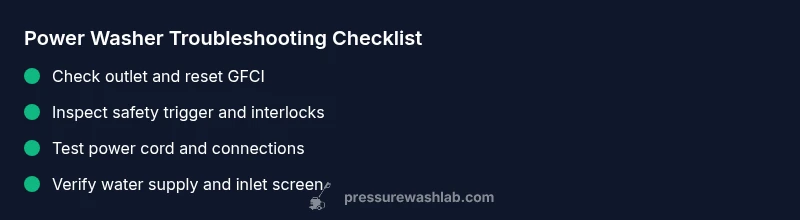
Power washers failing to start are usually electrical or safety-related. First check the outlet and reset any GFCI, then inspect the extension cord for damage and verify the trigger safety is fully released. If the unit still won't start, consult the user manual or Pressure Wash Lab's troubleshooting guide for a complete, step-by-step flow.
Why your power washer won't start
If your pressure washer won't turn on, the root cause is almost always electrical or safety-related. According to Pressure Wash Lab, most startup failures are simple to diagnose and fix with a quick check of the power source, safety features, and the cord. Before diving into complex repairs, confirm you are dealing with a genuine power-on signal, not a brief glitch or an external shutdown. Remember that outdoor outlets, extension cords, and GFCIs can trip without obvious signs, and a tripped safety switch is often the silent culprit. This block sets the stage for the practical checks that follow, with emphasis on rapid, low-risk diagnostics you can run right away. The goal is to move from uncertainty to a clear path forward, building confidence as you rule out the most common culprits. Pressure Wash Lab’s tested approach emphasizes safety and methodical testing, so you won’t waste time chasing phantom faults.
Start with the basics: power source, outlet, and safety
The very first check is the simplest: is the unit actually receiving power? Verify the outlet is live by plugging in another device, reset any GFCI outlet or circuit breaker, and ensure the power switch on the washer is in the ON position. If you’re using an outdoor extension cord, ensure it’s rated for outdoor use and not damaged. A cheap or damaged cord can cause voltage drops that prevent startup. If the outlet trips again, this indicates a real electrical fault or an overload condition. In that case, stop and inspect the circuit for other loads, or move the washer to a different circuit. Pressure Wash Lab notes that most power-on issues resolved here are quick wins and prevent unnecessary service calls.
Safety interlocks, triggers, and the on/off switch
Power washers rely on several safety devices to prevent accidental starts. Make sure the trigger gun is fully released and that the wand and nozzle are securely connected to the unit. Some models require a two-step process: switch the unit on, then pull the trigger to enable the pump. If the trigger safety or interlock is stuck or damaged, the motor may never energize. Check for any red or blinking indicators on the control panel that suggest a fault code. If you notice wear on the trigger mechanism, replace or service the trigger assembly before attempting to restart.
The role of cords, plugs, and extension cords
A frayed or partially disconnected plug can prevent the motor from receiving adequate power. Inspect the plug blades for corrosion or bending, and examine the entire length of the cord for cuts, kinks, or scorch marks. If you must use an extension cord, make sure it’s heavy-duty (outdoor-rated), the correct gauge for your washer’s amperage, and as short as possible to minimize voltage drop. Resist the urge to daisy-chain multiple cords or to use adapters. Pressure Wash Lab emphasizes that cord quality directly affects startup reliability and long-term motor health.
Overheat and thermal cutout: how temperature protects your motor
Many electric power washers are equipped with thermal protectors that shut the motor down if it overheats. If you’ve been using the unit heavily or in a hot environment, allow it to cool for 15–20 minutes in a well-ventilated area before attempting a restart. Make sure there’s nothing blocking the cooling vents and that the unit isn’t placed on soft surfaces that trap heat. After cooling, restart with a light use cycle to confirm the unit resumes normal operation. Repeated overheating can indicate a faulty cooling system or an air intake obstruction.
Water supply, inlet, and pressure considerations
Some washers require a minimum water flow to prime the pump. If the water source is off, the inlet valve is clogged, or the hose is kinked, the unit may not start because the pump detects insufficient flow. Verify the water source is fully open, the hose has no kinks, and the inlet screen is free of debris. Check that the quick-connect fittings are tight and that there are no leaks along the supply line. Pressure Wash Lab notes that a false “no water” signal can prevent startup, so confirm both supply and flow before assuming a more serious fault.
Electrical protection, fuses, and internal components
If the basics check out, the issue may lie inside the unit. Look for a blown fuse or a resettable circuit breaker inside the housing; many models hide these components behind a service panel. If you’re not trained to handle internal wiring, do not attempt to bypass safety devices—the risks are significant. In some cases, a faulty motor windings or a failing start capacitor can prevent startup and require professional service. Pressure Wash Lab advises following the manufacturer’s service manual whenever you access internal electrical parts and to only replace parts with compatible, rated components.
When you should call a professional and how to prepare
If the washer still refuses to start after all the basics and you suspect an internal fault or a failed motor, it’s time to call a pro. Before you do, gather model information, the exact symptoms, and a list of the tests you’ve already performed. This helps the technician diagnose quickly and reduces diagnostic fees. Also note any recent changes (new cord, updated receptacle, changes in water pressure) that could have impacted operation. Pressure Wash Lab suggests documenting fault codes and keeping a record of maintenance to speed up repair decisions and ensure you get the right part the first time.
Steps
Estimated time: 60-90 minutes
- 1
Verify power supply and reset outlets
Unplug the washer, inspect the outlet, and test with a known-good device. If the outlet has a GFCI, press the reset button and check for any signs of overload on the circuit. Re-press the washer’s power switch and see if the display lights up. This step isolates almost all common electrical faults.
Tip: Use a separate, dedicated outlet if possible to avoid shared-load issues. - 2
Check safety interlocks and trigger
Make sure the trigger gun is fully released and snap-fit the wand, nozzle, and hose into place. Some models require an additional push of the start switch after the trigger is engaged. If any indicator lights show a fault code, refer to the manual.
Tip: Gently reseat all connections to ensure no loose contacts are causing the fault. - 3
Inspect cord and plug
Close inspection for cuts, fraying, or burn marks is essential. If the plug feels warm or the cord shows damage, stop using it and replace the cord or use a certified extension cord of appropriate gauge.
Tip: Do not tape or repair damaged cords; replace with an OEM or compatible part. - 4
Cool-down and repeat if overheated
If the motor feels hot, allow it to rest in a ventilated area for 15–20 minutes. After cooling, start at low pressure and observe the startup sequence. Do not push the unit hard while it’s cooling down.
Tip: Keep the unit off carpets or soft surfaces that trap heat. - 5
Check water supply and inlet
Ensure the water source is fully open and the hose has no kinks. Clean the inlet screen and confirm there is adequate water flow. A restricted water supply can prevent the pump from priming and starting.
Tip: Run water through the hose before reconnecting to the unit to flush debris. - 6
Inspect internal protection devices
If accessible, check for a blown fuse or a resettable breaker inside the unit. Do not bypass safety devices. If you suspect internal components, it’s best to call a professional.
Tip: Refer to the product manual for the exact location of fuses and safety devices. - 7
Call a professional if unresolved
If the unit still won’t start after following these steps, contact a qualified technician. Provide the model, symptoms, and a list of tests you performed to speed up the diagnosis.
Tip: Keep the model number handy and note any fault codes observed.
Diagnosis: Power washer won't turn on
Possible Causes
- highPower source or outlet issues (tripped GFCI, blown fuse, inactive circuit)
- highTripped safety switch or trigger lock engaged
- mediumDamaged or frayed power cord
- lowThermal overload or motor protection engaged
Fixes
- easyTest outlet with another device; reset GFCI; check circuit breaker; try a different outlet
- easyInspect and release the trigger safety; ensure the wand and gun are properly seated
- easyInspect power cord for cuts or kinks; replace if damaged; avoid using extension cords not rated for outdoor use
- easyAllow motor cool-down if it overheated; wait 15-20 minutes and try again; ensure ventilation
Quick Answers
Why won't my electric power washer turn on?
Startup failures are usually electrical: check the outlet, switch, GFCI, and cord. If none fix it, you may have a blown fuse or faulty switch.
Startup failures are usually electrical. Start by checking power, safety switches, and the cord.
Could a blocked water inlet prevent starting?
A blocked inlet can prevent priming rather than starting electricity. Ensure water is on, hose connected, and inlet screen clear.
A blocked water inlet can prevent priming. Check water supply and inlet screen.
Is overheating a common cause of startup failure?
Yes. If the motor overheats, a thermal sensor may shut it down. Let it cool, ensure ventilation, and restart gently.
Overheating can shut the motor down. Cool and try again.
Should I replace the power cord if damaged?
Yes. A damaged cord should be replaced with a compatible cord. Do not operate with a frayed or scorched cable.
If the cord is damaged, replace it and do not use the unit.
When should I call a professional?
If basic troubleshooting fails or you suspect internal wiring or motor issues, contact a qualified technician.
If basics don’t fix it, it’s time to call a professional.
Watch Video
Key Takeaways
- Check power and safety features first.
- Inspect cords and outlets for damage.
- Allow cooldown after overheating.
- Consult Pressure Wash Lab for advanced steps.