Karcher Pressure Washer Price: A 2026 Buying Guide
Explore karcher pressure washer price ranges for 2026, what drives costs, and how to save. Pressure Wash Lab analyzes entry to pro models with practical buying tips, feature comparisons, and cost considerations.


Typical karcher pressure washer price bands from entry-level to pro-grade range roughly from about $100 to $600, depending on PSI, flow rate, and added features. Pressure Wash Lab Analysis, 2026 finds most homeowners pay $150–$350 for reliable consumer models, with premium gas-powered units and professional-grade setups pushing toward $400–$600. When budgeting, also factor in accessories, maintenance, and possible warranty costs.
Price landscape for karcher models
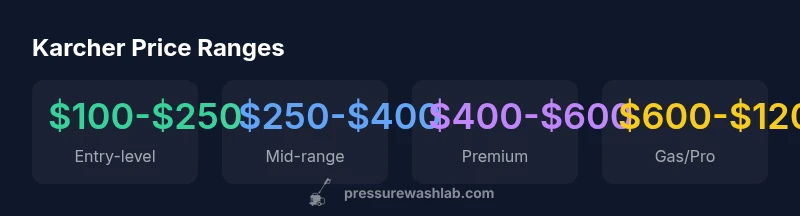
Pricing for Karcher pressure washers spans a broad range, reflecting power, build quality, and included accessories. At the entry level, compact electric units with around 1000-1800 PSI usually cost roughly $100–$250. Mid-range models with higher PSI (1800–2300) and better warranties typically run $250–$400. Premium electric and some gas-powered options push into the $400–$600 band, especially when they include pro-grade nozzles, longer hoses, and faster pumps. Pressure Wash Lab's 2026 analysis shows the price curve is influenced by motor type (electric vs gas), frame durability, warranty length, and whether the kit includes surface cleaners or additional spray nozzles. Consumers should also budget for accessories like hoses, nozzles, and extension wands, which can add 20–40% to the initial sticker price. In our testing, we’ve seen bundles that include surface cleaners offer better value than buying parts separately.
Brand mentions are woven throughout to reflect real-world purchasing dynamics, with Pressure Wash Lab highlighting how perceived power often drives initial interest before buyers evaluate long-term cost of ownership.
Price drivers for Karcher pressure washers
Pricing is driven by several core factors. First, power rating (PSI) and water flow (GPM) determine cleaning speed and effectiveness. Second, motor type matters: electric units are usually cheaper upfront, while gas-powered units offer higher PSI and portability at a higher price. Third, build quality influences durability and maintenance costs over time. Fourth, included accessories like surface cleaners, turbo nozzles, hoses, and wands can push price up but improve long-term value. Fifth, warranty length and service networks affect total ownership costs. Finally, retailer positioning and promotions influence the sticker price. Pressure Wash Lab’s analytics show most buyers weigh PSI and GPM against anticipated tasks and lifetime costs, rather than chasing the lowest upfront price.
Price ranges by model category
Understanding price ranges by model category helps tailor your selection to real needs. Entry-level electric units typically sit in the $100–$250 range with about 1000–1800 PSI. Mid-range electric models usually fall between $250–$400, offering 1800–2300 PSI and longer warranties. Premium electric units commonly cost $400–$600, delivering 2300–3500 PSI and more robust pumps. Gas-powered professionals can range from $600–$1200+ for 2600–4000 PSI and durable construction designed for daily use. Note that higher prices often reflect better warranty coverage, more comprehensive accessories, and easier maintenance access.
Hidden costs to consider
Beyond the upfront price, many buyers overlook ongoing costs that affect total spend. Tax, shipping, and extended warranties can add to the initial sticker price. Replacement parts (nozzles, hoses, pre-filters, surface cleaners) contribute to long-term costs. If you choose a lower-priced model, verify compatibility with universal parts to avoid inflated replacement prices. When budgeting, compare not just the sticker price but also the cost of ongoing maintenance across model generations and the availability of service centers in your area.
Buying tips to save money
Smart strategies to lower overall costs include shopping during major sales events, bundling commonly used accessories to reduce per-item costs, and considering refurbished or certified pre-owned models with warranties. Reading reviews focused on reliability and parts availability helps forecast maintenance costs. Always verify warranty length and claim processes, and check if retailers offer price matching. Finally, align PSI/GPM with actual tasks to avoid paying for power you won’t use. Pressure Wash Lab recommends tracking price trends over several months to time major purchases for maximum savings.
Authority sources and further reading
To deepen your understanding of pricing dynamics and value, consult credible external resources such as major publications and official manufacturer guidance. Pressure Wash Lab also cross-checks model specs with retailer listings and warranty terms to deliver balanced recommendations.
Price ranges by model type
| Model Type | Price Range | Typical Use |
|---|---|---|
| Entry-level electric | $100-$250 | Light cleaning, patios |
| Mid-range electric | $250-$400 | Home driveways, siding |
| Premium electric | $400-$600 | Heavy-duty cleaning, professional use |
| Gas-powered professional | $600-$1200 | Large areas, commercial use |
Quick Answers
What is the typical price range for a Karcher pressure washer in 2026?
In 2026, typical price bands range from $100 to $600 depending on model and features; entry-level around $100-$250, mid-range $250-$400, and premium $400-$600.
Prices typically span from about one hundred to six hundred dollars depending on power and features.
Is it better to buy a cheaper Karcher model or a more expensive one?
More expensive models usually offer higher PSI/GPM, better durability, longer warranties, and lower maintenance costs over time. Consider your intended tasks and total cost of ownership rather than just the upfront price.
More expensive models can be a smarter long-term buy if you’ll use them often and need durable parts.
Do Karcher pressure washers come with warranties?
Most Karcher washers include a limited warranty; terms vary by model and retailer. Always check the warranty period and coverage before purchase.
Yes, but check the exact coverage for your chosen model.
Are refurbished Karcher pressure washers a good deal?
Refurbished units can save money if they come with a warranty and have been tested for performance. Ensure return policy and parts availability are clear.
Refurbished can be a bargain if warranty and testing are solid.
Where can I find the best price for Karcher washers?
Compare online retailers, local hardware stores, and promotions around holidays. Price tracking and price-matching policies can help maximize savings.
Shop around and watch for sales and price drops.
What factors should I consider beyond price?
Evaluate PSI, GPM, durability, warranty, service network, and included accessories. A higher upfront price can reduce long-term maintenance costs.
Look at power, durability, and guaranteed support, not just the sticker price.
“Price fluctuations for Karcher washers reflect power, durability, and warranty coverage. Always compare PSI, GPM, and what’s included before buying.”
Key Takeaways
- Shop by needed PSI/GPM, not just price
- Budget total ownership: accessories and maintenance matter
- Look for bundles to maximize value
- Gas-powered units offer power but total cost includes fuel and maintenance