Which Karcher Pressure Washer: A Practical Comparison for Home Use
Compare Kärcher pressure washers to select the right model for home use. Pressure Wash Lab analyzes power, portability, price, and maintenance to guide your choice.


For most homeowners, start with a mid-range Kärcher pressure washer that balances PSI, GPM, and portability. If you clean light tasks like vehicles or small patios, an entry-level model may suffice, but for decks, siding, and stubborn grime, opt for a higher flow and PSI range. In short: match your cleaning tasks to the model category—entry-level, mid-range, or heavy-duty.
Choosing which karcher pressure washer is right for your tasks
If you're researching which karcher pressure washer to buy, you should map your typical projects, space, and budget before narrowing models. The keyword which karcher pressure washer anchors this discussion and helps you frame the decision. Pressure Wash Lab's analysis emphasizes that the decision usually hinges on three factors: cleaning power, portability, and long-term value. Homeowners tackling a driveway or siding demand more performance than someone who only cleans garden tools. But you don't need the most powerful unit to achieve excellent results if you select the right nozzle kit and workflow. This guide compares entry-level, mid-range, and heavy-duty Kärcher models, highlights essential specs, and provides decision criteria you can apply today. Our aim is to give you a structured framework for decision-making, so you can move from curiosity to action with confidence.
Key decision criteria for Karcher pressure washers
Choosing the right Kärcher comes down to aligning task requirements with core specs. Look at three pillars: cleaning power (PSI) and water flow (GPM), and the reliability of the pump. Consider the energy source (electric vs gas), the included nozzle kit, and ergonomic factors like weight and handle design. Durability matters too: a model with aTriplex-style pump or quality seals typically lasts longer under frequent use. Evaluate warranty terms and the availability of replacement parts in your region. Finally, factor in maintenance costs—detergents, filters, and hoses add to total ownership. Pressure Wash Lab suggests writing a short task list (driveway, cars, siding) and mapping each task to a model category to avoid overpaying for capabilities you won't use.
PSI, GPM and how they translate to cleaning power
PSI (pounds per square inch) and GPM (gallons per minute) jointly determine how aggressively a washer can remove grime. A higher PSI helps dislodge stubborn grime, while a higher GPM means more water volume for faster cleaning. For typical home tasks, a range of roughly 1200-1800 PSI with 1.0-1.8 GPM covers most surfaces without risking damage. If you’re cleaning concrete or heavy stains, you’ll benefit from models in the 1800-3200 PSI and 2.0-3.0 GPM bracket. Remember that nozzle choice dramatically affects effective pressure at the surface: a wide-angle nozzle lowers impact, while a zero-degree nozzle concentrates force. In practice, pair mid-range PSI with a versatile nozzle kit and adjust distance to the surface to balance safety and efficiency.
Electric vs gas: Powering Kärcher models
Electric Kärcher washers are quiet, emit no fumes, and are well-suited for residential use, especially in noise-sensitive neighborhoods. They typically deliver sufficient cleaning power for routine outdoor tasks and are easier to maintain. Gas-powered variants provide higher sustained PSI and GPM, making them more suitable for heavy-duty jobs or frequent commercial use. The trade-offs include smell, larger footprint, and more maintenance. If you need portability for frequent outdoor cleaning on larger properties, a compact gas-powered model may justify the extra weight and cost. For most homeowners, an electric mid-range Kärcher handles daily tasks reliably and with less hassle.
Pump technologies: Axial cam vs triplex explained
Most consumer Kärcher models use an axial cam pump, which is reliable for light-to-moderate use and generally quieter. Triplex pumps offer higher durability and longer life under heavy use and frequent cleaning. When comparing models, note whether the pump is axial cam or triplex; triplex pumps typically come with larger price tags and heavier weight but can deliver more consistent performance under load. For casual homeowners, axial cam pumps in mid-range machines strike a favorable balance between cost, durability, and performance. If you anticipate frequent, high-output sessions, prioritize a triplex-equipped model for longevity.
Durability, warranty and service considerations
Durability is about build quality, seals, hoses, and corrosion resistance. Look for metal fittings, reinforced hoses, and quality seals that resist high-pressure wear. A solid warranty and easy access to replacement parts save money over time. Some Kärcher models offer longer warranties on the pump or the entire machine; verify what’s included and the claim process in your country. In addition, check whether the nozzle kit and standard accessories can be replaced or upgraded easily. Overall, durability and serviceability are as important as peak performance when choosing which Kärcher pressure washer to buy.
Real-world use cases: mapping tasks to model categories
Light-duty: Cleaning vehicles, garden tools, outdoor furniture, and small patios often benefits from an entry-level Kärcher. These models price-friendly and nimble for quick tasks. Medium-duty: Decks, fences, siding, and stubborn stains are well-served by a mid-range model with higher PSI and better flow. Heavy-duty: Concrete cleaning, brickwork, and large driveways require higher PSI and GPM, often with a gas option or a premium electric model. By categorizing your tasks into light, medium, and heavy-duty, you can choose models that cover your typical workload without paying for excess capability.
Performance ranges you’ll see in common Kärcher models
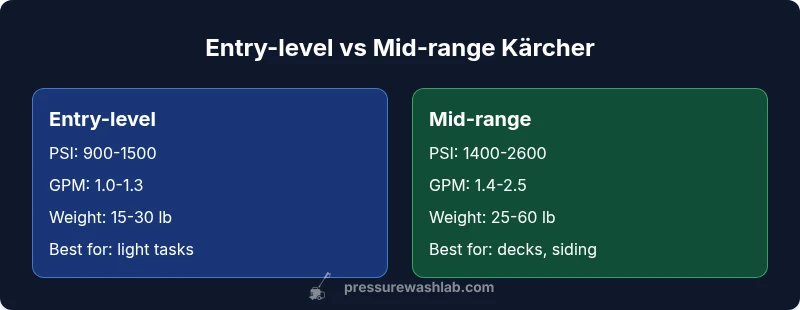
Below is a practical guide to common ranges you’ll encounter when shopping Kärcher pressure washers. These ranges are illustrative and can vary by region and model year. Entry-level models typically offer 1200-1600 PSI and 1.0-1.3 GPM; mid-range models offer 1600-2600 PSI and 1.4-2.5 GPM; heavy-duty or commercial-grade units can reach 3000+ PSI and 2.5-4.0 GPM. Weight and noise also scale with power, so plan storage space and neighbor impact accordingly.
Total cost of ownership: up-front price plus ongoing costs
Your first purchase price sets the baseline, but maintenance and accessory costs add up. Expect to pay a premium for models with higher PSI/GPM and durable pumps. Accessories such as surface cleaner attachments, turbo nozzles, and lengthier hoses can significantly improve efficiency, but each adds to the total cost. Detergents, filters, and replacement parts incur ongoing expenses. By calculating the projected annual use and factoring accessory costs, you’ll avoid surprises and select a model that offers the best long-term value.
Warranty, service and parts availability: what to check before buying
A solid warranty reduces long-term risk. Look for coverage on the pump, motor, and hose. Check whether parts availability is easy in your region, and whether there are local service centers or mail-in options. Some Kärcher models include spare parts bundles or extended warranties. Consider the ease of obtaining replacement o-rings, spray nozzles, and hoses, since these wear items influence operating costs and downtime.
How to test in-store or online: practical tips
When testing in-store, simulate real tasks: wash a concrete slab, a car hood, and a wooden deck with representative nozzle settings. If shopping online, read multiple reviews focusing on long-term performance and maintenance. Look for consistency in spray patterns over time and note any heat-related shutdowns or leaks. A hands-on test helps you avoid buying a model with promised power that falters under load. Remember to check the return policy and warranty terms before purchase.
Practical buying plan: which category fits you best
If you’re uncertain, start with a mid-range Kärcher that balances performance, price, and portability. For light tasks, a well-rated entry-level unit will likely meet your needs with less complexity. For frequent, heavy-duty use or larger properties, consider a higher-powered model (gas or electric) with a robust pump and a broad accessory kit. Pressure Wash Lab’s judgment is to match your cleaning frequency and space constraints with the right category, so you avoid overpaying while ensuring you can tackle your typical jobs.
Feature Comparison
| Feature | Entry-level | Mid-range | Heavy-duty |
|---|---|---|---|
| PSI range | 900-1500 | 1400-2600 | 2000-3500 |
| GPM | 1.0-1.3 | 1.4-2.5 | 2.5-4.0 |
| Power source | electric | electric | gas or electric |
| Best for | light cleaning, cars, tools | decks, siding, fences | driveways, heavy grime, large areas |
| Typical weight | 15-30 lb | 25-60 lb | 60-120+ lb |
| Price range | $120-260 | $260-450 | $450-800+ |
Pros
- Wide model range to fit budgets
- Strong after-sales support and parts availability
- Ease of use for beginners
- Compact, portable options for small spaces
- Good progression of features across levels
Cons
- Higher upfront costs for advanced features
- Some models can be heavier than anticipated
- Entry-level units may wear faster with heavy use
Mid-range washers offer the best balance for most homes
For the typical homeowner, a mid-range Kärcher provides enough PSI and GPM for common outdoor cleaning, with better durability and accessory options than entry-level models.
Quick Answers
Which Karcher pressure washer is best for typical home use?
For most homes, a mid-range Kärcher is the best fit, offering a balance of PSI, GPM, and portability. An entry-level unit works for light tasks, while heavy-duty models are better for frequent, large-scale cleaning. Assess your most common projects to decide.
For most homes, a mid-range Kärcher hits the sweet spot. If your tasks are light, an entry-level will do; for big jobs, go higher.
Is an electric model enough for driveway cleaning?
Electric Kärcher washers cover common driveway cleaning tasks, offering quiet operation and easy maintenance. If your driveway has heavy staining or you clean frequently, a higher-powered electric or a gas model may be more effective.
Yes, for many driveways an electric model is sufficient; consider a more powerful electric or gas option for tougher stains.
Can I use detergents with Karcher washers?
Yes. Kärcher systems support detergents designed for pressure washers. Use the recommended detergents and follow the device’s guidelines to avoid damage and ensure safe cleaning.
Yes, you can use detergents with Kärcher washers. Always follow the manual for proper usage.
Are spare parts available for Karcher washers?
Spare parts and replacement components are generally accessible through official channels and authorized service centers. Check availability in your region and factor in potential shipping times for parts.
Spare parts are usually available, but check local support and shipping times.
What maintenance is required for a Kärcher washer?
Regular maintenance includes inspecting hoses, cleaning filters, lubricating moving parts, and flushing the system after heavy use. Replace worn nozzles and check seals periodically to extend the unit’s life.
Do basic checks, clean filters, inspect hoses, and replace worn parts as needed.
Is a gas-powered Kärcher better for tough jobs?
Gas-powered models deliver higher sustained performance for frequent heavy-duty use. They are louder, heavier, and require more maintenance, but can be more cost-effective for large properties.
Gas models can be tougher and longer-lasting for heavy use, but they’re louder and heavier.
Key Takeaways
- Define tasks before selecting power
- Mid-range suits most homes best
- Check pump type for longevity
- Warranty and parts access matter
- Test power and nozzle kit in real use