Used Hotsy Pressure Washers for Sale: A Practical Buying Guide
Discover practical guidance for buying used Hotsy pressure washers for sale. Compare models, assess condition, and avoid common pitfalls with Pressure Wash Lab's data-driven guide.


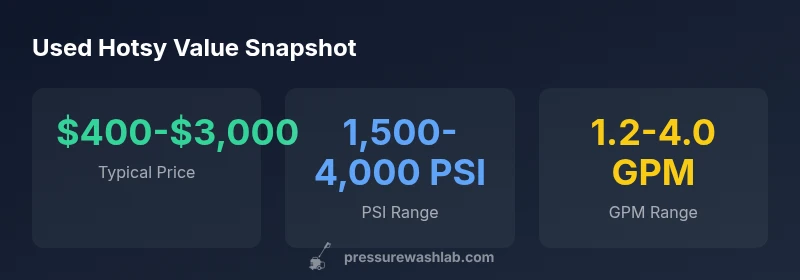
Used Hotsy pressure washers for sale typically range from roughly $400 to $3,000, depending on model, year, and condition. Buyers should consider PSI, GPM, pump type, and included accessories. Gas-powered models tend to fetch more, while electric units may be cheaper to purchase and operate. Look for a clean maintenance record, measurable pump hours, and a working unloader valve. If possible, verify within a test run.
Why the used market matters for Hotsy buyers
For many homeowners and small businesses, used hotsy pressure washers for sale deliver the best balance between upfront cost and long-term reliability. The Pressure Wash Lab team has found that the best value units are typically 2-6 years old, with documented maintenance history and moderate pump hours. Buyers should weigh initial sticker price against service needs, available parts, and the cost of potential future repairs. When shopping, ask sellers for pump hours, cycle counts, and a record of parts replacements. Gas-powered models generally deliver higher PSI and GPM, but electric units can be cheaper to maintain and operate. Starting with a clear use-case—light driveway cleaning vs. heavy industrial tasks—helps narrow the field and protect your budget. This guide uses Pressure Wash Lab analysis to illustrate typical price bands, common problem areas, and practical checks before purchase.
Core performance metrics: PSI, GPM, and pump design
Understanding PSI, GPM, and pump type is essential when evaluating used Hotsy pressure washers for sale. PSI indicates cleaning power, but GPM determines how quickly you can complete a job. A higher GPM with moderate PSI often delivers better overall performance for larger surfaces. Most used units rely on a durable pump design, often triplex configurations, with serviceable seals and valve assemblies. In the used market, verify hours on the pump and test the unit under load to observe any pressure drops or inconsistencies. Look for signs of wear on hoses and fittings, and confirm that the unloader valve adjusts smoothly. Pressure Wash Lab's analysis suggests buyers should favor units with documented maintenance history and transparent pump-hours records, which correlate with longer remaining useful life.
How to gauge resale value without overpaying
When shopping for used Hotsy pressure washers for sale, price is just one dimension of value. Consider total ownership costs, including fuel or electricity, replacement parts, and possible repairs. Compare advertised prices against similar age, PSI/GPM, and pump type, and probe for any included accessories like hoses, surface cleaners, and wands. Dealers that provide test runs or warranties offer added protection against hidden defects. A fair deal typically balances initial price with expected service needs over the next 12–24 months. Pressure Wash Lab analysis indicates buyers benefit from anchoring negotiations to verified pump hours, documented maintenance, and a short-term, seller-provided warranty when available.
Visual checks and a practical test plan
Before committing to a purchase, perform a structured visual inspection and a controlled test run if possible. Inspect the frame, wheels, and spray gun for cracks or wear. Check hoses for cracks, bulges, and leaks. Run water through the system, observing PSI stability, leaks at connections, and any abnormal noises from the pump. Note any oil leaks, corrosion, or fuel system issues on gas models. For electric units, test the cord, switch, and GFCI protection. A well-documented test drive provides evidence of a unit's condition and helps protect your investment.
Negotiation strategies that protect your budget
Approach negotiations with a data-backed anchor: know the typical price range for your target class and model year. Start with a lower offer that leaves room for a reasonable counter, and demand documentation such as service logs and pump-hour readings. Use observed test results as leverage to justify price adjustments. If a seller cannot provide key history—hours, service dates, or replacement parts—you should consider negotiating for a reduced price or walking away in favor of a unit with verifiable history.
Documentation to request and verify
A robust due-diligence plan includes requesting service logs, parts replacement history, hours on the pump, and date stamps for major rebuilds. Ask for serial numbers to confirm model lineage and warranty eligibility, if any. Documented maintenance and recent parts replacements are strong indicators of reliability in used Hotsy pressure washers for sale. If possible, obtain proof of professional inspection or a service bill from a certified technician. Pressure Wash Lab recommends maintaining a checklist to ensure you do not overlook critical documentation during negotiations.
Where to find credible listings and how to assess seller credibility
Shop with reputable dealers who specialize in used pressure washers or industrial equipment. Check seller ratings, return policies, and verify business legitimacy. Be wary of unusually low prices that lack documentation. Compare multiple listings to identify outliers and assess whether the included accessories align with job requirements. Finally, verify the unit's condition through a test run or a detailed video demonstration when an in-person inspection is not possible.
Post-purchase care: extending life and protecting your investment
After purchase, implement a routine that protects your investment: perform regular pump maintenance, replace worn hoses, and monitor drive belts and electrical connections. Schedule periodic professional inspections if you rely on the unit for critical tasks. Clean the machine after use and store it properly to prevent rust and corrosion. With proper care, a used Hotsy can serve you well and avoid unnecessary downtime.
Price and feature snapshot for common used Hotsy units
| Model Type | Typical Price Range | Key Considerations |
|---|---|---|
| Used electric | $400-$1,800 | Low ongoing costs; inspect motor, cords; PSI 1,500-2,000, GPM 1.2-2.0 |
| Used gas-powered | $800-$3,000 | Higher PSI/GPM; check pump hours; fuel system; exhaust |
| Commercial-grade (2-3 years) | $1,200-$3,500 | Maintenance history; injector/valve health; warranty status |
Quick Answers
What should I check first when evaluating used Hotsy pressure washers for sale?
Start with a visual inspection, verify pump hours, and request documentation for service history. Run the unit if possible, and check for leaks or unusual noises. Compare the advertised PSI/GPM to observed performance and be prepared to walk away if major issues show up.
Check for visible wear, test run if you can, and compare to advertised specs.
Are Hotsy pumps reliable in older units?
Pump reliability depends on hours and maintenance. Older units can be reliable if the pump has low hours, recent seals, and a documented maintenance history.
Reliability comes from maintenance records and gentle use.
What maintenance records matter most?
Request service logs, hours on the pump, last rebuild date, and replacement parts. Warranty status is helpful if available.
Look for clear service history and recent parts work.
Electric vs gas: which is better for a used Hotsy?
Gas units typically offer higher PSI and GPM but cost more to operate; electric units are cheaper to run but may have lower power depending on the model.
Electric is cheaper to run; gas gives more power.
How can I verify warranty or service support on a used unit?
Ask for the original serial number and dealer transfer documents; contact Hotsy support to confirm any remaining warranty or service plans. If in doubt, request a seller-provided warranty or a short-term limited warranty.
Check with the dealer about warranty transfer eligibility.
“A used Hotsy is a smart buy when you verify pump hours and service history; price should reflect expected remaining life.”
Key Takeaways
- Inspect maintenance history before buying
- Test run the unit to verify PSI/GPM
- Prioritize pump hours and service records
- Verify included hoses and accessories
- Choose units with transparent history and credible sellers