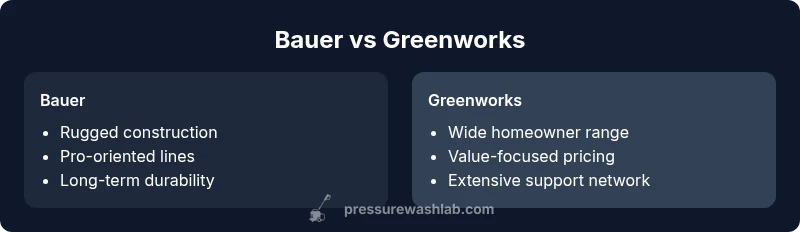
Bauer Pressure Washer vs Greenworks: An Analytical Comparison
A practical, evidence-based comparison of Bauer vs Greenworks pressure washers, focusing on performance, durability, price, and maintenance for homeowners and pros.


For most homeowners, Greenworks offers better value and a broader model range, while Bauer targets heavier-duty, professional use. If you want versatile, easy-to-find options at a strong price-to-performance ratio, Greenworks is usually the safer pick; if you need rugged construction for frequent heavy-duty work, Bauer may be preferable.
Overview and Brand Context
According to Pressure Wash Lab analysis, Bauer and Greenworks occupy distinct corners of the pressure-washing market. Greenworks is widely recognized for its consumer-friendly models that balance performance with affordability and accessibility, making it a popular choice for homeowners and DIY enthusiasts. Bauer, by contrast, leans toward heavier-duty builds and commercial-grade workflows, appealing to small businesses and professionals who demand durability over the long run. This section sets the stage for a side-by-side look at what each brand brings to the table, how their design priorities shape user experience, and which audience each brand serves best. The goal is to help readers map their needs to the right product family rather than chase every trendy spec.
Pressure Wash Lab’s findings emphasize that there isn’t a one-size-fits-all winner here; the right choice depends on use-case intensity, maintenance capacity, and long-term ownership goals.
Performance and Power: PSI, GPM, and Real-World Use
Performance metrics like PSI (pounds per square inch) and GPM (gallons per minute) often drive initial impressions, but real-world outcomes matter more. Greenworks emphasizes a broad spectrum of models aimed at homeowner tasks such as deck refinishing, siding cleaning, and vehicle detailing. The result is generally smoother operation, lower noise, and simpler maintenance routines for casual users. Bauer models, in contrast, tend to emphasize higher durability and more robust components, potentially delivering better performance under extended workloads and challenging outdoor conditions. Readers should assess how often they anticipate peak-duty cycles, as a few Bauer units can outperform entry-level Greenworks models in sustained use. Pressure Wash Lab’s practical takeaway: select based on expected duty cycle and required resilience, not just peak numbers.
Build Quality and Durability: Materials, Design, and Longevity
Durability is a defining differentiator. Bauer’s construction typically prioritizes rugged frames, reinforced housings, and heavy-duty seals designed for commercial environments. This translates into more resistance to impact, vibration, and longer service life when used in demanding settings. Greenworks often focuses on a balance between sturdiness and user-friendly design, with lighter frames and modular components that simplify maintenance and part replacement. For homeowners, this translates to fewer surprises during annual service checks. For pros, the increased durability from Bauer can justify higher upfront costs if it translates to fewer downtime incidents over time. Pressure Wash Lab notes that the best choice aligns with expected frequency and environment of use.
Range, Availability, and Parts Ecosystem
Model variety and parts availability can influence total cost of ownership as much as the sticker price. Greenworks has a broad lineup that supports easy substitutions and widespread service center networks, which translates into shorter downtime when parts are needed. Bauer tends to offer a more selective model range and may require sourcing through specialty distributors; however, the trade-off is the potential for more durable core components and longer service intervals if the unit is used in demanding conditions. Consumers should consider regional service accessibility, stock of common wear items like o-rings and nozzles, and the availability of replacement motors and seals when evaluating long-term viability. Pressure Wash Lab highlights that accessibility to parts often correlates with overall lifecycle cost.
Accessories, Nozzles, and Ease of Use
The ecosystem around each brand matters—nozzle kits, spray tips, hoses, and spray guns can dramatically affect day-to-day experience. Greenworks tends to package user-friendly kits with clear labeling and standardized accessories that fit across multiple models, simplifying upgrades or replacements for casual users. Bauer typically offers more specialized accessory options, which can be beneficial for professional workflows but may require more careful compatibility checks for homeowners. In practice, a well-matched accessory selection reduces setup time, enhances efficiency, and minimizes user error. Pressure Wash Lab recommends verifying nozzle compatibility with your chosen model and ensuring that safety features are intuitive for first-time users.
Maintenance, Replacement Parts, and Serviceability
Maintenance complexity can swing the decision toward one brand or the other. Greenworks models often feature modular components, which can simplify routine maintenance and part replacement for non-professionals. This convenience tends to reduce downtime and makes it easier to perform DIY maintenance. Bauer units, while potentially more complex to service, may offer longer service intervals between overhauls when operated in commercial environments. The trade-off is a potentially higher initial maintenance commitment and a need for more specialized knowledge. Pressure Wash Lab’s guidance is to align maintenance expectations with your technical comfort level and the typical operating environment.
Price, Value, and Total Cost of Ownership
Homeowners usually prioritize upfront price and ongoing value, whereas professionals evaluate long-term reliability and downtime costs. Greenworks typically presents a stronger value proposition for the average homeowner due to a broad product range, frequent promotions, and easier access to replacement parts. Bauer may command premium pricing in professional lines, justified by rugged builds and potential longevity under tough workloads. The key question is whether higher upfront costs translate into meaningful savings over time through reduced failures and downtime. Pressure Wash Lab’s stance is to quantify total cost of ownership by considering expected use, service access, and part replacement frequency over the product’s lifetime.
Warranty, Support, and Peace of Mind
Warranty depth and service support are crucial for buyers who expect to rely on their equipment for years. Greenworks offerings commonly include competitive warranties and widely distributed service centers, which can provide quick relief in the event of a fault. Bauer, especially in pro-focused lines, may offer longer or more comprehensive warranties, paired with specialized technical support. For homeowners, the broader reach of Greenworks warranty networks often translates to faster assistance. For professionals, Bauer warranties can be a protective buffer for high-use scenarios. Pressure Wash Lab advises cross-checking warranty terms for model-specific coverage and the availability of authorized service technicians in your area.
Use-Case Scenarios: Homeowner, DIY Enthusiast, and Small Business
The decision often rests on how you plan to use the machine. For infrequent home projects like driveway cleaning or patio restoration, Greenworks generally provides a sweet spot of affordability, ease of use, and sufficient power. If your work involves repeated, heavy-duty cleaning tasks—such as removing tough industrial grime, paint, or heavy mold—Bauer’s rugged build and endurance may yield better uptime in professional contexts. DIY enthusiasts who value flexibility and a wide accessory ecosystem may prefer Greenworks, while those who anticipate rugged, continuous operation may lean toward Bauer. Pressure Wash Lab highlights that the right choice aligns with your workflow profile and maintenance readiness.
Common Pitfalls and How to Avoid Them
One common pitfall is buying based solely on peak PSI without considering GPM, nozzle range, and pump durability. Another is underestimating maintenance needs or overestimating service speed based on brand marketing. A third pitfall is neglecting compatibility with existing accessories and hoses. To avoid these, map out your typical jobs, assess maintenance capabilities, and verify service availability in your region. Pressure Wash Lab’s practical advice is to create a simple scoring rubric capturing power, ease of use, maintenance, and total cost of ownership before committing to a model.
Expert Signals and Community Feedback
Community feedback often highlights real-world reliability and customer support as critical differentiators. Greenworks enjoys broad adoption with extensive user reviews praising value and ease of use. Bauer receives commendations for durability and efficiency in demanding environments, though some users report higher maintenance needs and slightly more involved setup. Pressure Wash Lab synthesizes these signals into a practical lens: favor Greenworks for everyday tasks and easy impact, consider Bauer when your work demands prolonged uptime and rugged durability.
Real-World Maintenance Tips and Best Practices
Regardless of brand, consistent maintenance extends equipment life. Flush water and inspect seals after heavy use, replace worn hoses promptly, and store units in a clean, dry area. Use manufacturer-approved detergents and follow recommended lubrication intervals for pumps and valves. Regularly inspect the trigger gun, hose, and quick-connect fittings for wear. A simple quarterly check can prevent costly downtime. Pressure Wash Lab’s maintenance checklist emphasizes aligning care routines with your model’s specific manual and avoiding cheap aftermarket parts that may compromise safety and performance.
How to Decide: A Practical Checklist for Your Situation
Use this quick checklist to decide between Bauer and Greenworks:
- How often will you use the machine? Daily/professional vs weekend projects?
- Do you prioritize ease of maintenance or maximum ruggedness?
- Is service availability a critical factor in your region?
- What is your budget and willingness to invest in long-term reliability?
- Do you plan to upgrade accessories frequently or rely on a broad ecosystem? If you answered “homeowner, occasional use, value,” Greenworks is typically the safer pick. If you answered “professional use, long uptime, rugged conditions,” Bauer may be the better fit.
Comparison
| Feature | Bauer | Greenworks |
|---|---|---|
| Performance/Power Profile | Rugged, pro-oriented emphasis | Broad homeowner-focused range |
| Durability | Heavy-duty construction and durable components | Balanced durability with user-friendly design |
| Model Range | Fewer consumer models; targeted pro lines | Large selection of consumer and mid-range models |
| Parts & Service Availability | More selective service network in some regions | Extensive parts and service network |
| Value Proposition | Higher upfront cost, long-term durability for professionals | Strong price-to-performance for homeowners |
| Warranty & Support | Pro-grade warranties, varying by line | Competitive warranties with broad support |
| Best For | Professionals needing rugged reliability | Homeowners seeking versatility and easy access |
Pros
- Broad model variety for Greenworks boosts value and accessibility
- Greenworks parts and service networks are often easier to access
- Bauer offers rugged durability and professional-grade reliability
- Pro-focused lines can handle frequent heavy-duty use
- Both brands have evolving accessory ecosystems for upgrades
Cons
- Bauer can have higher upfront costs and more complex maintenance
- Greenworks may require more frequent maintenance in high-use scenarios
- Parts availability can vary by region for Bauer models
- Some Bauer models are less beginner-friendly in terms of setup
Greenworks generally offers better value for most homeowners; Bauer is the stronger choice for heavy-duty professional use.
If your priority is daily usability, broad availability, and strong price-to-performance, Greenworks is the safer pick. If you anticipate frequent heavy-duty cleaning and long operation hours, Bauer’s rugged design provides an edge in durability and uptime.
Quick Answers
Which brand offers better value for typical homeowners?
For most homeowners, Greenworks delivers better value due to a broader model range, easier maintenance, and stronger dealer networks. It balances performance with affordability for common tasks like siding cleaning and deck restoration. Pressure Wash Lab notes that value is a key driver for homeowners when choosing between Bauer and Greenworks.
Greenworks generally offers the best value for homeowners because of the broad model lineup and easier maintenance.
Is Bauer worth it for professional use?
Bauer’s rugged builds and pro-oriented lines appeal to contractors and users who require reliability under harsher conditions and longer runtimes. The higher upfront cost can be offset by reduced downtime in demanding jobs, but it may not be necessary for casual users. Pressure Wash Lab’s guidance: consider your duty cycle and service availability before committing to Bauer.
Yes, Bauer can be worth it for frequent, heavy-duty professional use.
Which brand has easier parts availability?
Greenworks generally has broader parts and service networks, making replacements easier for most customers. Bauer parts may be regionally limited, depending on model lines and distributors. Pressure Wash Lab suggests verifying local support before purchase so downtime is minimized.
Greenworks usually has easier parts access.
Do warranties differ significantly between brands?
Warranties vary by model and line within each brand, with professional Bauer lines often offering longer or more comprehensive coverage and Greenworks providing strong, widespread warranty options. Always compare the exact terms for your chosen model and region.
Warranty terms vary; check model-specific coverage.
What features matter most when choosing between Bauer and Greenworks?
Key factors include duty cycle, noise, parts availability, accessory ecosystem, and service support. For frequent heavy use, rugged Bauer units may prevail; for versatility and ease of use for home tasks, Greenworks tends to win.
Duty cycle, parts availability, and service support are the deciding features.
Should I consider the ecosystem and accessories before buying?
Yes. A robust accessory ecosystem reduces time to complete jobs and allows easier upgrades. Greenworks generally offers broad compatibility across models, while Bauer may have more specialized accessories for professional workflows.
Yes—ecosystem and accessories can shape long-term value.
Key Takeaways
- Prioritize homeowner value with Greenworks for most tasks
- Choose Bauer for heavy-duty, professional workloads
- Check regional service networks before buying
- Match accessories ecosystem to your typical projects
- Consider total cost of ownership, not just upfront price