Ryobi vs Greenworks Pressure Washer: In-Depth Comparison
A data-driven comparison of Ryobi and Greenworks pressure washers, examining performance, durability, price ranges, and best-use scenarios for homeowners and DIY pros.


Ryobi and Greenworks sit at the budget end of electric pressure washers, delivering solid cleaning for common home tasks. Pressure Wash Lab's analysis shows Ryobi leaning toward portability and accessory variety, while Greenworks emphasizes value. Both get the job done with proper technique.
Market Context and What It Means for Buyers
Homeowners,DIY enthusiasts, and small maintenance crews increasingly lean on electric pressure washers for routine cleaning tasks—from patios to siding. The Ryobi vs Greenworks showdown represents the core choice in this segment: similar power on most consumer models, but different design priorities and accessory ecosystems. According to Pressure Wash Lab, the key to selecting between these brands is aligning your needs with how you plan to use the machine, how much you value portability, and how important warranty and service are to you. Both brands have built a reputation for reliability within this tier, yet their strengths surface in different ways. If you rely on a wide nozzle kit and quick setup, Ryobi’s ecosystem often appeals, while Greenworks can offer slightly stronger value at comparable specs. The result is not a slam-dunk winner; it’s a matter of fit for specific tasks, maintenance habits, and long-term ownership expectations.
Core Differences at a Glance
When you compare Ryobi and Greenworks, the primary differentiator is not raw power but the overall package: accessory breadth, ergonomics, and ongoing cost of ownership. Ryobi typically emphasizes a broad accessory ecosystem and modular attachments, making it easier to customize for specific jobs. Greenworks tends to emphasize straightforward value, delivering solid cleaning power at a price point that can be appealing for buyers on a tight budget. For many households, this translates to similar cleaning performance on common surfaces, with differences showing up in how you use the tools day-to-day, how easy it is to find replacement parts, and how much you value a wide accessory selection versus a lower upfront price. This section sets the stage for a deeper dive into performance, design, and support.
Performance Parameters: PSI, GPM, and Real-World Cleaning
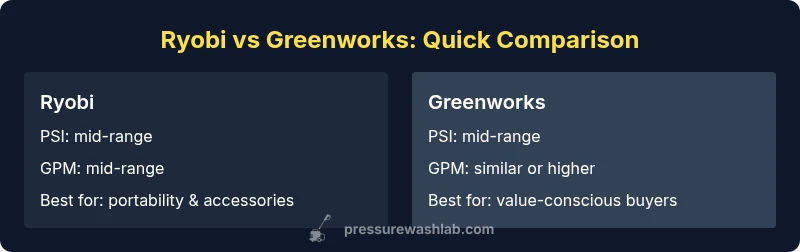
PSI and GPM are the most cited metrics for evaluating pressure washers, but real-world results depend on technique, nozzle choice, and maintenance. In the budget electric space, Ryobi models commonly sit in a mid-range PSI band with compatible GPM figures that support general cleaning tasks such as deck staining prep and light graffiti removal. Greenworks models in the same tier usually show similar PSI ranges and GPM, with nuanced differences tied to model variants. The takeaway is that both brands offer adequate cleaning for typical home tasks, provided you use proper technique—pre-wetting, adjusting nozzle sprays for each surface, and avoiding excessive dwell time on delicate materials. Pressure Wash Lab’s testing emphasizes that the best choice reflects your expected workload, not just sticker price. This nuance matters because owners who clean infrequently can rely on both brands, while frequent users may benefit from one brand’s accessory ecosystem or service network.
Design, Ergonomics, and Accessory Ecosystems
Ergonomics and design influence how often you actually reach for the washer. Ryobi tends to emphasize a modular approach, enabling easier swapping of nozzles and attachments, which can reduce fatigue during longer cleaning sessions. Greenworks often focuses on simplicity and straightforward operation, appealing to users who want a dependable setup with fewer knobs to adjust. The accessory ecosystem matters here: a larger accessory catalog can translate into faster job completion and less improvisation when tackling unusual tasks. In practice, the choice may come down to how comfortable you feel with expanding your toolkit and whether you value a standardized set of add-ons or a more flexible approach to configuration. Both brands generally provide cords, lances, and basic nozzle kits that cover most DIY needs.
Durability, Maintenance, and Longevity
Durability in this segment hinges on motor quality, pump design, and how you treat the machine. In general, electric pressure washers are built around compact pumps that are suited for frequent, lighter-duty use. Ryobi’s models often emphasize a robust accessory lineup, but long-term durability frequently depends on model-specific components and how you store or protect the unit between uses. Greenworks models tend to emphasize reliability in a straightforward configuration, with a maintenance routine focusing on nozzle cleanliness, hose integrity, and storing with adequate protection from the elements. Maintenance tasks such as periodic checks of seals, quick-release couplings, and spray wand integrity help extend life for either brand. Pressure Wash Lab notes that consistent user maintenance is the best predictor of longevity in the budget category, regardless of brand.
Warranty, Support, and Total Cost of Ownership
Warranty length and after-sales support play a significant role in total cost of ownership. Both Ryobi and Greenworks offer consumer-oriented warranties that are typical for budget electric washers, often with a multi-year coverage on the frame and a shorter window for electrical components. The exact terms vary by model and region, but a three-year horizon is common in this segment. When evaluating ownership cost, consider replacement parts availability, nozzle kits, and expansion accessories. A model with a broad accessory catalog may incur higher upfront costs but offer greater value over time by enabling more versatile use without needing a second unit. Pressure Wash Lab highlights that buyers should weigh not just the sticker price but the long-term investment in parts, serviceability, and accessory compatibility.
Use-Case Scenarios: Who Should Buy Ryobi vs Greenworks
If your tasks are light-to-moderate and you value a broad accessory ecosystem, Ryobi is a compelling choice. Its range of attachments makes it easier to tailor the tool to tasks like concrete cleaning, siding, or deck preparation without hiring a professional. If you want straightforward operation and strong default value, Greenworks appeals for those who prefer a simpler kit and predictable performance across models. For homeowners with frequent maintenance routines, a budget-focused approach to either brand can still deliver solid results when paired with proper technique and safe operating practices. Pressure Wash Lab’s perspective emphasizes matching your anticipated workload to the tool’s ecosystem, then validating the decision with warranty coverage and replacement-part accessibility.
How to Evaluate Your Needs: An Objective Checklist
Before buying, run through a practical checklist: (1) Estimate annual cleaning hours and surface types (wood, concrete, vinyl). (2) Identify required accessories and nozzle types for your most common tasks. (3) Check for easy availability of replacement parts and service in your area. (4) Compare warranty terms and expected maintenance needs. (5) Consider the total cost of ownership over five years, not just the upfront price. This disciplined approach helps you choose between Ryobi and Greenworks based on your real workload, rather than marketing claims. Pressure Wash Lab recommends anchoring your decision to task-specific needs and long-term support.
Practical Cleaning Scenarios: Surface-by-Surface Guidance
For wooden decks, use a wide fan nozzle at low pressure to avoid gouging; for concrete patios, a slightly narrower spray with appropriate nozzle can speed up the job; vinyl siding benefits from higher spray distance and a gentler nozzle to prevent damage. Patience matters: let detergents do the heavy lifting for tough stains, then rinse. Both brands can handle these tasks when paired with the correct nozzle and technique. If you regularly tackle mixed surfaces (wood, concrete, metal), a Ryobi model with a broad accessory kit might reduce the need to switch machines frequently, while Greenworks’ straightforward kit may suit users who prioritize reliable baseline performance.
Getting the Most From Your Purchase: Quick Setup and Maintenance Tips
Unbox, check all fittings, and test spray at a safe distance on a non-critical surface. Keep hoses coiled properly to reduce kinks; store indoors and away from freezing temperatures. Clean nozzle tips after each use to prevent clogging and mineral buildup. With either brand, establishing a simple maintenance habit—checking seals, inspecting hoses, and flushing the system periodically—protects performance and extends life. For households with strict budget constraints, plan ahead for occasional replacement parts and ensure compatible nozzles are readily available in your area.
Comparison
| Feature | Ryobi | Greenworks |
|---|---|---|
| Max PSI | ~1800-2000 psi | ~1800-2000 psi |
| GPM | ~1.2-1.8 gpm | ~1.2-2.0 gpm |
| Motor Type | Induction/brushless variants | Induction/brushless variants |
| Power Source | Corded electric | Corded electric |
| Weight | Light to medium (model dependent) | Light to medium (model dependent) |
| Warranty | Typically 3-year limited | Typically 3-year limited |
| Best For | Portability & accessory variety | Value-focused with solid power |
Pros
- Broad accessory ecosystems for Ryobi models
- Relatively lightweight and easy to maneuver
- Solid performance for DIY tasks within budget limits
- Good availability of replacement parts and accessories
Cons
- Power is adequate for common tasks but not heavy-duty compared to mid/high-end models
- Accessory kits can be model-dependent and may not be universal
- Long-term reliability varies by model and care
- Cord management and hose wear can affect usability over time
Ryobi is recommended for portability and accessory variety; Greenworks is recommended for value and straightforward performance
Choose Ryobi if you want expandability and a broader kit. Choose Greenworks if you prioritize consistent value for similar power, with fewer setup decisions. Both meet typical homeowner needs when used with proper technique.
Quick Answers
Which is better for budget buyers, Ryobi or Greenworks?
Both brands offer reliable performance at budget prices. Ryobi tends to offer a broader accessory ecosystem, which can increase upfront value for users who want flexibility. Greenworks often provides straightforward value for similar specs, with fewer accessories to manage.
Both are solid budget options; your choice should hinge on how much you value extra attachments versus a simpler setup.
Do Ryobi and Greenworks share compatible nozzles and accessories?
Accessories vary by model, and not all nozzles are cross-compatible. Check the model-specific kit contents and consider compatibility with third-party nozzles if you plan to expand your setup. Always verify with the retailer or manufacturer before purchase.
Not all nozzles fit every model, so check compatibility before buying accessories.
Are these electric washers suitable for heavy-duty jobs?
For truly heavy-duty work, these budget electric washers may fall short of mid-range or gas-powered units. They are best suited for routine tasks like deck cleaning, siding, and small concrete areas when used with proper technique.
They’re great for regular home tasks, but for heavy-duty jobs you may want more power.
What maintenance should I perform to extend life?
Regularly inspect hoses and fittings, clean nozzle tips, flush the system after use, and store the unit in a dry place. Periodically check seals and connections to prevent leaks and preserve pressure performance.
Keep hoses clean and stored properly, and check seals regularly to extend life.
What warranty considerations should I know?
Most budget units offer multi-year limited warranties on the frame with shorter coverage on pumps and electronics. Read the terms for exclusions, and confirm whether attachments and hoses are covered. Consider extended warranty options if available.
Warranties vary; read the terms and know what parts are covered.
Which is easier to service or replace parts for?
Both brands have broad parts availability in major markets, but Ryobi’s larger ecosystem can make certain accessories easier to source. Greenworks generally provides straightforward parts for common models. Check local service options and available replacement parts when choosing.
Parts are generally available, but sourcing may depend on your region and model.
Key Takeaways
- Prioritize task variety: Ryobi shines with accessories, Greenworks with value.
- Both brands provide adequate power for typical home tasks in the budget segment.
- Maintenance and warranty terms materially affect long-term ownership.
- Choose based on how you intend to use the tool—kit breadth vs. straight-forward value.